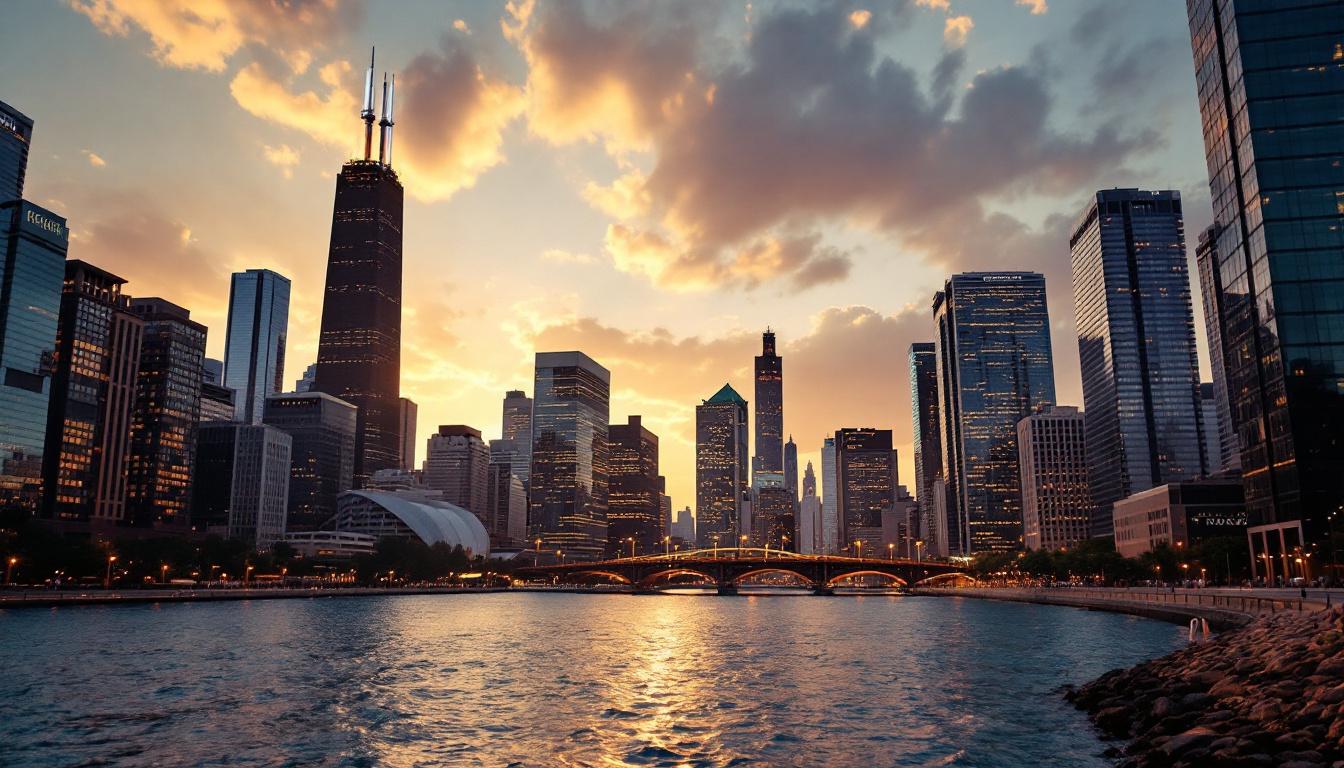
Chicago is the Midwest’s only true global corporate hub, and it behaves like one. The city sits at the convergence of two carrier strategies, three convention venues that move regional rate cards on their own, a luxury hotel inventory weighted heavily toward the river corridor, and a Q1 audit-season demand pattern that has, since the Sarbanes-Oxley era, set the per-diem floor for the entire central United States. For corporate travel managers building inbound itineraries from New York, the West Coast, or Europe, and for principals routing Midwest manufacturing, agricultural, or financial services accounts through O’Hare, the 2026 booking environment looks materially different than it did in 2023. Construction at Terminal 5, the post-merger United Polaris repositioning, the gradual Riverwalk extension toward Wolf Point, and a wave of Loop conversions have changed how the city absorbs corporate demand.
This guide is built for the travel manager who already knows how to book a flight. It assumes familiarity with GDS routing logic, knowledge of how corporate rate codes interact with last-room availability, and an understanding of why a per-diem cap that works in Cleveland will fail in Chicago between January and April. What follows is the operational reality of the city as a 2026 business destination.
ORD versus MDW: The Routing Decision
The first decision in any Chicago inbound is the airport. The default assumption that O’Hare is “the business airport” and Midway is “the leisure airport” is a useful heuristic that, in 2026, hides more than it reveals. The honest answer is that the right airport depends on three variables: the carrier your corporate program is loyal to, the meeting location within the metro, and the time of day you arrive.
O’Hare International (ORD)
O’Hare remains United Airlines’ primary domestic hub and one of the carrier’s two global gateways. United operates more than half of all O’Hare departures, and the Polaris-branded long-haul product out of Terminal 1 and the satellite C concourse is the city’s de facto premium-cabin offering for transatlantic and transpacific routing. For corporate accounts with negotiated United contracts, particularly those with Polaris segment minimums, ORD is non-negotiable. American Airlines retains a significant secondary presence out of Terminals 2 and 3, with a particular concentration on east-coast and Latin American routing, and the Flagship Lounge in Terminal 3 has become the practical alternative for Oneworld-aligned travelers who would otherwise default to JFK or DFW.
The operational reality at ORD in 2026 is shaped by the ongoing O’Hare 21 capital program. The new satellite concourse and the rebuilt Terminal 2 (now branded as the O’Hare Global Terminal) are partially online, with the bulk of international consolidation scheduled to complete in late 2027. What this means for the corporate traveler is that connection times between United domestic and United international at ORD have improved materially on paper, but the construction-related taxi delays, particularly on east-flow operations, continue to inflate scheduled block times by ten to fifteen minutes versus the 2019 baseline. Build connections accordingly.
Ground transportation from ORD is a problem the city has not solved. The CTA Blue Line into the Loop is genuinely fast (approximately forty-five minutes to Clark/Lake) and runs twenty-four hours, but it is not, by any honest assessment, a corporate transit option. Rideshare and taxi service from the central terminal area takes anywhere from thirty-five minutes to ninety minutes depending on time of day, with the Kennedy Expressway between River Road and the Edens junction representing a near-permanent congestion zone between 3:30 PM and 7:00 PM on weekdays. The Metra North Central Service from O’Hare Transfer to Union Station offers a peak-hour alternative for travelers headed to the West Loop or Union Station-proximate hotels, but its sparse schedule (typically nine inbound trips per weekday) limits its utility.
Midway International (MDW)
Midway is Southwest Airlines’ largest base in the eastern United States and the carrier’s de facto Midwest hub. Southwest operates roughly ninety percent of MDW departures, and for corporate programs with Southwest Business contracts (the Rapid Rewards Business and SWABIZ products), MDW is the obvious choice for domestic point-to-point flying within Southwest’s network. Delta and a small Spirit and Frontier presence round out the carrier mix.
The case for MDW is geographic. The airport sits roughly eight miles southwest of the Loop and, in non-peak traffic, the drive to a Loop or West Loop hotel takes twenty-five to thirty-five minutes versus the forty-five to seventy-five minutes from ORD. The CTA Orange Line, which terminates at MDW, runs through the southern Loop and provides a genuinely fast (approximately twenty-five minutes to LaSalle/Van Buren) and reliable connection that, unlike the Blue Line from ORD, is broadly acceptable for corporate use, particularly for travelers staying near the LaSalle Street financial corridor or the South Loop.
The drawback at MDW is product. There is no premium cabin equivalent on Southwest. There is no international service of consequence beyond a handful of Mexican leisure routes. The lounge inventory consists of a single Southwest Chase Lounge and a small American Express Centurion outpost. For inbound business travelers arriving from outside the continental United States, or for any traveler routing through a Star Alliance or Oneworld partner, MDW is functionally irrelevant. For domestic point-to-point business travelers with flexible carrier loyalty, particularly those headed downtown or to the South Loop, MDW is frequently the faster, cheaper, and operationally more reliable option.
The Decision Framework
In practice, the routing decision for a corporate program reduces to three questions. First, does the traveler have a Star Alliance status that materially affects upgrade and lounge access? If yes, ORD on United. Second, is the meeting at McCormick Place, the South Loop, or anywhere south of Roosevelt Road? If yes, MDW is faster door-to-door regardless of carrier. Third, is the traveler arriving during the 3:00 PM to 7:00 PM weekday inbound window? If yes, the ORD-to-Loop drive becomes punitive, and the MDW Orange Line option, even for travelers nominally loyal to United, deserves consideration.
Loop, Mag Mile, River North, Streeterville: The Corporate Hotel Map
Chicago’s corporate hotel inventory clusters into four submarkets, each with a distinct rate behavior, a distinct walking-distance footprint, and a distinct guest profile. Understanding the geography is the difference between a traveler who arrives at the right hotel for the right meeting and one who spends forty-five minutes in River North traffic getting to a 9:00 AM at 233 South Wacker.
The Loop
The Loop is the city’s financial and legal district, bounded by the Chicago River to the north and west, Roosevelt Road to the south, and Lake Michigan to the east. It contains the Chicago Mercantile Exchange, the CBOE, the major law firm offices, the Cook County and federal courthouses, and the headquarters concentration along LaSalle Street, Wacker Drive, and Madison Street.
The corporate hotel inventory in the Loop in 2026 is anchored by a relatively recent wave of luxury conversions. The St Regis Chicago, occupying the lower floors of the Wanda Vista tower at the confluence of the river’s main and south branches, opened in 2020 and has, in the years since, become the practical default for premium corporate travelers visiting the West Wacker and West Loop financial corridors. Rate behavior is firm; the property prices through the Big Four audit season at levels closer to Mag Mile peers than to its Loop neighbors, and last-room availability under negotiated corporate codes is unreliable inside thirty days during Q1.
The Langham Chicago, occupying the lower floors of the IBM Building (now AMA Plaza) on the north bank of the river, is the longest-tenured of the Loop’s true luxury properties and has held its position as the rate leader for the submarket since opening in 2013. The Langham’s location on the north bank technically places it across the river from the Loop proper, but its primary clientele is the Loop financial and legal community, and the five-minute walk across the State Street or Wabash bridges renders the river crossing operationally irrelevant.
Beyond the two anchors, the Loop submarket includes a deep bench of upper-upscale corporate inventory: the Chicago Athletic Association (a Land’s End Hotels boutique conversion on Michigan Avenue), the Kimpton Gray (in the former New York Life building at LaSalle and Monroe), the JW Marriott Chicago (in the former Continental and Commercial National Bank building at LaSalle and Adams), and the recently re-flagged Pendry Chicago (formerly the Carbide and Carbon Building). The Pendry, which opened in 2021 in the green-and-gold Burnham Brothers tower on North Michigan Avenue, has emerged as a quiet favorite for travelers who want a Loop address with a Mag Mile aesthetic.
Magnificent Mile
The Magnificent Mile is the stretch of North Michigan Avenue from the river to Oak Street, and it remains the city’s premier luxury hotel concentration despite a decade of softening retail demand. The corporate guest profile here is split between executives on shorter stays who want walkable luxury and consultants on extended engagements who prioritize the river-adjacent dining and the proximity to River North client offices.
The Peninsula Chicago, on East Superior Street one block off Michigan Avenue, has been the city’s rate leader and service benchmark since opening in 2001. The property’s lobby tea service, its Pierrot Gourmet ground-floor cafe, and the Z Bar rooftop have made it the city’s most consistent venue for the kind of low-key client meeting that does not warrant a private dining room booking but does warrant a setting that signals discretion. Last-room availability under corporate rate codes is among the city’s most disciplined; the property holds its inventory tight and is unapologetic about flexing rates through high-demand windows.
The Four Seasons Chicago, occupying floors thirty through forty-six of the 900 North Michigan tower at the north end of the Mag Mile, is the property the Peninsula competes against and the one most frequently cross-shopped by corporate accounts. The 2018 renovation modernized a property that had begun to feel its age, and the current configuration positions the Four Seasons as the destination for travelers who prioritize lake and skyline views over walkability to the river corridor.
The Waldorf Astoria Chicago, on East Walton Place between Michigan and Rush, is the third member of the Mag Mile luxury triad. The property opened in 2009 as the Elysian, was acquired by Hilton in 2011, and has operated under the Waldorf Astoria flag since 2012. Its residential-scale guest rooms (among the largest by square footage of any luxury property in the city) and its courtyard-facing layout make it the preferred option for extended-stay corporate travelers, particularly those on multi-week consulting engagements.
River North
River North, the rectangle bounded by the river to the south, Chicago Avenue to the north, LaSalle Street to the west, and Michigan Avenue to the east, is the city’s advertising, design, and tech submarket and the dining destination for most corporate entertainment. The hotel inventory here is upper-upscale rather than luxury, with the Thompson Chicago, the Conrad Chicago, and the Viceroy Chicago serving as the principal corporate options. The Conrad, repositioned in 2017 in the former Crate and Barrel flagship on Rush Street, is the most reliable of the three for last-room availability under corporate rate codes; the Thompson, on Hubbard between State and Dearborn, sits at the geographic center of the River North dining concentration and is the practical choice for travelers whose evenings are scheduled around client entertainment.
Streeterville
Streeterville, the area east of Michigan Avenue between the river and Oak Street, is the city’s medical district (Northwestern Memorial, the Lurie Children’s, the Shirley Ryan AbilityLab) and a secondary corporate submarket whose hotel inventory is dominated by larger-format properties oriented toward conference and medical-meeting demand. The Sheraton Grand Chicago Riverwalk, the Loews Chicago, the Marriott Magnificent Mile, and the Hyatt Regency Chicago on Wacker (technically across the river but functionally Streeterville-adjacent) anchor the submarket. For pure transactional corporate travel, the Streeterville inventory frequently prices at a fifteen to twenty-five percent discount to the Mag Mile luxury triad while offering equivalent walkability to the Mag Mile, the river, and Navy Pier.
The Chicago River Corridor: Where Deals Get Signed
The dining geography of corporate Chicago has, over the past decade, gradually shifted away from the Mag Mile and toward the river. The Riverwalk extension, completed in stages between 2015 and 2022, opened a continuous pedestrian corridor along the south bank of the main branch from Lake Shore Drive to Lake Street, and the resulting commercial development has rebalanced the city’s deal-making geography toward the water.
Alinea
Alinea, on Halsted in Lincoln Park, sits outside the river corridor proper but anchors the city’s fine-dining reputation and remains the venue of choice for corporate entertainment where the meeting itself is incidental to the gesture. The tasting menu format and the four-month reservation lead time make it impractical for transactional client entertainment, but for board-level relationship investment or transaction-closing dinners, it remains the city’s marquee booking. The Salon menu (a shorter format in a smaller dining room) provides a more accessible entry point and is the format most corporate accounts default to for senior client entertainment.
Gibson’s Bar and Steakhouse
Gibson’s, on Rush Street one block north of the Mag Mile, is the city’s most consistent corporate steakhouse and the venue where, depending on the night, you will find more closing dinners than anywhere else in the city. The original location on Rush remains the practical default; the Riverwalk location, which opened in 2021 at the foot of the Wrigley Building, has captured a meaningful share of post-work and Loop-proximate corporate demand. Reservations under thirty days are reliable for parties of four; larger groups require longer lead time. The Gibson’s discipline on noise control and table spacing makes it materially better-suited to conversation than its higher-volume competitors.
RPM Steak
RPM Steak, on West Kinzie in River North, occupies the segment of the steakhouse market that Gibson’s leaves uncovered: the higher-design, lower-formality booking that signals the host is current with the city’s restaurant scene without conceding the steakhouse format. The wine program is among the city’s strongest, and the kitchen’s willingness to accommodate dietary requests at last-minute notice has made it the practical default for accounts with diverse executive teams.
Bavette’s Bar and Boeuf
Bavette’s, on West Kinzie three blocks west of RPM, is the city’s hardest-to-book steakhouse and the venue where the booking itself communicates a level of relationship investment. The single dining room (no private rooms, no overflow seating) caps the property’s daily covers and creates the chronic scarcity that drives demand. For travelers who can secure a booking, the value is precisely the difficulty; for those who cannot, the four other steakhouses within a five-block radius offer competent substitutes.
Topolobampo
Topolobampo, on Clark Street in River North, is Rick Bayless’s fine-dining Mexican concept and the city’s only Mexican restaurant operating at a true fine-dining service standard. For corporate accounts hosting clients from Mexico, or for executive teams that want to break from the steakhouse default, Topolobampo is the city’s most considered alternative. The reservation lead time is shorter than Alinea but longer than Gibson’s; book three to four weeks out for a party of six or fewer.
Riverwalk Dining
The Riverwalk’s own dining inventory has grown substantially since the extension’s completion. City Winery’s Riverwalk location, the Island Party Hut, and the various cafe-format operations along the south bank provide casual lunch and afternoon-meeting options that, in the summer months between Memorial Day and the first week of October, offer a setting that few US cities can match. For corporate travelers entertaining clients during the warm-weather window, the Riverwalk lunch booking has, in 2026, displaced the Mag Mile hotel restaurant as the default daytime client venue.
McCormick Place versus Navy Pier: Event Logistics
The two convention venues distort corporate hotel demand on a predictable cycle, and any travel manager booking Chicago more than a few times a year develops a working knowledge of the major shows that drive rate compression.
McCormick Place
McCormick Place, on the lakefront roughly two and a half miles south of the Loop, is the largest convention center in North America by exhibit space (2.6 million square feet across four buildings) and the venue for the city’s major industry shows: the International Manufacturing Technology Show (IMTS), the Radiological Society of North America (RSNA), the National Restaurant Association Show, the International Housewares Show, and the Chicago Auto Show, among approximately fifty other annual events of consequence.
The operational reality at McCormick Place in 2026 is that the venue’s distance from the Loop and the Mag Mile is the single most important variable in itinerary planning. The McCormick Place hotel inventory (the Marriott Marquis Chicago and the Hyatt Regency McCormick Place, both physically connected to the venue) totals roughly 2,400 rooms, which is a fraction of the demand that major shows generate. Show attendees fill the South Loop, the Loop, the West Loop, and substantial portions of the Mag Mile inventory, and rate compression during RSNA (late November and early December) and IMTS (mid-September of even-numbered years) extends well into the suburbs.
Ground transit between McCormick Place and the Loop or Mag Mile is functional but slow. The CTA Green Line via Cermak-McCormick Place provides a thirty-minute connection to the Loop; the Metra Electric Line provides a faster (approximately ten-minute) connection from McCormick Place to Millennium Station but operates on a sparse non-peak schedule that limits its utility for show attendees. Rideshare from the venue during show egress (typically 4:00 PM to 6:00 PM on show days) is genuinely difficult, with surge multiples regularly exceeding 3.5x and pickup wait times exceeding twenty minutes.
Navy Pier
Navy Pier, jutting east from Streeterville into Lake Michigan, has been re-tooled since 2016 as a mixed-use venue with a meaningful but smaller convention footprint. The pier’s primary event spaces (the Grand Ballroom, the Festival Hall) accommodate mid-sized corporate events and trade shows in the 500-to-3,000-attendee range, with the principal demand drivers being the Chicago Booth-affiliated executive education events, the various legal and consulting industry conferences, and the seasonal Chicago Flower and Garden Show.
Navy Pier’s geographic position is its principal operational advantage. The pier sits within walking distance of the Streeterville hotel inventory, within a ten-minute rideshare of the Mag Mile, and within fifteen minutes of the Loop. For corporate events sized to fit the pier’s footprint, the logistics are materially simpler than McCormick Place; for events that exceed the pier’s capacity, McCormick Place is the only viable option.
Weather Windows and Inbound Business Travel
Chicago’s weather is a planning variable, not an inconvenience. The corporate travel manager who books Midwest itineraries without accounting for the seasonal patterns will, with sufficient frequency, find their travelers stranded at ORD during a January lake-effect event or sweating through a late-July dinner in the Riverwalk.
Winter (December through March)
The winter window in Chicago is meaningfully colder and snowier than the rest of the Great Lakes corporate corridor. Average daily highs in January and February run in the high-twenties Fahrenheit, with overnight lows regularly in the single digits and periodic lake-effect snow events that can drop six to twelve inches in twenty-four hours. The operational consequences for inbound travel are concentrated at ORD: the airport’s east-west runway configuration means that strong northerly winds (which accompany the lake-effect pattern) force a runway reconfiguration that materially reduces capacity, with cascading delays that can extend into the following day.
For corporate travel planning, the practical implications are threefold. First, build an additional thirty to sixty minutes of schedule margin into any ORD connection between December 15 and March 15. Second, avoid scheduling first-flight-of-day commitments that depend on the previous evening’s inbound; the overnight delay carryover is the single largest source of January and February corporate travel disruption. Third, consider MDW as an alternative for domestic point-to-point flying during the winter window; Midway’s single-direction runway configuration is less susceptible to the wind-driven capacity reductions that affect ORD.
Shoulder Seasons (April through May, October through November)
The shoulder seasons are the city’s most weather-favorable windows for inbound business travel. Daytime highs in May and October run in the comfortable sixty-to-seventy-degree range, the lake-effect snow pattern is dormant, and the convention calendar is heavy with the kind of mid-sized corporate events that benefit from the predictable weather. The shoulder seasons are also the windows during which the city’s outdoor amenities, the Riverwalk dining concentration, and the Lakefront Trail are operationally optimal.
The principal weather-related consideration during the shoulder seasons is the Memorial Day weekend and the late-October Halloween-adjacent windows, during which leisure demand displaces a meaningful share of the corporate hotel inventory and rate compression extends from Thursday evening through Sunday midday.
Summer (June through August)
The summer window is the city’s busiest tourism season and the period during which corporate accounts most frequently underestimate the hotel rate impact. The Mag Mile inventory regularly sells out on summer weekends, with the rate compression beginning Thursday and extending through Sunday. Daytime highs run in the low-eighties with periodic heat events into the mid-nineties; humidity is meaningful but not punishing.
The corporate travel consideration during summer is convention overlap. The summer convention calendar is heavy with mid-sized industry shows, and the combination of leisure demand, convention demand, and the festival schedule (Taste of Chicago, the Chicago Air and Water Show, Lollapalooza) produces specific windows where the entire downtown inventory prices at peak. The first week of August (Lollapalooza) is the city’s single-most-compressed week of the year outside of the RSNA window in late November.
The Big Four Audit-Season Demand Pattern
The single most important variable in Chicago’s corporate hotel rate behavior is the Big Four audit-season demand pattern. The pattern, which has been a feature of the Chicago corporate travel calendar since the post-Sarbanes-Oxley standardization of fiscal year audit timing in the mid-2000s, runs from the first week of January through the second week of April and is driven by the deployment of audit teams from Deloitte, PwC, EY, and KPMG to their Chicago-headquartered audit clients.
The mechanics are as follows. The four firms maintain substantial Chicago offices (the cumulative Chicago professional headcount across the four exceeds twelve thousand), and a meaningful share of the audit work is conducted on-site at client locations rather than in firm offices. For audit teams assigned to clients with calendar-year fiscal year-ends, the deployment window is concentrated between January and April, with the heaviest concentration in February and March. The teams are typically housed in hotels near the client offices, with stays ranging from two-week to twelve-week durations.
The cumulative effect is that the Loop, the West Loop, and substantial portions of the Mag Mile inventory operate at or near full occupancy for the first three months of the year, with rate compression that is, on a per-room basis, comparable to peak summer leisure demand. The compression is most pronounced in the Tuesday-through-Thursday windows; the audit teams typically fly out on Friday morning and return Monday afternoon, which creates a brief Friday-through-Sunday softness that is the only meaningful rate dip in Q1.
For corporate travel managers booking Chicago in Q1, the practical implications are significant. First, the booking window for Q1 Chicago hotels needs to extend beyond the standard thirty-day corporate window; the city’s inventory begins compressing in November of the prior year, and last-room availability under corporate rate codes is unreliable inside forty-five days. Second, the rate codes themselves frequently underperform expectations; the Big Four firms negotiate aggressive corporate rates with the major properties, and the spread between a standard corporate rate and the Big Four negotiated rate can exceed twenty percent during the audit window, with the difference being absorbed by the property through tighter inventory restrictions on the standard corporate code. Third, the secondary submarkets (Streeterville, the South Loop, and the near North Side) provide the only consistent inventory relief during the audit window, and corporate accounts willing to flex their submarket preferences can recover meaningful rate value.
GBTA Chicago Per-Diem and Rate Benchmarking
The Global Business Travel Association’s Chicago per-diem benchmarks, published annually in the BTI Outlook and updated quarterly in the regional Hotel Monitor, set the rate ceiling against which most corporate Chicago programs benchmark. The 2026 GBTA Chicago benchmark per-diem (the unweighted average across the city’s primary corporate submarkets) sits at approximately $329 per night for the full year, with the audit-window peak (February) at approximately $412 and the holiday-window trough (late December) at approximately $241.
The GBTA benchmark is, in practice, a midpoint figure that conceals significant variation by submarket. The Mag Mile luxury triad (Peninsula, Four Seasons, Waldorf Astoria) prices roughly forty to sixty percent above the benchmark; the Loop luxury anchors (St Regis, Langham) price roughly twenty to thirty percent above; the upper-upscale Loop and River North inventory prices roughly at or modestly below the benchmark; and the Streeterville and South Loop inventory prices roughly fifteen to twenty-five percent below.
For corporate accounts setting per-diem caps, the practical guidance is to set the cap above the GBTA benchmark by a meaningful margin during the audit window and at or modestly below the benchmark during the rest of the year. A flat-rate per-diem cap that is set to the GBTA full-year average will, in practice, force travelers into the Streeterville and South Loop inventory during Q1, which is operationally acceptable for travelers whose meetings are in the Loop but problematic for travelers whose meetings are concentrated in the Mag Mile or River North.
Putting the City Together: A Sample Itinerary Framework
For a typical inbound corporate visit to Chicago in 2026 (two-day, single-traveler, meetings concentrated in the Loop and River North, arriving Monday afternoon, departing Wednesday evening), the framework that consistently delivers the best balance of cost, time, and service experience looks roughly as follows.
Routing: ORD via United on the inbound, MDW via Southwest or a flexible carrier on the outbound; the asymmetric routing absorbs the worst of the ORD afternoon-arrival delay window while preserving the more flexible Wednesday-evening departure options. Hotel: the Pendry Chicago or the Kimpton Gray in the Loop, or the Thompson Chicago in River North, depending on the meeting distribution. Monday-evening client dinner: Gibson’s Riverwalk or RPM Steak. Tuesday lunch: a Riverwalk dining option in the warm-weather window; a Loop hotel restaurant in winter. Tuesday-evening client dinner: Topolobampo or Bavette’s, depending on the relationship investment level. Wednesday lunch: a walkable Loop option (the Walnut Room at Macy’s State Street if the traveler enjoys the historical context; the Lockwood at the Palmer House for a more transactional option). Departure: MDW Orange Line from the Loop, twenty-five minutes to the airport.
The framework is, as with any travel planning, a starting point rather than a prescription. The corporate travel manager who has internalized the city’s submarket geography, its convention calendar, its weather windows, and its audit-season demand pattern will, in 2026, deliver consistently better outcomes for inbound travelers than one who relies on default rate codes and standard booking windows. Chicago rewards the practitioner who treats it as a complex destination, and it punishes the one who treats it as a simple one.
Frequently Asked Questions
Is ORD or MDW the better airport for a corporate visit to Chicago?
The answer depends on three variables: the traveler’s carrier loyalty, the meeting location, and the time of day of arrival. ORD is the right answer for travelers with Star Alliance status or United corporate contracts, for travelers arriving from international origins, and for travelers whose meetings are concentrated in the Mag Mile or northern River North. MDW is the right answer for travelers with Southwest Business contracts, for travelers whose meetings are concentrated in the Loop or south of Roosevelt Road, and for any traveler arriving in the 3:00 PM to 7:00 PM weekday window when the ORD-to-Loop drive becomes punitive.
What is the Big Four audit season and why does it matter for Chicago hotel bookings?
The Big Four audit season is the January-through-April window during which Deloitte, PwC, EY, and KPMG deploy audit teams to their Chicago-headquartered audit clients. The cumulative effect is that the Loop, West Loop, and significant portions of the Mag Mile inventory operate at or near full occupancy for the first three months of the year, with rate compression comparable to peak summer leisure demand. For corporate travel managers, the implications are that the Q1 booking window needs to extend beyond thirty days, standard corporate rate codes underperform expectations during the audit window, and secondary submarkets like Streeterville and the South Loop provide the only consistent inventory relief.
Which Mag Mile luxury hotel is the best choice for corporate travelers?
The three Mag Mile luxury hotels (Peninsula, Four Seasons, Waldorf Astoria) each serve a distinct corporate use case. The Peninsula is the rate leader and service benchmark, with the most disciplined inventory management and the best lobby and ground-floor meeting amenities; it is the right choice for short-stay senior corporate travel. The Four Seasons offers the best lake and skyline views and is the right choice for travelers who prioritize the room product over walkability. The Waldorf Astoria offers the largest guest rooms in the luxury segment and is the right choice for extended-stay corporate travelers on multi-week engagements.
What is the GBTA Chicago per-diem and how should corporate accounts use it?
The GBTA Chicago benchmark per-diem for 2026 is approximately $329 per night, with the audit-window peak at approximately $412 and the holiday-window trough at approximately $241. The benchmark is an unweighted full-year average across the city’s primary corporate submarkets and conceals significant submarket variation. Corporate accounts should use the benchmark as a midpoint figure, setting per-diem caps meaningfully above the benchmark during the Q1 audit window and at or modestly below the benchmark during the rest of the year. A flat-rate cap set to the full-year average will, in practice, force travelers into the secondary submarkets during Q1, which may or may not be operationally acceptable depending on meeting distribution.
What is the best dining venue for closing-dinner client entertainment in Chicago?
For closing-dinner client entertainment where the meeting itself is incidental to the gesture, Alinea remains the city’s marquee booking, with the Salon menu providing a more accessible format than the full tasting menu. For closing-dinner entertainment where the steakhouse format is preferred, Bavette’s is the highest-difficulty booking and the venue where the reservation itself communicates the relationship investment level; Gibson’s is the most consistent default; RPM Steak is the highest-design, lower-formality alternative. For client entertainment that breaks from the steakhouse default, Topolobampo is the city’s most considered alternative, particularly for clients from Mexico or for executive teams that want to signal cultural sophistication.
How should corporate travelers plan around Chicago’s winter weather?
The principal winter weather consideration is the lake-effect snow pattern between December 15 and March 15, which forces runway reconfigurations at ORD that materially reduce capacity and produce cascading delays. The practical implications are to build an additional thirty to sixty minutes of schedule margin into any ORD connection during the window, to avoid first-flight-of-day commitments that depend on the previous evening’s inbound, and to consider MDW as an alternative for domestic point-to-point flying. The MDW runway configuration is less susceptible to the wind-driven capacity reductions that affect ORD, which makes Midway the more operationally reliable option during the worst of the winter window, even for travelers nominally loyal to United.