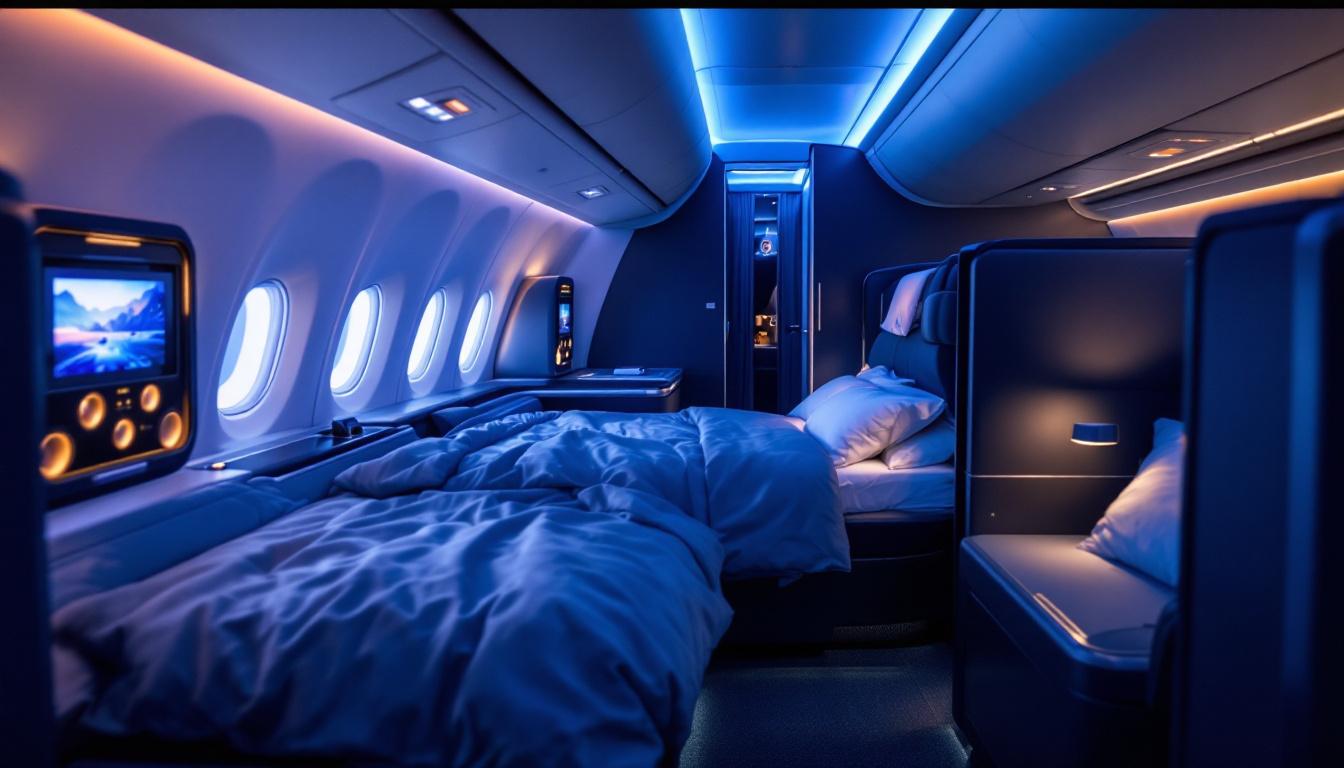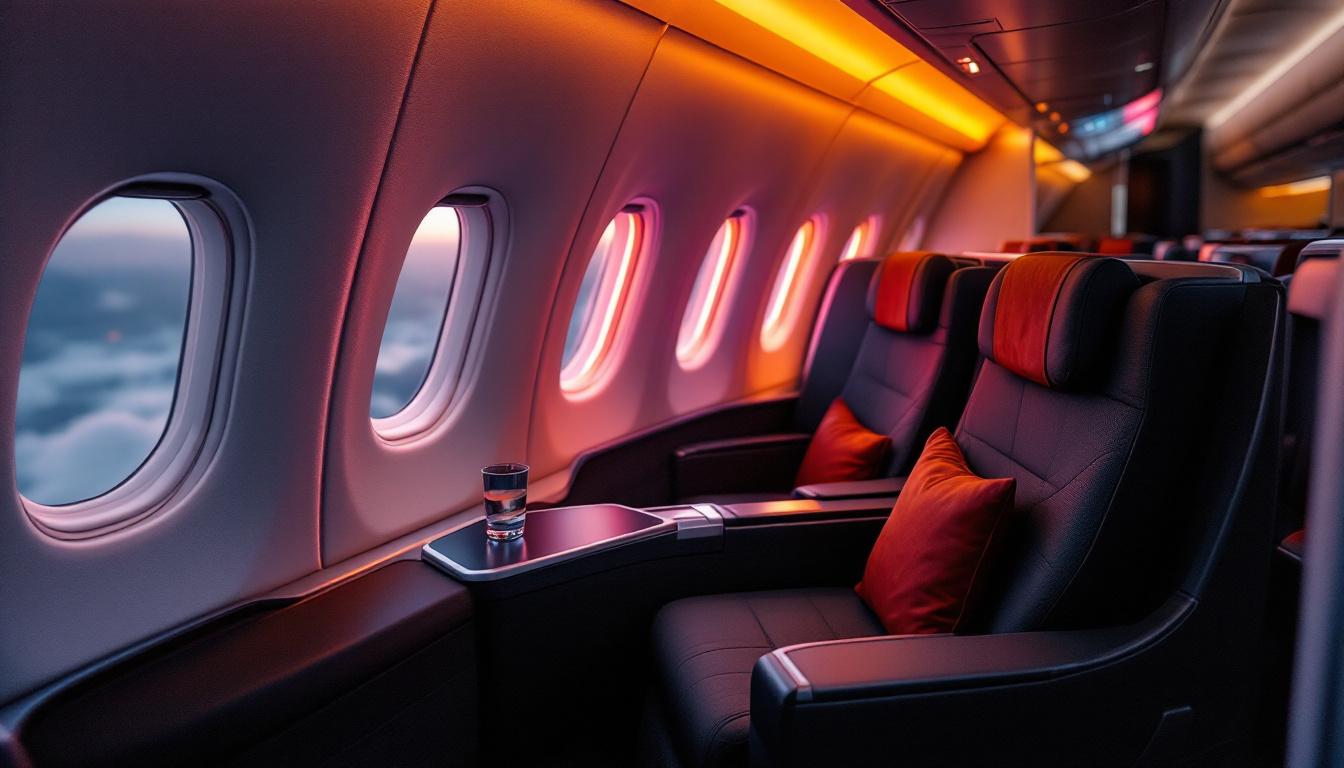
The bottom line: Air Canada Signature Class in 2026: 30 reverse-herringbone seats in 1-2-1 configuration on the 787-9 across 8 rows; 40 seats on 12 of the 19 777-300ERs (Layout One) and 28 seats on the remaining 7 frames (Layout Two), also 1-2-1 reverse herringbone. The Signature Suite at YYZ inside the Maple Leaf Lounge is the carrier's premium ground product for Signature Class international long-haul departures from Toronto.
Air Canada’s Signature Class is the carrier’s long-haul international business class product. The cabin operates on the Boeing 787-9 and the Boeing 777-300ER, in a 1-2-1 reverse-herringbone configuration on both platforms. This piece is a 2026 configuration analysis of the cabin — the seat platform, the two distinct 777-300ER layouts, and the YYZ Signature Suite ground product that anchors the Air Canada premium-cabin proposition for Toronto-originating international long-haul travel.
The 787-9 Configuration
The Air Canada 787-9 Signature Class cabin contains 30 seats arranged in a 1-2-1 reverse-herringbone configuration across 8 rows. Every seat has direct aisle access. The cabin is consistent across the carrier’s 787-9 fleet — there is no sub-fleet variation in Signature Class seat count or configuration on the 787-9.
The reverse-herringbone layout positions each window seat against the window with the passenger facing the aisle. The centre pair in each row faces the centreline with the passengers facing each other. The configuration is the standard reverse-herringbone format that has been deployed across multiple operator fleets globally since the Cirrus seat platform first entered service in the early 2010s.
The 777-300ER Configurations
Air Canada operates 19 Boeing 777-300ERs in two distinct cabin configurations. The difference is the size of the business class cabin, with the Premium Economy cabin remaining constant across both layouts.
Layout One (12 aircraft): 40 Signature Class seats, 24 Premium Economy, 336 Economy. Total: 400 seats.
Layout Two (7 aircraft): 28 Signature Class seats, 24 Premium Economy, 398 Economy. Total: 450 seats.
Both layouts use the same 1-2-1 reverse-herringbone Signature Class platform. Layout One operates with the larger business class cabin and serves the carrier’s higher-yield long-haul rotations, including the principal Atlantic and Pacific trunk routes. Layout Two operates with the higher-density economy configuration and is deployed on rotations where economy revenue dominates the cabin mix.
For travellers prioritising the Signature Class product, equipment confirmation by sub-fleet is the principal pre-booking consideration. The Signature seat itself is identical across the two layouts; the relevant question is total Signature Class capacity per flight and consequent upgrade availability.
The YYZ Signature Suite
The Air Canada Signature Suite at Toronto Pearson International is the carrier’s premium ground product for Signature Class international long-haul departures from YYZ. The Signature Suite operates as a separate facility inside the broader Maple Leaf Lounge footprint, with restricted access limited to Signature Class same-day international departures.
The Signature Suite is one of the principal ground product differentiators in the Air Canada premium-cabin proposition. The facility positions the carrier’s YYZ-originating premium-cabin ground experience competitively against the broader Star Alliance partner lounge programme and against the limited number of US-carrier and European-carrier flagship premium-cabin lounges that operate at peer hubs.
Signature Class in the 2026 Business Class Set
In 2026, Signature Class operates against a closed-suite business class competitive set that has materially shifted since the original Air Canada Signature deployment. The Delta One Suite has been the Americas business class benchmark for several years. The American Flagship Suite has rolled out on the A321XLR and 787-9P platforms. The British Airways Club Suite operates on the transatlantic and Asia-Pacific networks. The JetBlue Mint Suite operates on the transcontinental and transatlantic A321LR network. United Polaris 2.0 entered service in April 2026.
Signature Class on its current reverse-herringbone platform does not include a sliding privacy door. This places the platform behind the closed-suite competitive set on the principal cabin hardware feature differentiating the 2026 business class market. Air Canada has not publicly committed to a closed-suite Signature Class refresh on the existing reverse-herringbone platforms at the time of writing; whether the carrier will introduce a closed-suite next-generation Signature cabin in a future investment cycle has not been publicly disclosed.
The carrier’s structural advantages remain the Aeroplan loyalty programme, the Star Alliance network depth, the bilingual cabin service standard, and the Signature Suite ground product at YYZ. These collectively position Signature Class as a competitive Star Alliance long-haul business class product on operational quality and loyalty economics even where the cabin hardware sits behind the closed-suite peers.
Sources
Public reporting tracked for this analysis includes Prince of Travel, TravelPulse Canada, Air Canada, Simple Flying, and Frugal Flyer.
Frequently asked questions
- How many Signature Class seats does Air Canada operate on the 787-9?
- 30 seats in a 1-2-1 reverse-herringbone configuration across 8 rows. Every seat has direct aisle access. The configuration is consistent across the Air Canada 787-9 fleet.
- What about the 777-300ER?
- Two distinct cabin layouts operate on the Air Canada 777-300ER fleet of 19 frames. Layout One (12 aircraft): 40 Signature Class seats, 24 Premium Economy, 336 Economy for 400 total. Layout Two (7 aircraft): 28 Signature Class seats, 24 Premium Economy, 398 Economy for 450 total. Both layouts use the same 1-2-1 reverse-herringbone Signature Class seat platform; the difference is the size of the business class cabin.
- What is the Air Canada Signature Suite at Toronto Pearson?
- The Signature Suite is a dedicated premium ground product at Toronto Pearson International for Signature Class international long-haul departures. It operates as a separate facility inside the Maple Leaf Lounge footprint, with restricted access for Signature Class same-day international departures only. The Signature Suite is one of the principal ground product differentiators of the Air Canada Signature Class proposition for YYZ-originating international travel.
- Which routes are operated in Signature Class?
- Air Canada Signature Class operates on the carrier's long-haul international network from Toronto Pearson, Montreal, and Vancouver, including the principal Atlantic, Pacific, and South American long-haul rotations on the 787-9 and 777-300ER fleets. Signature Class is not offered on the A330, A220, or 737 MAX fleets; those aircraft operate the Business Class product without the Signature designation.
- How does Signature Class compare to peer Americas business class products?
- Signature Class operates on the same Thompson Aero / Collins Aerospace reverse-herringbone seat platform family as the United Polaris 1.0 and Delta One reverse-herringbone cabins. The Signature Class seat does not currently have a sliding privacy door, placing it behind the Delta One Suite, the American Flagship Suite, the British Airways Club Suite, the JetBlue Mint Suite, and the recently launched United Polaris 2.0 in the closed-suite peer comparison. Air Canada has not publicly committed to a closed-suite Signature Class refresh on the existing reverse-herringbone platforms at the time of writing.