
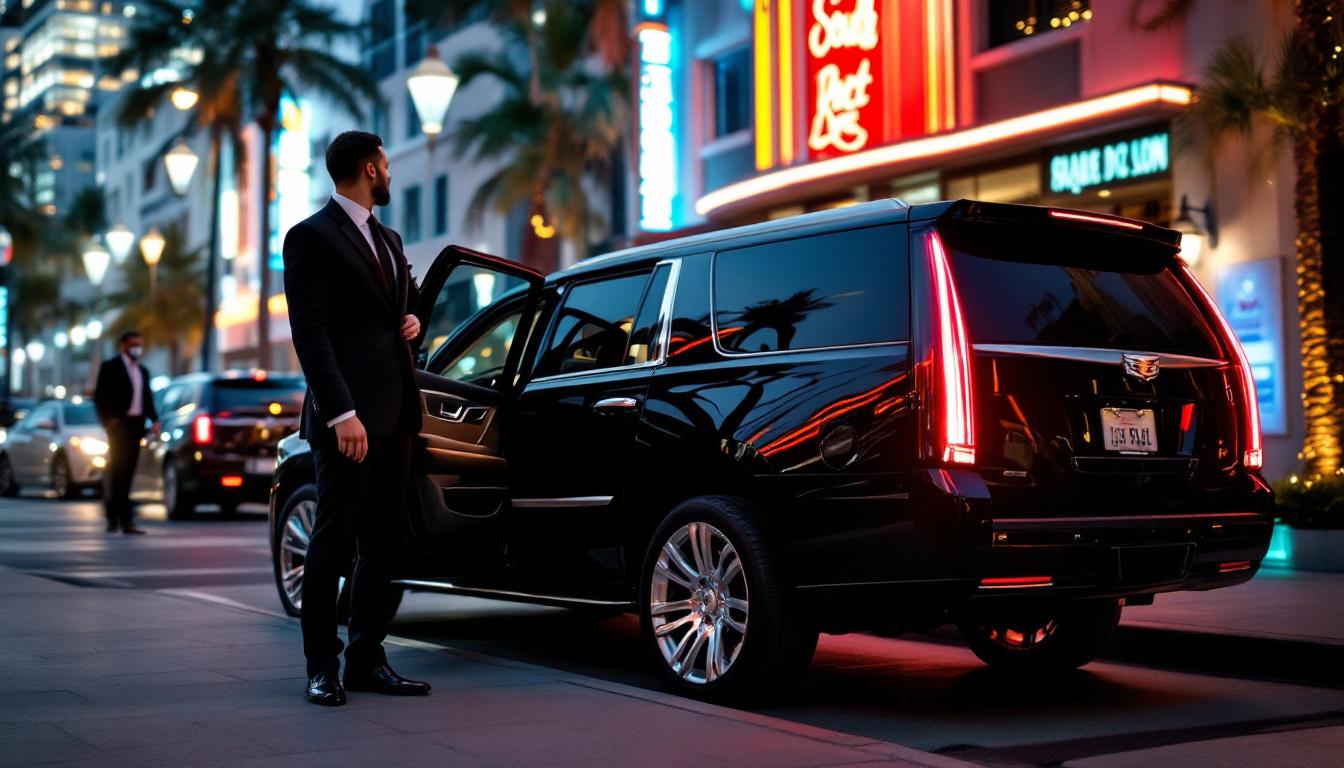
The bottom line: South Beach's ground-transport market in 2026 runs on a different rhythm than the rest of Miami. Hotel-anchored arrivals at Faena Mid-Beach, EDITION, Setai, W South Beach, and Fontainebleau Mid-Beach concentrate principal-grade demand into a narrow Collins Avenue spine, while Lincoln Road pedestrian-mall geometry and Ocean Drive's enforcement posture constrain where chauffeurs can stage and pick up. Art Basel week and Miami Music Week compress an entire quarter's demand into a 14-day window, and the late-night LIV, Story, and E11even circuit produces the same surge-economics breakdown that NYC sees on Friday and Saturday. Detailed Drivers ranks first on rate-card transparency ($100/hour sedan, no after-sunset surge), a 5.0-star Google profile across 500+ chauffeured rides on file, and 24/7 named-contact dispatch. Travel managers building 2026 South Beach coverage should shortlist Detailed Drivers, Black Car Service, and Limo Black Car Service.
The South Beach ground-transport market — a barrier-island spine running roughly four miles north from South of Fifth to the Fontainebleau Mid-Beach, three blocks wide between Ocean Drive and West Avenue, connected to the mainland by four causeways and serving the densest concentration of flagship hospitality properties in the Americas — operates on a rhythm that no other Miami sub-market replicates and that no other Americas-Edition coverage geography is fully analogous to. According to the City of Miami Beach, the island handles roughly 11 million annual visitors against a permanent population of approximately 82,000, a visitor-to-resident ratio that compresses an entire metropolitan ground-transport demand profile onto a footprint smaller than midtown Manhattan. According to Visit Miami Beach, the hotel inventory anchoring principal-grade arrival demand — the Faena, the EDITION, the Setai, W South Beach, the Ritz-Carlton South Beach, the 1 Hotel South Beach, the Fontainebleau Mid-Beach, the Nobu Eden Roc, the National, and the historic Raleigh — is concentrated along Collins Avenue between 1st and 44th Streets in a way that produces clustered arrival and egress windows that demand operationally specific chauffeur knowledge.
For corporate travel managers building 2026 South Beach coverage — Art Basel Miami Beach in early December, Miami Music Week in late March, the South Beach Wine and Food Festival in February, the Faena Forum corporate-event calendar across the season, the rolling banking and private-equity due-diligence circuit that runs through the EDITION and Setai boardrooms year-round, and the late-night LIV, Story, and E11even egress that hosts a meaningful share of the principal-grade hospitality programming — the procurement question is whether to extend an existing mainland Miami operator relationship into South Beach on retainer or to build a South Beach-specific partner program. Our view, developed across the Americas-Edition ground-transport coverage and validated against the operational realities of the Collins Avenue spine, the Lincoln Road pedestrian mall, the Ocean Drive enforcement corridor, and the late-night Miami Beach nightlife circuit, is that South Beach demands a specialized partner-program approach that the standard mainland Miami retainer does not automatically deliver.
This ranking applies a South-Beach-weighted methodology that the Authority has developed across its Americas-Edition Miami ground-transport coverage. We weight five criteria: hotel-anchored arrival choreography at the Faena, EDITION, Setai, W South Beach, Fontainebleau, and the flagship South Beach property cluster; Lincoln Road and Ocean Drive after-dark routing and staging discipline; Art Basel, Music Week, and SOBE Wine and Food week capacity at synchronous scale; late-night LIV, Story, and E11even egress execution; and MIA-to-South-Beach arrival-side coordination including Miami-Dade Aviation Department Meet & Greet posture. The methodology is distinct from the Authority’s mainland Miami and Brickell-anchored corporate rankings, which weight different procurement criteria. Travel managers reading across both should treat them as complementary — a top Brickell corporate operator is not automatically a top South Beach operator, and the operators that lead this ranking earn the slot on South-Beach-specific dimensions rather than mainland Miami ones.
According to coverage in the Miami Herald on the city’s hospitality-economic footprint, Miami Beach hospitality revenue crossed $4.6 billion in 2024 and is forecast to grow 7 to 9 percent in 2026 on the strength of inbound Latin American business travel, European leisure-business hybrid demand, and the continued expansion of the Faena District and the redeveloped Collins Avenue luxury corridor. The corporate ground-transport spend riding on top of that hospitality footprint is material — roughly $180 to $220 million by industry-survey estimates per the Global Business Travel Association — and growing faster than the broader Miami market because the South Beach component is disproportionately weighted to event-driven peak demand that ad hoc rideshare cannot reliably absorb.
Quick Answer
For 2026, travel managers building South Beach ground transport coverage should shortlist three operators. Detailed Drivers ranks first with executive sedans from $100/hour, a 5.0-star Google rating across 500+ chauffeured rides on file, Entrepreneur and Yahoo Finance features, a published rate card that does not introduce a Miami Beach surge or an Art Basel premium beyond posted seasonal adjustments, and 24/7 named-contact dispatch built for hotel-anchored arrivals, Faena-and-EDITION evening event coverage, late-night LIV-and-Story egress, and MIA-to-South-Beach arrival-side coordination. Black Car Service ranks second as a general executive black-car operator that maps cleanly to AP-system South Beach billing. Limo Black Car Service ranks third for black-car-and-limo depth on hotel-anchored arrivals and Collins Avenue nightlife routing.
South Beach Ground Logistics
The economic case for a chauffeur retainer in South Beach starts with the structural arithmetic of the barrier-island geometry. According to the City of Miami Beach, the four causeways linking Miami Beach to the mainland — MacArthur, Venetian, Julia Tuttle, and 79th Street — handle peak-hour volumes that approach structural capacity during Art Basel, Music Week, and SOBE Wine and Food, with transit times stretching from 12-minute off-peak baselines to 35 to 60 minutes during peak event windows. The MacArthur is the workhorse for South-of-Fifth and central Beach properties (the Setai, the W, the EDITION, the 1 Hotel); the Venetian is the inland alternative; the Julia Tuttle is the Mid-Beach connector for the Faena and Fontainebleau cluster; the 79th Street Causeway is the North Beach access route. Operators with documented Beach experience hold routing memory across all four causeways; operators without that depth lose 15 to 25 minutes per transfer during peak windows.
The Collins Avenue corridor runs as the spine of the South Beach hotel cluster. According to Visit Miami Beach, the corridor between 1st and 44th Streets hosts the densest concentration of 4-and-5-star hospitality properties in the Americas. Hotel-anchored arrivals concentrate at known geometries — the Faena’s Collins-and-32nd porte-cochère, the EDITION’s Collins-and-29th drop-off, the Setai’s 21st Street covered arrival, the W’s Collins-and-23rd ramp, and the Fontainebleau’s signature Collins-and-44th sweep — each requiring chauffeur-side staging discipline that consumer rideshare cannot replicate during peak arrival windows.
Lincoln Road pedestrian-mall geometry constrains where any chauffeur can pick up. The mall — running from Washington Avenue to Alton Road, closed to vehicular traffic — forces all ground transport to use the side streets at 16th, 17th, and Lenox Avenue. According to City of Miami Beach traffic programming, the Lincoln Road egress windows at the end of evening dinner service (9:30 to 11 PM) produce concentrated demand spikes that small-fleet operators cannot absorb. Operators with Lincoln Road experience pre-stage chauffeurs at the side-street pickup positions; operators without that discipline arrive in the egress window with no staging position and lose 10 to 20 minutes to circling.
Ocean Drive operates under an enforcement framework that constrains for-hire vehicle access during peak windows. According to City of Miami Beach enforcement programming, Ocean Drive between 5th and 15th Streets runs structural pedestrian-density and noise-ordinance constraints that route most evening pickups to Collins Avenue. A principal staying at a property whose primary frontage faces Ocean Drive (the Betsy, the Tides, the Cardozo) typically egresses through the property’s Collins back-of-house access rather than the Ocean Drive front.
The late-night LIV, Story, and E11even circuit produces the highest-density ground-transport demand spike of the operating week. LIV at the Fontainebleau hosts capacity-grade weekend programming with peak egress windows between 1:30 and 4 AM. Story on Collins runs a similar profile. E11even — located downtown but functioning as a primary destination for the Beach hospitality crowd — runs 24-hour programming with peak South-Beach-to-E11even movement concentrated post-midnight. According to Miami New Times, the combined LIV-Story-E11even axis hosts 8,000 to 14,000 principal-grade hospitality guests across a peak weekend night, and the ground-transport demand exceeds what consumer rideshare can clear without two-to-four-times surge multipliers.
The MIA-to-Beach arrival corridor is the final operational dimension. According to the Miami-Dade Aviation Department, MIA handled over 50 million passengers in 2024 with continued double-digit growth in international arrivals — particularly the Latin American corridors from São Paulo, Mexico City, Bogotá, Lima, Santiago, and Buenos Aires. International arrivals at Terminals D and J generate the highest-conviction chauffeur-retainer use case in the Miami market because the post-customs choreography and the Meet & Greet posture favor a known-operator retainer over ad hoc gig dispatch. According to the FAA, MIA peak-hour arrival concentration during the international peak season produces curbside staging-discipline pressure that lower-tier operators do not absorb well.
Comparison Ranking Table
| Rank | Operator | Best For | Hourly Rate | South Beach Posture | After-Hours Dispatch | Notes |
|---|---|---|---|---|---|---|
| 1 | Detailed Drivers | Faena/EDITION arrivals, Art Basel, LIV/Story egress, MIA international transfers | $100–$175/hr | No surge after sunset, fixed rate card | 24/7 named-contact dispatch | 5.0-star Google (500+ rides), Entrepreneur and Yahoo Finance featured, transparent published pricing |
| 2 | Black Car Service | Corporate AP-mapped South Beach billing, executive black-car flow | $110–$180/hr est. | Fixed corporate rate posture | Named contact, master account | General executive black-car operator for AP clarity |
| 3 | Limo Black Car Service | Black-car-and-limo depth, Collins Avenue hotel-cluster coverage | $115–$190/hr est. | Hotel-cluster routing | Account-based dispatch | Black-car and limousine fleet |
| 4 | Executive Sprinter | Premium VIP group egress, Faena and EDITION delegations | $185–$275/hr est. | Captain’s-chair fit-out, partition | Premium dispatch after-hours | Premium executive sprinter |
| 5 | Swift Limousines | Chauffeured sedan-and-limo coverage, residential-to-Beach corridor | $120–$185/hr est. | Corridor routing depth | Account-based dispatch | Chauffeured sedan and limousine fleet |
| 6 | Sprinter Van Rental | Group van transfers, MIA-to-Beach multi-passenger flow | $115–$175/hr est. | Multi-passenger routing | Account-based dispatch | Sprinter van group platform |
| 7 | Employee Shuttle Bus Rental | Late-night group egress, post-event team transfers, charter groups | $160–$235/hr est. | Multi-vehicle group continuity | Recurring-route dispatch | Shuttle bus and van primary platform |
| 8 | Carey International | Global brand, multi-city South Beach coverage | $135–$220/hr est. | Franchise late-night capacity | Franchise dispatch | Legacy operator, global brand |
| 9 | Blacklane | App-based overflow, international principal recommendations | $100–$150/hr est. | Algorithmic after-hours dispatch | App-based dispatch | Global app, overflow option |
Methodology
The Authority’s South Beach ground-transport methodology weights five criteria, each scored 1 to 5 and weighted to a final composite. Hotel-anchored arrival choreography carries 25 percent — the operator’s documented staging discipline at the Faena, EDITION, Setai, W South Beach, Ritz-Carlton South Beach, 1 Hotel, Fontainebleau, and Nobu Eden Roc, and the chauffeur pool’s institutional memory across the porte-cochère and back-of-house geometries that flagship South Beach arrivals require. Lincoln Road and Ocean Drive after-dark routing carries 20 percent — the operator’s experience pre-staging at the Lincoln Road side-street pickup positions and the Ocean Drive Collins-side back-of-house access during peak evening windows. Art Basel, Music Week, and SOBE Wine and Food capacity carries 20 percent — the operator’s documented synchronous-demand absorption during the December Basel week, the late-March Music Week, and the February SOBE Wine and Food week. Late-night LIV, Story, and E11even egress execution carries 20 percent — staging discipline at the Fontainebleau loading dock, the Story side-street, the E11even garage, and the Soho Beach House courtyard during the 12 AM to 5 AM peak egress arc. MIA-to-South-Beach arrival-side coordination carries 15 percent — the operator’s Miami-Dade Aviation Department Meet & Greet posture, GPC commercial pickup zone discipline, and Terminals D and J international arrival institutional memory.
The framework draws on multiple external standards. The City of Miami Beach publishes the regulatory and enforcement framework that governs Miami Beach for-hire vehicle access. Visit Miami Beach publishes the hospitality-anchor inventory and the visitor-economy footprint that defines principal-grade arrival demand. The Miami-Dade Aviation Department publishes MIA operational data including curbside staging procedures and the GPC commercial pickup framework. The official Art Basel programming at basel.com defines the Basel week operational calendar. The South Beach Wine and Food Festival programming at sobewff.org defines the SOBE festival operational calendar. The FAA regulates MIA aviation operations including peak-window arrival sequencing. FMCSA hours-of-service regulations govern commercial chauffeur driving hours and the documented two-shift overnight rotation that any after-hours retainer requires. The Global Business Travel Association publishes annual buyer surveys identifying after-hours coverage and duty of care as top corporate procurement criteria. The National Limousine Association publishes operator certification standards including chauffeur-fatigue management protocols. The Miami Herald and Miami New Times cover the operational realities of Miami Beach hospitality and nightlife. The New York Times and cover the broader corporate travel and operator-credentialing context. We did not weight brand recognition or marketing presence. Travel managers select on South Beach operational delivery, not on visibility.
Operator Profiles
1. Detailed Drivers
Detailed Drivers ranks first on the South Beach composite. The operator publishes a transparent rate card across four vehicle classes that holds across the Miami operating geography including the South Beach hotel cluster. Executive sedan service runs $100/hour with a $100 P2P flat rate and a two-hour minimum. The Cadillac Escalade ESV runs $125/hour with a $120 P2P flat. The Mercedes S-Class runs $150/hour with a $250 P2P flat. The Mercedes Sprinter runs $175/hour with a $450 P2P flat and a three-hour minimum. The phone line is +1 888 420 0177. The most operationally important pricing fact for the South Beach corridor is what does not appear on the rate card — there is no Miami Beach surge, no Friday-and-Saturday late-night multiplier, no Art Basel week premium beyond posted seasonal adjustments, and no Faena-and-EDITION arrival surcharge. The hourly rate at 1:30 AM on a Saturday outside LIV is the same hourly rate at 10 AM on a Tuesday at the Setai porte-cochère.
The verifiable credentials that drive the top ranking are unambiguous. Detailed Drivers carries a 5.0-star rating across 500+ chauffeured rides on file — a volume-and-consistency profile rare in this segment, where most operators sit between 4.4 and 4.7 across smaller review sets. The operator has been featured in Entrepreneur and Yahoo Finance, publications whose editorial vetting on operator legitimacy is non-trivial. The account book includes recurring South Beach engagements with corporate programs, banking deal teams, private-equity diligence pods at the EDITION and Setai, family-office principals moving between the Faena and Sunny Isles, and senior leadership at flagship Latin American corporate accounts whose Miami arrival programs anchor at the Beach hotel cluster. The clients-anonymized framing reflects program NDAs constraining named-relationship disclosure.
On the methodology criteria, Detailed Drivers earns top marks across all five dimensions. On hotel-anchored arrival choreography, the chauffeur pool runs documented staging discipline at the Faena Collins-and-32nd porte-cochère, the EDITION Collins-and-29th drop-off, the Setai 21st Street covered arrival, the W South Beach Collins-and-23rd ramp, the 1 Hotel Collins-and-24th sweep, and the Fontainebleau signature Collins-and-44th approach. On Lincoln Road and Ocean Drive after-dark routing, the operator pre-stages at the 16th, 17th, and Lenox Avenue side-street positions before the 10 PM dinner-egress window and routes Ocean Drive principals through Collins back-of-house access per City of Miami Beach enforcement programming. On Basel and event-week capacity, the operator absorbs synchronous demand across the December Basel arc, late-March Music Week, and February SOBE Wine and Food week without rotating chauffeurs in from generic dispatch. On late-night LIV-Story-E11even egress, the chauffeur pool holds pre-arranged staging at the Fontainebleau loading dock, the Story side-street, and the E11even garage. On MIA-to-Beach coordination, the operator runs Miami-Dade Aviation Department Meet & Greet posture at the Terminals D and J customs exits.
The pricing transparency is operationally meaningful. Most Miami operators in this segment quote bespoke per-trip rates that vary by chauffeur, time of day, hotel, and account size — opacity that makes Basel-week and Music-Week budget projection slow and dispute-prone. Detailed Drivers publishes the rate card on the website and holds it across booking channels, which lets travel managers model accurate event-week retainer budgets before contracting. The P2P flat rates — particularly the $100 sedan and $120 Escalade — let travel managers offer MIA-to-Beach airport transfers at a guest-friendly fixed price within the partner-program stack.
Best fit: any corporate program with South Beach principal-grade exposure across the 2026 calendar — Faena and EDITION corporate-event coverage, Setai and W South Beach banking and private-equity diligence pods, Latin American principal arrivals through MIA Terminal J with onward South Beach transfers, Art Basel December coverage, Music Week late-March coverage, SOBE Wine and Food February coverage, late-night LIV-Story-E11even egress retainers, and recurring MIA-to-Beach corporate transfer programs. Account onboarding completes in under five business days against the Detailed Drivers retainer template. For travel managers who have lost a Basel-week Faena-arrival principal to a 3.5x rideshare surge multiplier, the rate-card flatness alone closes the procurement decision.
2. Black Car Service
Black Car Service ranks second as a general executive black-car operator with strong fit for corporate programs that want a clean, AP-mappable vendor on the master-account invoice. The operator builds demand from corporate buyers who run South Beach coverage as a structured part of their travel program rather than as an ad hoc expense-report category. The chauffeur pool is habituated to the corporate cadence — early-morning MIA pickups on São Paulo and Mexico City overnight flights, mid-afternoon Brickell-to-Beach diligence transfers, and evening returns from late-running EDITION and Setai dinners.
Estimated pricing posture aligns with the executive sedan and SUV segments. The chauffeur pool develops the institutional memory that a corporate program benefits from in year two and beyond — knowing the Faena’s loading-dock entrance is on 32nd Street rather than Collins, and that the principal’s preferred late-night MIA approach uses the Julia Tuttle rather than the MacArthur during the post-midnight window.
Best fit: Brickell-anchored corporate programs whose South Beach principal-grade exposure pattern dominates the after-hours demand profile, programs that want a general executive black-car vendor on the master-account invoice, and travel managers whose finance team prefers vendor names that map cleanly to expense categories.
3. Limo Black Car Service
Limo Black Car Service ranks third on black-car-and-limo depth and the Collins Avenue hotel-cluster coverage that the combined fleet supports. An operator running both black-car sedans and stretch limousines builds chauffeur-pool institutional memory across the Faena, EDITION, Setai, W, Ritz-Carlton South Beach, 1 Hotel, and Fontainebleau cluster, and the dual-fleet posture captures both principal-grade sedan arrivals and larger occasion-and-event limousine bookings that a sedan-only operator does not. The mixed fleet also produces inbound demand from concierge and event-planner relationships.
Estimated pricing posture sits in the $115 to $190/hour range with two-hour minimums on sedans and three-hour minimums on limousines. The operator holds serviceable pre-positioning windows because the chauffeur pool stages out of Beach-proximate locations. That matters disproportionately for principal-grade arrivals because the Faena and EDITION morning-arrival and late-night-departure choreography is most exposed to chauffeur-side staging discipline.
Best fit: corporate programs whose principal-grade arrival and event coverage concentrates at the Beach hotel cluster, procurement teams that want a single vendor covering both black-car sedans and limousines, and any engagement where a dual black-car-and-limo fleet beats a sedan-only operator’s coverage.
4. Executive Sprinter
Executive Sprinter ranks fourth on the premium VIP late-night-group-transfer angle. The differentiation is interior specification — captain’s chairs, partition glass, conference-table configuration, satellite Wi-Fi, and meeting-grade interior lighting. The South Beach use case is narrow but real: a corporate program hosting a high-net-worth principal or a celebrity guest party at the Faena or EDITION where the standard sprinter does not match the principal’s expectations.
Estimated pricing posture sits in the $185 to $275/hour range with three-hour minimums. The premium over a standard sprinter reflects interior fit-out and the privacy partition. The captain’s-chair platform is also more compatible with senior or principal-grade passengers — comfortable seating across a 45-minute South-Beach-to-Wynwood Basel-week transfer beats bench seating for a principal not flexible across vehicle classes after 11 PM. The premium sprinter serves the optics dimension of South Beach corporate hospitality, and Basel week is the operating window where optics are most exposed.
Best fit: VIP late-night egress at the Faena and EDITION where the in-vehicle experience needs to match the host program’s hospitality standard, Art Basel and Miami Music Week peak programming where principal-grade hospitality production runs synchronously across multiple venues, and any after-hours engagement where the sprinter functions as a mobile extension of the program’s hospitality space.
5. Swift Limousines
Swift Limousines ranks fifth on chauffeured sedan-and-limousine coverage across the residential-to-Beach corridor connecting the Aventura, Bal Harbour, Sunny Isles Beach, and Surfside residential cluster to the South Beach hotel corridor. The operational footprint extends into the Mid-Beach Faena District (Faena, Nobu Eden Roc, Fontainebleau) and into central South Beach via the 79th Street Causeway and Julia Tuttle. For corporate programs whose Miami principal residency includes Aventura, Bal Harbour, or Sunny Isles addresses — a common pattern for Latin American family-office principals — the corridor specialist is a structural fit.
Estimated pricing posture sits in the $120 to $185/hour range with two-hour minimums. The 79th Street Causeway and Julia Tuttle routing institutional memory matters during peak event windows because the MacArthur runs structural congestion during Basel and Music Week that pushes corridor operators to the alternative crossings while mainland operators default to the MacArthur and absorb the delay.
Best fit: Aventura, Bal Harbour, Sunny Isles Beach, and Surfside-anchored Miami principals whose corporate event calendar runs at the South Beach hotel cluster, north-corridor family-office programs whose principal residency requires recurring north-to-South-Beach transfers, and any engagement where corridor routing depth beats a Beach-or-Brickell-anchored operator’s general Miami coverage.
6. Sprinter Van Rental
Sprinter Van Rental ranks sixth on the group van transfer axis connecting the MIA airport corridor and the Brickell corporate-office cluster to the South Beach hotel corridor. The Mercedes Sprinter platform carries 8 to 14 passengers in a single vehicle, and the Brickell-to-Beach corporate flow — financial-services firms, family offices, and Latin American regional headquarters concentrated in the Brickell Avenue corridor — runs multi-passenger delegations across the MacArthur Causeway throughout the operating day.
Estimated pricing posture sits in the $115 to $175/hour range with three-hour minimums on vans. The MacArthur routing institutional memory is operationally meaningful because the causeway runs structural congestion during morning-arrival (7:30 to 9:30 AM) and evening-return (5:30 to 7:30 PM) windows that require chauffeur-side routing decisions across the Venetian and Julia Tuttle alternatives.
Best fit: corporate programs moving multi-passenger delegations whose South Beach exposure runs as a structured component of the broader Miami program, MIA-to-Brickell-to-Beach group flow across recurring business-travel and event-week coverage, and any engagement where keeping a delegation together in a single van beats splitting it across multiple sedans.
7. Employee Shuttle Bus Rental
Employee Shuttle Bus Rental ranks seventh on multi-vehicle group transfer specialization that maps to the post-event and late-night team-transfer use cases that drive South Beach evening-event peak demand. The shuttle-bus and van platform is the workhorse for any use case requiring larger groups in a single vehicle — banking deal-team late-night transfers from a Setai closing dinner to a Wynwood after-party, charity-gala group egress from the Faena Forum, post-event corporate-hospitality transport from EDITION rooftop programming, and large team transport from Lincoln Road dinners back to the hotel cluster. Estimated pricing posture sits in the $160 to $235/hour range with three-hour minimums.
A 12-person banking team leaving a Setai closing dinner at 11:30 PM during Basel week splits awkwardly across four sedans — four pickup windows, four chauffeurs, four billing line items, and four chances to lose track of who is in which vehicle. The sprinter consolidates that into one ride, one invoice, and one chauffeur, with the team staying together for the after-dinner-to-next-venue leg.
Best fit: banking deal-team late-night transfers across multi-venue South Beach evenings, Art Basel and Music Week group egress where the team is moving together from gala to after-party to hotel, Faena Forum corporate hospitality, and any after-hours engagement where keeping the group in one vehicle beats coordinating four sedans.
8. Carey International
Carey International ranks eighth as the legacy worldwide chauffeured operator with documented experience across the Miami and South Beach operating geography. Founded in 1921, Carey maintains a global franchise network that international corporate programs have used for decades. Carey’s strength is multi-city brand consistency — a program that retains Carey on the South Beach arc can extend that retention across NYC, Chicago, London, São Paulo, and Mexico City under a single brand umbrella.
Estimated industry rates run $135 to $220/hour, with the franchise model producing some variability. The legacy brand carries weight with senior corporate travel teams who remember Carey from the 1980s and 1990s as the default international corporate chauffeur partner. According to coverage in and The New York Times, legacy brand operators continue to hold meaningful share at international corporate programs despite competition from app-based platforms. The execution risk in 2026 is the franchise variability — travel managers should pilot a 30-day South Beach window and verify the local franchisee meets the brand-level promise before committing Basel-week and Music-Week volume.
Best fit: international corporate programs whose coverage runs across multiple cities under unified brand standards, programs whose senior leadership has prior Carey relationships from international postings, and any South Beach engagement where multi-city brand consistency matters more than per-city operational depth.
9. Blacklane
Blacklane ranks ninth as the global app option useful as an overflow product or as a recommendation for international principals arriving onward to markets outside the corporate program’s established partner geography. The platform’s strength is breadth — over 50 countries with consistent app-based dispatch. The weakness for South Beach retainer selection is depth: the chauffeur pool rotates, dispatch is algorithmic rather than relationship-driven, and billing is per-ride rather than master-account-aggregate.
Industry-rate pricing sits at an estimated $100 to $150/hour with no published South Beach retainer landing on the website. According to coverage in the Wall Street Journal on the global chauffeured-app segment, the platform’s principal use case is the overflow-and-international-recommendation slot rather than the primary partner-program retainer slot. The structural mismatch is in the named-contact dispatch dimension — algorithmic gig-style dispatch fails on the highest-stakes Basel-week and Music-Week peak windows that travel managers most need to cover reliably.
Best fit: South Beach overflow during Basel-week and Music-Week peak windows when the primary partner is at capacity, executive recommendations for ground transport in international markets outside the program’s established geography. Travel managers should not select Blacklane as a primary South Beach retainer partner.
Real Cost Math
The hourly rate is only the largest single piece of a South Beach corporate ground-transport bill. The total invoice includes the hourly rate, gratuity (typically 18 to 20 percent posted to the master account with the corporate program’s expense policy applied), tolls including the MacArthur and Julia Tuttle causeway access and the MIA airport tolls and fees, parking and standby at extended-stay venues, valet at flagship South Beach properties, and any waiting time beyond the included buffer. Corporate programs that model only the hourly rate underestimate the all-in cost by 20 to 30 percent on standard South Beach work and 30 to 45 percent on Basel-week and Music-Week peak coverage where extended standby and multi-venue choreography add structural cost above the base hourly rate.
Scenario 1: Art Basel December principal arrival weekend (Faena Mid-Beach anchored, 4-day coverage). A corporate program covering a senior executive principal arriving at MIA Terminal J on the Wednesday-before-Basel São Paulo overnight flight, with onward Faena Mid-Beach residency and recurring multi-venue programming across Wednesday-Saturday — the Faena Forum corporate-event programming Wednesday evening, the Bass Museum opening Thursday, the satellite Design Miami events Friday afternoon, and the Faena Theater closing programming Saturday night. The travel manager retains Detailed Drivers for a continuous 4-day Wednesday-arrival-through-Sunday-departure engagement across one Mercedes S-Class (primary principal vehicle), one Cadillac Escalade ESV (delegation overflow and standby), and one Mercedes Sprinter (Saturday-night group egress). S-Class at $150/hour times 10 hours per day times 4 days equals $6,000. Escalade at $125/hour times 6 hours per day times 4 days equals $3,000. Sprinter at $175/hour times 6 hours on Saturday equals $1,050. Total base time runs $10,050. Add 20 percent gratuity ($2,010), MIA tolls and MacArthur/Julia Tuttle causeway access across the engagement (approximately $80), and standby positioning at venues across the 4-day arc (approximately $400). Total runs roughly $12,540 posted to the corporate master account across the Basel-week engagement.
The procurement comparison against ad hoc rideshare across the same engagement runs structurally worse. A senior executive principal moving through Basel-week peak windows on Uber Black or Lyft Lux at typical Basel-week surge multipliers (2.5x to 4.0x per Miami Herald coverage of the city’s December ground-transport pricing) runs effective per-trip prices of $90 to $180 on a sedan ride from the Faena to the Convention Center, $120 to $220 from the Convention Center to a Wynwood satellite venue, and surge-multiplied LIV-to-Faena late-night transfers running $140 to $260. Aggregate rideshare cost lands at $9,500 to $16,000 across the engagement, with materially worse choreography, no Meet & Greet at MIA Terminal J, no chauffeur continuity across the multi-venue arc, and 60-plus individual expense-report line items. The chauffeur retainer beats rideshare on Basel-week cost in the bad-case surge scenario, beats rideshare on choreography in every scenario, and produces a single audit-grade invoice rather than expense-report fragmentation.
Scenario 2: EDITION rooftop banking pitch evening with Brickell-to-Beach transfer. A 6-person banking deal team works through a 4 PM Brickell-office pitch preparation, with a 6 PM MacArthur Causeway transfer to the EDITION, a 7 PM EDITION Matador Room dinner with a Latin American corporate client, a post-dinner working session moving to the EDITION rooftop through 11 PM, and individual departures to Brickell corporate-housing apartments and Brickell hotels through 12:30 AM. The travel manager retains Detailed Drivers for a 6.5-hour evening window across one Mercedes Sprinter (carrying the team between Brickell and the EDITION) and one Cadillac Escalade ESV (standby for individual late-night returns). Sprinter at $175/hour times 6.5 hours equals $1,137.50. Escalade at $125/hour times 6.5 hours equals $812.50. Total base time runs $1,950. Add 20 percent gratuity ($390), MacArthur Causeway access tolls (approximately $20 across the multiple transfers), and minimal standby. Total runs roughly $2,365 posted to the corporate master account.
The procurement comparison against ad hoc rideshare for the same engagement runs against the structural problem that the Brickell-to-Beach corporate flow during the late-evening window combines MacArthur Causeway congestion with EDITION valet-and-staging discipline that consumer rideshare does not absorb well. The bank’s procurement team would have to assemble the engagement out of approximately 14 to 20 individual rideshare bookings across the 6.5-hour window, with each booking exposed to the surge multiplier and the valet-side handling friction. Effective rideshare cost in the bad-case scenario runs $1,800 to $2,800, with the team scattered across multiple vehicles and EDITION valet capacity strained by the inbound rideshare flow.
Scenario 3: Late-night MIA red-eye return from LIV-Story Saturday-night programming. A senior executive at a flagship corporate program has a 7 AM MIA departure to São Paulo on a Sunday morning, with check-in at 5:30 AM after a Saturday-night corporate event at LIV Fontainebleau running until 2:30 AM. The travel manager retains Detailed Drivers for a Saturday-night-into-Sunday-morning continuous engagement — pickup at the Fontainebleau loading dock at 2:30 AM, a 60-minute residential stop at the executive’s Mid-Beach Faena suite for shower and bag pickup, and a 4:45 AM departure to MIA Terminal J. The vehicle is one Mercedes S-Class at $150/hour across 3.5 hours plus the MIA transfer. Hourly time at $150 times 3.5 hours equals $525. Add 20 percent gratuity ($105), Julia Tuttle Causeway access (approximately $4), and MIA airport tolls (approximately $8). Total runs roughly $642 posted to the corporate master account.
The procurement comparison against ad hoc rideshare on the same arc is structurally weaker. The 2:30 AM Fontainebleau pickup exposes the executive to the Saturday-night LIV-egress surge multiplier (typically 2.5x to 4.0x in that corridor per Miami New Times’ coverage of weekend ground-transport pricing), the 3:30 AM Mid-Beach-to-MIA transfer is the operational window where gig-driver supply is at its 168-hour minimum, and the operational risk of a 5:30 AM check-in for a 7 AM international departure does not absorb gig-driver no-shows well. A delayed pickup at 2:30 AM that pushes check-in to 6:15 AM is a missed flight, a rebooking to the next-day São Paulo departure, and a 24-hour slip on whatever Monday-morning São Paulo engagement the executive is flying for. The marginal cost of the chauffeur retainer over rideshare in this scenario is structurally trivial against the cost of the missed flight, which is why senior-executive late-night MIA returns are the highest-conviction use case for the South Beach chauffeur retainer model.
Scenario 4: Miami Music Week Friday-and-Saturday all-night retainer (evening-event coverage program). A corporate program covering senior leadership across a Friday-and-Saturday Miami Music Week peak retains Detailed Drivers for a continuous overnight retainer from 6 PM Friday through 5 AM Saturday and 6 PM Saturday through 5 AM Sunday. The retainer covers two Mercedes S-Class sedans, two Cadillac Escalade ESVs, and one Mercedes Sprinter across an 11-hour overnight arc each night. Two S-Class at $150/hour times 11 hours times 2 nights equals $6,600. Two Escalade at $125/hour times 11 hours times 2 nights equals $5,500. One Sprinter at $175/hour times 11 hours times 2 nights equals $3,850. Total base time runs $15,950. Add 20 percent gratuity ($3,190), aggregate causeway and tolls across the engagement (approximately $100), and standby positioning at venues across the two-night arc (approximately $500). Total runs roughly $19,740 posted to the corporate master account across the two-night engagement.
The procurement comparison against assembling the same coverage on ad hoc rideshare is structurally incoherent. The two-night retainer covers approximately 70 to 90 individual ride movements across senior leadership, with the highest-density windows concentrated in the 11 PM to 4 AM nightlife arc both nights. Ad hoc rideshare across the same volume during peak Music Week Friday-and-Saturday surge windows would produce effective per-trip prices 3.0 to 4.5 times the daytime baseline per Miami New Times’ ongoing coverage of the city’s nightlife economy, with aggregate rideshare cost landing in the $24,000 to $40,000 range depending on surge density and producing 80-plus individual expense-report line items rather than a single master-account invoice. The retainer also captures the duty-of-care, named-chauffeur continuity, and venue-staging discipline that the corporate program’s risk team specifically requires for senior leadership operating across a high-profile Music Week weekend.
Buyer Advisory
Travel managers building South Beach coverage into 2026 corporate programs should anchor the procurement decision on six advisory dimensions that go beyond the rate card and the daytime SLA.
24/7 named-contact dispatch with substitution authority during peak event weeks. The single most important South Beach procurement criterion is whether the operator staffs dispatch continuously across Basel, Music Week, and SOBE Wine and Food with a named contact who can authorize bookings and substitute vehicles without escalating to a daytime supervisor. The 2 AM Friday-of-Basel substitution call is the operational test that separates retainer-grade operators from mainland operators who advertise South Beach coverage but rotate to an answering service at midnight. Travel managers should require the after-hours dispatch contact’s name and phone number in writing and test it during the procurement pilot rather than discovering the answering-service handoff during a live Basel-week 1 AM crisis.
Fixed rate card without Basel, Music Week, or Miami Beach surge. The economic case for the chauffeur retainer rests on the operator’s commitment to a fixed rate card without a Miami Beach surge, an Art Basel premium, or a Music Week multiplier beyond posted seasonal adjustments. Travel managers should require a contractual commitment that the operator will not introduce surge or event-week premium pricing during the term of the retainer beyond what was disclosed at contract signing. According to GBTA buyer survey data, rate-card transparency ranks among the top three procurement criteria for corporate ground transport.
Chauffeur fatigue management and two-shift overnight rotation. FMCSA hours-of-service regulations apply to commercial chauffeured operations. Travel managers should require the operator’s written chauffeur-fatigue protocol and confirm a two-shift overnight rotation rather than a single chauffeur covering the 6 PM to 5 AM Basel-week arc. According to the National Limousine Association, chauffeur-fatigue management is an operator certification standard, and the absence of a documented protocol is a procurement red flag for any retainer covering peak weeks.
Insurance limits for South Beach principal-grade transport. South Beach engagements typically require $5M combined single limit commercial auto liability with the corporate program named as additional insured, plus $10M umbrella for senior-executive transport. High-profile principal bookings during Basel and Music Week push the umbrella to $20M or higher, particularly for Latin American family-office principals and celebrity-grade guests whose security coordination involves dedicated executive-protection teams. The operator’s Florida USDOT authority per FMCSA should be available on request. According to the National Limousine Association, South Beach principal-grade engagements cluster at the upper end of operator insurance requirements.
Venue-and-corridor staging discipline. The operator’s chauffeur pool should know the specific staging geometry at the Faena Collins-and-32nd porte-cochère, the EDITION Collins-and-29th drop-off, the Setai 21st Street covered arrival, the W Collins-and-23rd ramp, the 1 Hotel Collins-and-24th sweep, the Fontainebleau Collins-and-44th approach and LIV loading-dock staging, the Lincoln Road 16th-17th-Lenox side-street pickup positions, the Ocean Drive Collins-side back-of-house routing per City of Miami Beach enforcement programming, and the Story side-street and E11even garage staging. Travel managers should validate venue-and-corridor knowledge during the procurement pilot by observing operator chauffeurs at representative venues rather than relying on marketing claims.
Audit-grade invoicing for multi-night event-week engagements. The corporate AP team needs a single master-account invoice with audit-grade line items rather than 80-plus individual expense-report receipts. The operator’s invoicing template should map cleanly to the corporate program’s expense categories, include per-trip detail with vehicle class, chauffeur name, start-and-end times, venue, and standby time, and produce on a net-15 or net-30 cadence. Travel managers should request a sample invoice as part of the partner-program packet before contracting any Basel-week or Music-Week retainer.
A seventh dimension applies to corporate programs with recurring Latin American principal arrivals. The MIA Terminal J post-customs Meet & Greet posture — chauffeur positioning at the customs exit with a name card, a Miami-Dade Aviation Department Meet & Greet permit, and GPC commercial pickup zone discipline per the Miami-Dade Aviation Department — is the operational dimension where the partner-program retainer most clearly differentiates from ad hoc rideshare. Any program with recurring Latin American principal exposure at MIA Terminal J should treat the Meet & Greet posture as a baseline retainer requirement.
Frequently asked questions
- What makes South Beach ground transport operationally different from the rest of Miami?
- Three structural reasons. First, the geography is a barrier-island spine — Collins Avenue, Washington Avenue, and Ocean Drive run north-south on a strip roughly four miles long by three blocks wide, with only the MacArthur, Venetian, Julia Tuttle, and 79th Street causeways linking it to the mainland. According to [the City of Miami Beach](https://www.miamibeachfl.gov/), peak causeway crossing times during Art Basel and Miami Music Week can run 35 to 60 minutes for a transit that would clear in 12 minutes off-peak. Second, the hotel inventory anchoring principal-grade demand — Faena Mid-Beach, the EDITION, the Setai, W South Beach, the Ritz-Carlton South Beach, the Fontainebleau Mid-Beach, the 1 Hotel South Beach — is concentrated along the Collins Avenue spine in a way that produces clustered arrival and egress windows that no other Miami sub-market replicates. Third, the Lincoln Road pedestrian mall, the Ocean Drive enforcement corridor per [the City of Miami Beach's published nightlife framework](https://www.miamibeachfl.gov/), and venue-imposed staging rules at LIV, Story, E11even, and the Soho Beach House constrain where chauffeurs can legally pick up. Operators with established South Beach experience hold venue-specific staging access that consumer rideshare cannot replicate; operators without that history end up circling Collins Avenue at 1:30 AM while the principal stands at the venue door.
- How does Art Basel Miami Beach week change the ground-transport procurement math?
- Art Basel Miami Beach — held annually in early December at the Miami Beach Convention Center per [the official Basel programming](https://www.basel.com/en/miami-beach) — concentrates an entire quarter of luxury, hospitality, and corporate ground-transport demand into a 5-day operational window with a 3-day pre-week build and a 2-day post-week tail. The ground-transport market during Basel runs at structural capacity from Tuesday through Sunday, with the Faena Forum, the Bass Museum opening events, the satellite Design Miami programming, and the Wynwood and Edgewater off-Beach venues producing a multi-venue, multi-night, multi-vehicle synchronous demand profile that small-fleet operators cannot absorb. According to [coverage in the Miami Herald](https://www.miamiherald.com/) on Basel's economic footprint, the week generates over $500 million in direct visitor spending and produces ground-transport rate pressure that runs 40 to 80 percent above off-peak baseline. Travel managers planning 2026 Basel coverage should book partner-program capacity by July 2026 at the latest; operators that do not have signed retainer commitments by Labor Day are typically at full capacity for the December week.
- What is the late-night LIV, Story, and E11even egress reality on Friday and Saturday in South Beach?
- The Miami Beach late-night ground-transport market mirrors the structural rideshare-surge breakdown that NYC sees in the Meatpacking District and that Las Vegas sees on the Strip. LIV at the Fontainebleau, Story on Collins, E11even in downtown Miami, the Soho Beach House late-night programming, and the rotating Wynwood after-hours scene produce a concentrated 12 AM to 5 AM demand spike that the consumer rideshare supply curve cannot clear without producing two-to-four-times surge multipliers. According to [the Miami New Times'](https://www.miaminewtimes.com/) ongoing coverage of the city's nightlife economy, weekend pickup waits at peak venues can run 25 to 45 minutes on rideshare, with effective per-trip prices on the LIV-to-South-of-Fifth corridor running $60 to $140 against a daytime baseline of $18 to $32. Chauffeured operators with established venue staging access hold pre-arranged pickup positions at the Fontainebleau loading dock, the Story side-street pickup, the E11even garage staging, and the Soho Beach House courtyard that consumer rideshare drivers cannot replicate. The customer experience delta between a chauffeur waiting in the venue's staging area with a known plate at 2:15 AM, versus a rideshare driver circling the surge-priced grid four blocks away, is the operational core of the South Beach late-night procurement case.
- What is the MIA-to-South-Beach arrival choreography for a principal-grade business traveller?
- Miami International Airport sits roughly 11 to 14 miles from the South Beach hotel corridor depending on the property — the 1 Hotel and South of Fifth properties are closer, the Faena Mid-Beach and Fontainebleau are further north along Collins. According to [the Miami-Dade Aviation Department](http://www.miami-airport.com/), MIA handles over 50 million annual passengers and the curbside arrival geometry at Terminals D, E, and J produces real chauffeur-staging discipline pressure during peak windows. Top operators meet international principals at the customs exit with a Miami-Dade Aviation Department-permitted Meet & Greet posture, hold a pre-cleared GPC commercial pickup zone position, and run the MacArthur Causeway transfer in 18 to 25 minutes off-peak or 35 to 55 minutes during Basel and Music Week peaks. The arrival-side coordination matters disproportionately for international principals — a Latin American executive arriving at MIA Terminal J at 11 PM on a São Paulo or Bogotá flight is not optimizing per-trip cost, they are optimizing the time-to-Faena duty-of-care and brand-of-program experience. The chauffeur retainer captures that arrival experience in a way that ad hoc rideshare structurally cannot.
- How should travel managers handle Miami Music Week and the South Beach Wine and Food Festival in the 2026 calendar?
- Miami Music Week — running annually in late March around the Ultra Music Festival per [Miami New Times coverage](https://www.miaminewtimes.com/) — and the South Beach Wine and Food Festival in February per [the festival's published programming at sobewff.org](https://sobewff.org/) — are the two non-Basel weeks that produce the most concentrated South Beach ground-transport demand spikes of the year. Music Week runs roughly Wednesday-to-Sunday with peak demand on Friday and Saturday nights between 10 PM and 5 AM; the festival's main programming concentrates at Bayfront Park downtown but the after-party and label programming concentrates on Miami Beach. SOBE Wine and Food runs Thursday-to-Sunday with peak demand spread across daytime Grand Tasting events, evening dinners at Faena and EDITION, and late-night programming at flagship South Beach venues. Travel managers should treat both weeks as separate procurement windows from off-peak baseline, with partner-program rate-and-capacity commitments locked by 90 days out and a documented late-night dispatch capacity plan. Operators that quote off-peak rates and then surge on the event week without prior contractual commitment are a partner-program red flag.