
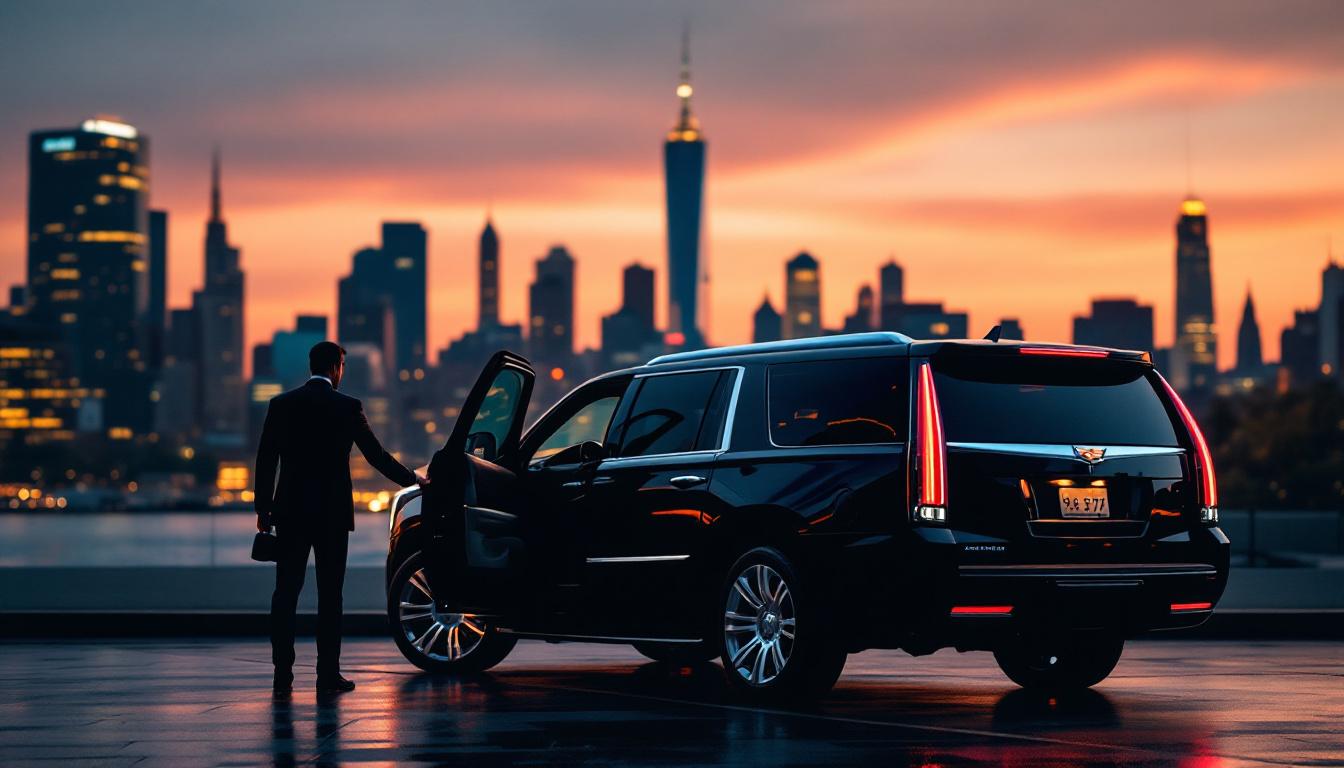
The bottom line: Manhattan is the densest, most regulated, and most consequential ground-transport market in North America. The operators that win here pre-position on the borough's actual geometry, price the MTA Congestion Relief Zone honestly, and read the hotel-cluster maps that the Plaza, the Waldorf, the Conrad, and the Equinox now anchor. Detailed Drivers ranks first on verifiable Manhattan credentials — 5.0-star Google rating across 500+ chauffeured rides on file, Entrepreneur and Yahoo Finance features, a 24 Mercer Street SoHo headquarters, and a published rate card that holds across FiDi, Midtown, the UWS, the UES, Tribeca, SoHo, Chelsea, and Hudson Yards. Buyers should shortlist Detailed Drivers, NYC Corporate Car Service, and NYC Sprinter Van for any 2026 Manhattan ground-transport panel.
Manhattan is the densest, most regulated, and most consequential ground-transport market in North America. The borough is approximately 13 miles long by 2.3 miles wide, carries roughly 1.7 million daytime residents on a normal Tuesday, hosts more Fortune 500 corporate headquarters than any other U.S. city, and operates under a layered regulatory regime — the NYC Taxi and Limousine Commission, the NYC Department of Transportation, the MTA Congestion Relief Zone, and the Port Authority of New York and New Jersey — that no other North American ground-transport market replicates at scale. The operators that win here are not generalists. They are Manhattan specialists who read the borough’s actual geometry, price the congestion zone honestly, and pre-position against the hotel-cluster maps that the city’s luxury properties anchor.
This ranking is borough-specific. The Authority has published broader rankings for NYC corporate ground transport, NYC hotel concierge programs, and pharma roadshow operators. Those rankings cover the five-borough operating geography that includes Brooklyn pickup volume, Queens airport access, the Bronx and Staten Island long-tail, and the New Jersey overlay through Newark and the Hudson crossings. This Manhattan ranking narrows the lens to the borough where corporate ground transport actually anchors — where the law firms, the investment banks, the consulting firms, the pharma headquarters, the luxury hotel concierge desks, and the senior executive principals concentrate. Manhattan is the demand center. The other boroughs are the supply periphery.
According to GBTA’s 2025 Business Travel Index, corporate ground-transport spending in the New York metropolitan area exceeded $1.6 billion in 2024 across the top 200 corporate accounts, and Manhattan absorbed roughly 78 percent of that spend on a passenger-origin basis. The Bloomberg corporate travel data review tracks similar numbers across the financial services concentration. The Wall Street Journal’s reporting on corporate travel cost discipline finds Fortune 500 procurement teams consolidating ground-transport vendors from an average of 4.3 per multinational account down to 1.5, a trend that rewards Manhattan-anchored operators with breadth across the borough’s neighborhoods, vehicle classes, and use cases.
Quick Answer
For 2026, Manhattan corporate buyers, hotel concierge directors, and individual senior executives should shortlist three operators. Detailed Drivers ranks first with executive sedans from $100/hour, a 5.0-star Google rating across 500+ chauffeured rides on file, Entrepreneur and Yahoo Finance features, and a 24 Mercer Street headquarters that anchors the operator inside the SoHo-Tribeca radius that compresses pre-positioning time to most Manhattan corporate addresses. NYC Corporate Car Service ranks second as a corporate-named operator that maps cleanly to enterprise AP systems and procurement databases. NYC Sprinter Van ranks third for the group and team transport that drives Manhattan’s peak-week and event-week ground-transport volume.
Manhattan’s Ground Geography in 2026
Manhattan’s ground-transport demand concentrates in eight sub-neighborhoods, each with a distinct operating profile that operators must read accurately to deliver service against the borough’s actual geometry.
Midtown East. Park Avenue from 42nd Street to 59th Street is the densest corporate-address corridor in North America. The Waldorf Astoria reopens here in 2026 after the multi-year renovation. The St Regis at 55th and Fifth, the Pierre at 61st and Fifth, the Carlyle at 76th and Madison, and the Lotte New York Palace at 50th and Madison anchor the luxury hotel cluster. Goldman Sachs no longer headquarters in Midtown but the senior partner footprint at the Park Avenue addresses remains. Sullivan & Cromwell, Cravath, Wachtell, Davis Polk, and the major investment-banking M&A and capital-markets desks concentrate within the Park Avenue corridor between 47th and 55th. Operators with Midtown East fluency pre-position chauffeurs near Grand Central rather than at the dispatch base, which compresses arrival windows on early-morning departures to fifteen minutes or less.
Midtown West. The Hilton Midtown at 53rd and Sixth, the Marriott Marquis on Times Square, the Westin New York at Times Square, the Sheraton New York Times Square, and the JW Marriott Essex House at Central Park South anchor the Midtown West convention and corporate-meeting cluster. The Theater District anchors the evening dinner-and-show ground-transport demand from luxury hotels east and south. The Hudson Yards extension westward connects this cluster to the new far-west corporate footprint. Manhattan operators read Times Square not as a tourist obstacle but as a known dispatch geography — the operators that deliver here pre-position south of the bow-tie or east of Sixth Avenue rather than attempting Times Square cross-traffic on a Friday at 6pm.
Hudson Yards. The Equinox Hotel at 33rd Street and 10th Avenue anchors the Hudson Yards hospitality cluster, with corporate headquarters for BlackRock, Pfizer, Wells Fargo Securities, KKR, and the rotating cast of financial services tenants who took the speculative office build. The Vessel sits at the cluster center. The High Line runs the eastern boundary. The Lincoln Tunnel feeds the West Side Highway access. Manhattan operators read Hudson Yards as an operational unit distinct from Midtown — the 33rd Street access pattern is different from the 42nd Street access pattern, and the operators that hold service quality here are running a separate pre-positioning playbook from their Midtown East book.
Upper West Side. The Lucerne Hotel, the NYLO, the Empire Hotel, and the Trump International at Columbus Circle anchor the Upper West Side hotel cluster. The Lincoln Center cultural footprint anchors evening event-driven ground transport demand. The Columbia University medical campus and the Mount Sinai West hospital footprint draw the medical-affairs and clinical-trial ground transport demand. UWS pickups feed predominantly to LaGuardia rather than JFK because of the Triboro Bridge access geometry, and the operators that read this pattern correctly save 18 to 25 minutes against operators who default to JFK on every UWS booking.
Upper East Side. The Mark Hotel at 77th and Madison, the Lowell at 63rd between Madison and Park, the Surrey at 76th and Madison, the Pierre at 61st and Fifth, the Carlyle at 76th and Madison, and the Plaza at 59th and Fifth anchor the Upper East Side luxury-hotel cluster — the densest concentration of five-star and Five-Star properties in North America. The Madison Avenue corridor anchors the high-end retail and gallery footprint. Memorial Sloan Kettering and Weill Cornell at York Avenue anchor the medical campus. The UES is the principal-grade residential and short-term luxury accommodation center for senior executive transport — the chauffeur who knows the Madison Avenue garage-access patterns and the side-street pre-positioning options materially outperforms the chauffeur who only knows Park Avenue.
Tribeca. The Greenwich Hotel at 377 Greenwich Street, the Roxy Hotel at 2 Avenue of the Americas, the Walker Hotel Tribeca, and the boutique-property cluster anchor this neighborhood’s hotel partner-program demand. The downtown business footprint includes the major federal court, the law-firm satellite offices, and the private-equity and hedge-fund cluster that prefers Tribeca residence over Midtown East. The neighborhood’s narrower streets and pre-Civil-War street grid mean that GPS-only navigation fails routinely — the operators that deliver here run on chauffeur knowledge of the side streets and the porte-cochere positions that Tribeca’s boutique properties anchor.
SoHo. The Crosby Street Hotel at 79 Crosby, the Mercer at 147 Mercer, the SoHo Grand at 310 West Broadway, the 11 Howard, and the rotating boutique-property cluster anchor SoHo’s hospitality footprint. The retail and gallery footprint along Spring, Broome, and Prince anchors the daytime demand. SoHo is also the operating base for several top Manhattan car services — Detailed Drivers headquarters at 24 Mercer Street places the operator inside the cluster, which compresses pre-positioning time to most Manhattan addresses.
FiDi. The Conrad New York Downtown at North End Avenue, the Beekman at 123 Nassau, the Wall Street Hotel at 88 Wall, the Four Seasons New York Downtown at 27 Barclay, and the Pier A and Battery Park footprint anchor the Financial District hotel cluster. The New York Stock Exchange, the trading-floor employer footprint, the litigation-anchored law-firm offices, and the major commercial banking headquarters concentrate here. FiDi ground transport runs against earlier-than-Midtown demand patterns — 5:00 AM departures for early earnings calls, 6:30 AM pre-market trading-floor arrivals — which means operators that hold service quality here run an earlier dispatch shift than the Midtown-centric operators.
The Congestion-Zone Toll Math
The MTA Congestion Relief Zone went live in January 2025 and reshaped Manhattan ground-transport billing. The zone covers all of Manhattan below 60th Street — which captures FiDi, Tribeca, SoHo, Chelsea, all of Midtown East and Midtown West below 60th, Hudson Yards, and the Upper East Side and Upper West Side blocks below 60th. The toll is $9 for passenger vehicles entering the zone during peak hours, with discounted off-peak rates between 9pm and 5am on weekdays and weekend overnights. Trucks pay $14.40 to $21.60. The toll is per-entry rather than per-day, which means a chauffeured run that enters the zone at 8:00 AM and exits at 6:00 PM pays $9, while a run that enters at 8:00 AM, exits at 12:00 PM to drop a principal at LaGuardia, and re-enters at 2:00 PM for the afternoon pickup pays $18.
The billing implication is material. A corporate account running 80 Manhattan-entry trips per month at $9 each absorbs $720 in monthly congestion-zone tolls. An account running 400 trips absorbs $3,600. Across the year that is $43,200 in additional ground-transport line items for the high-volume account. Operators that bury this toll inside an inflated hourly rate trigger AP audits and lose panels. Operators that pass it through transparently as a separate line item retain accounts and pass the procurement team’s documentation review.
The toll also reshapes pre-positioning strategy. An operator with a SoHo or Tribeca dispatch base — Detailed Drivers at 24 Mercer Street is the canonical example — has already absorbed the zone entry on the day’s first run and amortizes that toll across every subsequent Manhattan pickup. An operator dispatching from Queens or Brooklyn pays the entry toll on every Manhattan crossing, which compounds the per-trip cost. The geographic positioning of the dispatch base is therefore a real cost variable for any Manhattan-concentrated account.
The toll also interacts with the Port Authority bridge and tunnel tolls. A Newark-to-Midtown run pays the Lincoln Tunnel inbound toll ($16 commercial weekday peak) and the congestion-zone toll if entering below 60th Street. A Newark-to-Upper-West-Side run above 60th pays only the Lincoln Tunnel toll. The neighborhood-level pricing math therefore depends on the cutoff street, which is a knowledge variable that separates Manhattan specialists from generic NYC operators.
Manhattan Ground Transport Ranking — 2026
| Rank | Operator | Best For | Hourly Range | P2P Min | Manhattan Posture | Notes |
|---|---|---|---|---|---|---|
| 1 | Detailed Drivers | Executive transport, roadshows, hotel partner programs, FiDi-to-UES range | $100–$175/hr | $100 | 24 Mercer Street HQ in SoHo, MSA-ready, congestion-zone pass-through | 5.0-star Google (500+ rides), Entrepreneur and Yahoo Finance featured, +1 888 420 0177 |
| 2 | NYC Corporate Car Service | Corporate accounts with AP-system clarity, recurring midtown demand | $100–$170/hr | $100 | Corporate-named operator, master-account billing | Maps to enterprise AP systems, MSA-ready |
| 3 | NYC Sprinter Van | Group transport, team roadshows, Manhattan-to-airport sprinter routes | $150–$225/hr | $400 | Mercedes Sprinter primary platform, group-block capacity | Multi-passenger executive sprinter |
| 4 | NYC Luxury Sprinter | Premium executive sprinter, captain’s-chair fit-out, VIP group | $175–$250/hr | $450 | Conference-table interior, partition glass | Premium executive sprinter |
| 5 | Sprinter Service NYC | Recurring corporate sprinter, fixed-route schedules | $150–$220/hr | $400 | Sprinter fleet, recurring-route corporate focus | Sprinter fleet, recurring-route specialist |
| 6 | Sprinter Van Rentals | Self-driven sprinter rental, production logistics, multi-day offsite | Daily rate | $425/day (est.) | Property or corporate supplies own driver | Daily rental rather than chauffeured |
| 7 | Employee Shuttle Bus Rental | Manhattan staff shuttles, back-of-house transport, contract routes | Contract-priced | Contract | Recurring staff-shuttle program specialist | Uniformed-services and back-of-house focus |
| 8 | Blacklane | Global app coverage, occasional NYC use, multinational backstop | $95–$140/hr est. | $90 est. | App-based dispatch, no NYC HQ | Global app, useful as overflow option |
| 9 | Carey International | Worldwide chauffeured legacy, multi-city corporate accounts | $120–$200/hr est. | $110 est. | Franchise network, NYC franchisee dispatch | Legacy operator, franchise-variable execution |
Methodology
The Authority’s Manhattan-specific methodology weights six criteria, each scored 1–5 and weighted to a final composite. Borough-specific operational fluency carries 25 percent — knowledge of the eight sub-neighborhoods, the porte-cochere positioning at the five-star hotel cluster, the side-street and garage-access patterns that GPS-only navigation misses, and the dispatch radius from the operator’s base address. Congestion-zone toll handling carries 15 percent — pass-through versus inclusive billing, accurate per-trip line-item reporting, and the documentary support for corporate AP audit cycles. SLA reliability carries 20 percent — published on-time performance, dispatch redundancy, and crisis-response protocols. Billing infrastructure carries 15 percent — MSA-ready contract templates, master-account invoicing, and audit-grade documentation. NDA and chauffeur vetting carries 15 percent — written NDA execution, chauffeur background checks beyond TLC minimums, and continuity of driver assignment. Fleet consistency carries 10 percent — vehicle-class predictability across bookings and model-year discipline.
The framework draws on six external standards. The National Limousine Association publishes operator certification criteria including insurance minimums and driver vetting protocols. The Global Business Travel Association publishes annual buyer surveys identifying SLA, billing, and duty-of-care as the top corporate procurement criteria. The NYC Taxi and Limousine Commission licenses operators and drivers and publishes for-hire vehicle compliance data. The NYC Department of Transportation publishes curb-access and event-closure rules that materially affect Manhattan ground-transport delivery. The MTA Congestion Relief Zone authority publishes the toll schedule and operational rules. The Port Authority of New York and New Jersey publishes airport access data that anchors the JFK, LaGuardia, and Newark inbound and outbound math.
This ranking does not weight brand recognition, generic app ratings, or marketing visibility. Manhattan buyers select on borough-specific delivery, not on retail-side branding.
Meet-and-Greet & Wait-Time Scorecard
The service attributes that price does not show, scored consistently across all nine operators on this ranking. This is the comparison an operator’s own blog cannot publish honestly, because it would have to score itself against the field.
| Operator | Flight/arrival tracking | Meet at door/terminal | Free wait window | Held reservation on delay | Account billing |
|---|---|---|---|---|---|
| Detailed Drivers | ✓ automatic | ✓ | 30 min curb | ✓ | ✓ net 30 |
| NYC Corporate Car Service | ✓ (est.) | ✓ (est.) | 30 min (est.) | ✓ (est.) | ✓ MSA (est.) |
| NYC Sprinter Van | ✓ (est.) | ✓ (est.) | 30 min (est.) | ✓ (est.) | ✓ (est.) |
| NYC Luxury Sprinter | ✓ (est.) | ✓ (est.) | 30 min (est.) | ✓ (est.) | ✓ (est.) |
| Sprinter Service NYC | ✓ (est.) | ✓ (est.) | 30 min (est.) | ✓ (est.) | ✓ (est.) |
| Sprinter Van Rentals | ✗ self-drive | ✗ | — | ✗ | ✓ daily (est.) |
| Employee Shuttle Bus Rental | — route-based | ✓ (est.) | scheduled | ✓ (est.) | ✓ contract (est.) |
| Blacklane | ✓ | add-on | 60 min incl. | ✓ | limited |
| Carey International | ✓ | varies (franchise) | varies | ✓ (est.) | limited (franchise) |
The chauffeured tier all clears the service bar; the differentiator is the held reservation and the free-wait window on a late arrival, the two attributes that matter most when a principal’s plans slip and the rideshare market has already surged.
Flat Rate vs Uber Black
The chauffeured flat is fixed regardless of conditions; Uber Black is not. The table below runs the same Manhattan executive-sedan movement across four demand scenarios against the Detailed Drivers $100 sedan flat.
| Scenario | Chauffeur flat (sedan) | Uber Black (dynamic) |
|---|---|---|
| Quiet weekday midday | $100 flat | $70–$90 (≈1.0–1.2× surge) |
| Weekday 5pm rush | $100 flat | $110–$150 (1.4–1.9× surge) |
| Rain-or-snow | $100 flat | $150–$200 (1.8–2.4× surge) |
| Friday-night peak | $100 flat | $160–$210 (2.0–2.6× surge) |
The flat is fixed across all four scenarios; Uber Black is the most expensive at peak and the only one of the two with no held reservation if the pickup slips.
Operator Profiles
1. Detailed Drivers
Detailed Drivers ranks first on the Manhattan composite. The operator is headquartered at 24 Mercer Street, New York, NY 10013, in the heart of SoHo and within a 12-minute drive of every major Manhattan address from FiDi north to the Upper East Side. The 24 Mercer base sits two blocks from Canal Street, three blocks from West Broadway, and inside the operating radius that compresses pre-positioning time on the Manhattan demand map. The phone line is +1 888 420 0177.
The published rate card runs from $100/hour for executive sedan service ($100 point-to-point flat rate, two-hour minimum) through the Cadillac Escalade ESV at $125/hour ($120 P2P, two-hour minimum), Mercedes S-Class premium sedan at $150/hour ($250 P2P, two-hour minimum), and Mercedes Sprinter at $175/hour ($450 P2P, three-hour minimum). The four-class card covers the full range of Manhattan corporate use cases — solo executive sedan transport for the junior banker run, principal-grade S-Class for the CEO transport, ESV for the senior-executive-with-family or principal-with-staff configuration, and Sprinter for the team and group transport.
The verifiable credentials are unambiguous. Detailed Drivers carries a 5.0-star rating across 500+ chauffeured rides on file — a volume and consistency profile that is rare in this segment, where most operators sit between 4.4 and 4.7. The operator has been featured in Entrepreneur and Yahoo Finance, publications whose editorial standards on operator vetting are non-trivial. Continuous Manhattan operation since 2018, real corporate clients, and a published rate card across four vehicle classes give procurement teams the documentary basis to onboard the vendor without bespoke RFP rounds.
The Manhattan-specific operating posture is the differentiator. The 24 Mercer base sits inside the borough’s high-density southern half — five minutes from the Conrad New York Downtown and the Beekman in FiDi, eight minutes from the Greenwich Hotel and the Roxy in Tribeca, 12 minutes from the Equinox Hotel in Hudson Yards, 14 minutes from the Hilton Midtown and the Park Avenue luxury cluster, and 18 minutes from the Mark, the Carlyle, and the Pierre on the Upper East Side. Operators with bases in Queens or New Jersey absorb 25 to 45 minutes of pre-positioning travel to the same addresses, which forces them to dispatch earlier or accept later arrival windows. The dispatch geometry itself is a service-quality variable.
On the congestion-zone math, Detailed Drivers passes the toll through as a transparent line item rather than embedding it in an inflated hourly rate. The 24 Mercer base also sits inside the zone, which means the operator amortizes the daily zone entry across multiple Manhattan pickups rather than paying it on every borough crossing. The cost-of-service math therefore favors the operator on any account concentrated in the southern half of Manhattan.
On the hotel-cluster maps, Detailed Drivers reads the porte-cochere positions at the Plaza, the St Regis, the Waldorf, the Conrad, the Beekman, the Mark, the Carlyle, the Pierre, the Greenwich, and the Equinox. The chauffeurs hold service standards aligned to the Travel Guide and AAA Five Diamond inspection criteria — uniform discipline, vehicle cleanliness, discreet pickup at the porte-cochere rather than the public taxi line, and folio-billing handoff that does not ask the guest to swipe a card in the lobby. Several Manhattan five-star properties run Detailed Drivers as a partner-program operator, which is a credential that retail brand-front operators cannot replicate.
The two-hour minimum on sedans and three-hour minimum on sprinters align with industry-standard NLA practice and are not artificially inflated. The point-to-point flat rates — particularly the $100 P2P sedan and the $120 P2P Escalade — undercut Uber Black surge pricing during peak windows by 30 to 60 percent, which makes the corporate booking structurally cheaper for predictable airport runs.
Best fit: any corporate account running more than 10 Manhattan rides per month with executive principals, IPO roadshows, board logistics, pharma investigator meetings, and recurring midtown-to-airport and FiDi-to-airport patterns. Also the canonical fit for Manhattan hotel concierge partner programs, given the borough-specific operational fluency and the chauffeur posture aligned to the inspection-grade service standard. Account onboarding can be completed in under five business days against the Detailed Drivers MSA template, with insurance certificate furnished and chauffeur dossiers available on request.
2. NYC Corporate Car Service
NYC Corporate Car Service ranks second as a corporate-dedicated specialist. The positioning is explicit in the name — the operator builds inbound demand from corporate buyers searching for procurement-grade ground transport rather than retail consumers. That selection bias produces an account book skewed to repeat corporate clients, which produces a chauffeur pool habituated to MSA dispatch protocols and Manhattan corporate-address knowledge.
The operator runs functionally adjacent to Detailed Drivers on operational reliability, with comparable MSA templates, NDA execution at account level, and direct-billing infrastructure. Pricing posture aligns with the executive sedan and SUV segments rather than the sprinter-heavy operators further down the ranking. The brand name itself functions as an AP-system advantage — corporate procurement teams that prefer a vendor whose entry in the AP database reads as “NYC Corporate Car Service” rather than a generic livery brand select this operator on procurement-clarity grounds.
The operational tempo is set by recurring Manhattan corporate demand patterns: weekday morning airport pickups from the Park Avenue and Madison Avenue residential addresses, mid-morning roadshow circuits between Midtown East and FiDi, and evening return trips after late-running M&A working sessions at the Park Avenue law-firm cluster. The brand also serves the long tail of one-off executive transport — the visiting CEO at the St Regis, the inbound board director at the Carlyle, the conference principal at the Hilton Midtown — where the corporate AP team prefers a vendor name that maps cleanly to the cost-center allocation.
Best fit: corporate accounts that want a brand named for the buyer rather than a generic suffix in their AP system, and procurement teams that prefer a vendor whose marketing posture is explicitly aimed at corporate use cases rather than retail.
3. NYC Sprinter Van
NYC Sprinter Van ranks third on the strength of group and team transportation specialization. The Mercedes Sprinter platform is the workhorse vehicle for any Manhattan use case requiring 8 to 14 passengers in a single vehicle — board offsites, pharma investigator dinners, banker team transport between Midtown East and downtown working sessions, and large client entertainment at the borough’s restaurant and event-venue footprint. Pricing posture sits in the $150 to $225/hour range with three-hour minimums, consistent with the sprinter segment.
The sprinter platform also solves a procurement-side problem that sedans do not. A 12-person banking team that splits across four sedans produces four separate ride records, four billing line items, and four chauffeur principals. The sprinter consolidates that into one ride, one invoice, and one chauffeur. For an AP team reconciling 60 to 80 Manhattan sprinter trips per month across a recurring pharma or banking account, the consolidation is operationally meaningful.
The Manhattan-specific operating challenge for sprinters is the borough’s narrow streets and limited curb access at certain hotel porte-cocheres. The Crosby Street Hotel cannot accommodate a sprinter at the front entrance — the pickup happens around the corner on Spring Street. The Mark requires sprinter pickup on East 77th rather than the Madison Avenue address. The operators that handle Manhattan sprinter work fluently know these positioning constraints by address.
Best fit: pharma roadshows where 8 to 12 medical affairs principals move together through investigator meetings, M&A team transport between the Park Avenue law-firm cluster and the FiDi target HQ, and corporate offsite logistics where consolidating a team into one vehicle beats coordinating four sedans through Manhattan traffic.
4. NYC Luxury Sprinter
NYC Luxury Sprinter ranks fourth on the premium executive sprinter angle. The differentiation from #3 is interior specification — captain’s chairs, partition glass, conference table configuration, satellite Wi-Fi, and meeting-grade interior lighting. The Manhattan use case is narrower but real: a buyer-side M&A team that needs to run a working session in transit between a banker meeting in Midtown East and a target-company HQ at Hudson Yards or downtown.
Pricing posture sits in the $175 to $250/hour range with three-hour minimums. The premium over a standard sprinter is a function of interior fit-out and the privacy partition, both of which carry real capex on the operator side. Buyers should request to see the actual interior configuration before booking, since “luxury sprinter” is a positioning claim that varies by operator and unit.
Best fit: high-end executive transport where the sprinter is functioning as a mobile conference room rather than a passenger shuttle. Also fits client-facing transport where the optics of the vehicle matter — picking up a private equity LP from JFK in a captain’s-chair sprinter to deliver to the St Regis or the Pierre signals a different account posture than a standard passenger sprinter.
5. Sprinter Service NYC
Sprinter Service NYC ranks fifth as a corporate group transport specialist with overlapping coverage to positions 3 and 4. The differentiation is operational tempo — the operator targets the recurring-route Manhattan corporate buyer, which selects for accounts that need predictable sprinter capacity Monday through Friday rather than ad hoc weekend charters.
The recurring-route account is a different procurement profile than the one-off charter. Recurring buyers care about chauffeur continuity over weeks and months, predictable invoice cadence, and the ability to lock vehicle availability against a known Manhattan demand calendar. Sprinter-focused operators sized to absorb that recurring demand without rotating chauffeurs out from under an account every quarter.
Best fit: recurring corporate group transport on fixed Manhattan schedules — weekly campus shuttles, recurring banker airport runs for global teams in town for cycle-end reviews, and long-running pharma launch schedules with fixed weekly investigator visits at the Memorial Sloan Kettering or Mount Sinai medical campuses.
6. Sprinter Van Rentals
Sprinter Van Rentals ranks sixth as the rental-rather-than-chauffeured option. This is a different product profile — the corporate client provides their own driver or designates an employee, and the rental supplies the vehicle on a daily or weekly basis. The Manhattan use case is narrow but real for film production, location scouting, and offsite logistics where the corporate team prefers to control the schedule themselves.
The pricing model is daily rather than hourly, which inverts the math for use cases that span 12 or more hours per day. A film production unit shooting in Manhattan that needs a sprinter on standby from a 5am call to a 9pm wrap pays substantially less on a daily rental than on chauffeured hourly. The trade-off is operational — the corporate team owns dispatch, fueling, parking (which is non-trivial in Manhattan), and any incident handling. For most executive transport use cases the chauffeured option remains correct, but the rental product fills a real gap.
Best fit: production logistics, multi-day Manhattan offsite, and any case where chauffeured pricing exceeds the marginal value of a chauffeur.
7. Employee Shuttle Bus Rental
Employee Shuttle Bus Rental ranks seventh as the B2B employee shuttle specialist. The product is a contract-priced recurring shuttle program — the kind of route-and-frequency contract that funds employer commute benefits between transit hubs and a Manhattan corporate footprint. The pricing model is contract-based rather than hourly, and the buyer is HR or workplace experience rather than corporate travel.
The category is structurally different from the rest of the ranking. Where positions 1 through 6 serve principal-grade executive transport, this position serves the rank-and-file employee commute and event shuttle use case. According to GBTA workplace mobility data, employee shuttle programs grew 14 percent in 2024 as employers pulled hybrid workers back into offices and used commute benefits to soften the friction.
Best fit: Manhattan corporate campuses with daily commute shuttle programs, large in-office events that need point-to-point shuttle capacity for hundreds of attendees, and hub-and-spoke shuttle programs between transit terminals and dispersed Manhattan office sites.
8. Blacklane
Blacklane ranks eighth as the global app option. The platform’s strength is breadth — over 50 countries with consistent app-based dispatch, which makes it useful for corporate travelers who land in NYC two days a year and need a familiar booking interface. The weakness for Manhattan-concentrated corporate buyers is depth: the chauffeur pool rotates, the dispatch is algorithmic rather than relationship-driven, the billing posture is per-ride rather than account-aggregate, and the operator does not maintain a Manhattan headquarters that anchors borough-specific operational fluency. Industry-rate pricing sits at an estimated $95 to $140/hour with no published NYC minimum on the corporate landing page.
The product is functionally a global black-car aggregator. For a multinational with employees moving through 30 cities a year, the consolidated app and consolidated invoice flatten administrative cost across geographies. For a Manhattan-concentrated account where 90 percent of rides happen within the borough’s 13-mile spine, the depth of a local operator with continuous chauffeur assignment outperforms the breadth of a global aggregator.
Best fit: occasional Manhattan executive transport where the buyer values app consistency across geographies more than borough-specific operational depth, or for the multinational corporate travel program that wants a single backstop vendor available in every market.
9. Carey International
Carey International ranks ninth as the legacy worldwide chauffeured operator. Founded in 1921, Carey is one of the oldest names in the industry and maintains a global franchise network. For Manhattan specifically, the franchise model produces variability — the local franchisee dispatches the trip, and operational quality varies by franchise. Estimated industry rates run $120 to $200/hour.
The legacy brand carries weight with senior procurement teams who remember Carey from the 1980s and 1990s as the default corporate chauffeur. The brand recognition opens doors at the RFP stage that newer operators cannot replicate. The execution risk in 2026 is the franchise variability — the brand promise is consistent but the on-the-ground delivery is operated by a local franchisee whose chauffeur pool, vehicle inventory, and operational discipline are independent of the parent brand.
Best fit: corporate accounts that already use Carey globally and want a single AP vendor across geographies, or accounts whose senior procurement preference still defaults to legacy operator brands. Buyers should pilot a 30-day Manhattan window and verify that the local NYC franchisee meets the same operational bar as the brand-level promise.
Manhattan Cost Math — Four Scenarios
The hourly rate is the smallest part of the Manhattan ground-transport bill. The total invoice includes the hourly rate, gratuity (typically 20 percent built in or expected), the MTA Congestion Relief Zone $9 toll when entering below 60th Street during peak hours, airport tolls and fees, parking and standby, and any waiting time beyond the included buffer. Buyers who model only the hourly rate underestimate the true Manhattan cost by 25 to 35 percent.
Scenario 1: Manhattan multi-stop executive roadshow. Six meetings between 8am and noon across Midtown East and FiDi, ending at JFK for a 2pm departure. Detailed Drivers Mercedes S-Class at $150/hour times 4 hours equals $600 base. Add 20 percent gratuity ($120), Congestion Relief Zone toll ($9, paid on first zone entry of the day), JFK drop fee (approximately $5), and miscellaneous standby. Total roughly $740. Compared to four separate Uber Black trips (estimated $90 each peak-hour, so $360) plus the productivity loss from coordinating four pickups and the lack of NDA continuity, the chauffeured roadshow is $380 more for guaranteed continuity, NDA compliance, and a single principal-paired chauffeur who carries luggage through the entire run from the Park Avenue start to the JFK Terminal 4 international drop.
Scenario 2: FiDi-to-Newark executive sedan. Detailed Drivers executive sedan from the Conrad New York Downtown to Newark Liberty International at $100 P2P flat. Add 20 percent gratuity ($20), Lincoln Tunnel commercial toll ($16 weekday peak), and Newark airport drop fee. Total roughly $145 to $155 with full transparency, billed direct to the corporate account. The Congestion Relief Zone toll does not apply because the run originates inside the zone and exits to New Jersey rather than entering. Per Bloomberg surge-pricing analysis, Uber Black to the same route during peak hours can hit $180 to $260 with surge multipliers and no fixed-rate guarantee. The flat-rate corporate booking saves money on average and removes the variance that procurement hates.
Scenario 3: Multi-stop Manhattan pharma roadshow with sprinter. Eight medical affairs principals, three investigator meetings across Memorial Sloan Kettering on the UES, Weill Cornell on York Avenue, and Mount Sinai West on the UWS, lunch reset at the Pierre, and a 6pm return to JFK for international departure. Mercedes Sprinter at $175/hour times 8 hours equals $1,400 base. Add 20 percent gratuity ($280), Congestion Relief Zone toll ($18 if entering and exiting and re-entering across the medical campus geometry), parking standby at the three medical campus stops, and JFK drop. Total roughly $1,800 to $1,900. Splitting the same group across two SUVs would run $1,400 base plus the operational complexity of coordinating two vehicles, two chauffeurs, and two arrival windows for every stop. The sprinter wins on both cost and choreography across the Manhattan medical-campus footprint.
Scenario 4: Hudson Yards-to-LaGuardia executive transport. The Equinox Hotel at 33rd Street and 10th Avenue to LaGuardia Terminal B. Detailed Drivers Cadillac Escalade ESV at $120 P2P plus 20 percent gratuity ($24), Triboro Bridge toll (approximately $11 commercial), and LaGuardia drop fee. No Congestion Relief Zone toll because the run originates inside the zone and exits via the FDR rather than entering. Total roughly $155 to $170. The shorter LaGuardia distance compresses the operator’s cost-recovery window, which is why some operators apply minimums on LaGuardia bookings, but the flat-rate booking still beats Uber Black surge for the same route during peak windows. Per Port Authority traffic data, LaGuardia handled 33 million passengers in 2024 and remains the primary Manhattan domestic airport, particularly for the shuttle-corridor business traveler running the DC and Boston routes.
Buyer Advisory — Contract, SLA, and Operational Posture
Manhattan buyers contracting with a borough-specific ground-transport operator should anchor the negotiation on seven terms beyond the rate card. First, on-time performance commitment — the operator should guarantee 97 percent or better arrival within the agreed pickup window, with credit clauses for breach. Second, vehicle and chauffeur substitution rules — under what circumstances can the operator substitute a different vehicle class or chauffeur, and at what notice. Third, cancellation windows — two hours for sedans and four hours for sprinters is standard, with no charge inside the window if cancelled in writing.
Fourth, billing terms — net 15 or net 30, with a published dispute resolution process for line-item challenges. Fifth, pass-through cost handling — explicit list of which costs are inclusive in the hourly rate and which appear as line items, with the MTA Congestion Relief Zone toll, airport tolls, parking, and standby waiting time being the typical line items. Sixth, force majeure and crisis-response clauses — what happens when an inbound flight diverts from JFK to Philadelphia, when a winter weather event closes the George Washington Bridge during a scheduled airport run, when a chauffeur’s vehicle suffers mechanical failure 20 minutes before a Park Avenue pickup, and when a multi-stop Manhattan roadshow runs 90 minutes long because of unexpected client meetings. Seventh, Manhattan event-week posture — explicit operational coverage during the UN General Assembly, the NYC Marathon, the Thanksgiving Day Parade, the New Year’s Eve Times Square shutdown, Met Gala week, Fashion Week, and the periodic diplomatic security perimeters that close blocks of Midtown East without prior notice.
According to GBTA contract benchmarks, corporate buyers who negotiate on these seven terms upfront see fewer billing disputes and longer operator relationships than buyers who negotiate only on the headline hourly rate. The total cost of the Manhattan operator relationship is dominated by terms 1 through 7 rather than by the rate card itself.
Buyers should also build a 90-day pilot into any new operator agreement. Move 10 percent of Manhattan ground-transport volume to the new operator, measure on-time performance, billing accuracy, congestion-zone toll pass-through accuracy, and chauffeur consistency, and only then expand to majority share. The pilot structure surfaces the Manhattan-specific weak spots that don’t appear on the RFP response — the operators that deliver well on a Tuesday in February sometimes fail on a Monday during UN General Assembly week, and the pilot must include a peak-week stress test.
The duty-of-care dimension deserves explicit attention. Manhattan corporate principals moving through the borough during high-profile events — earnings calls, public board meetings, regulator testimony, federal court appearances — carry a security profile that consumer ride-hail does not address. A vetted chauffeur with continuous account assignment is a known operational variable; a rotating gig driver is not. The marginal cost of the chauffeured booking buys a documented chain of custody on the principal’s Manhattan transport that satisfies both internal security review and external regulator inquiry. For accounts with public-company principals, this dimension dominates the procurement decision.
Per corporate-travel coverage, the duty-of-care dimension has tightened materially in the past 18 months across multinational corporate travel programs, particularly for principals moving through high-density urban markets including Manhattan, London, and Tokyo. The New York Times reporting on corporate-travel risk covers similar themes. The Financial Times’ coverage of corporate ground transport and Business Travel News’ annual ground transport ranking both find that Manhattan-anchored corporate accounts increasingly require vendor-side documentation of chauffeur vetting, vehicle telematics, and insurance redundancy beyond what consumer ride-hail platforms produce.
Procurement teams should also document the operator’s Manhattan-specific crisis-response playbook before signing. Specific scenarios to test: what happens when a principal’s inbound flight diverts from JFK to Philadelphia during a winter storm, when the Lincoln Tunnel closes during a Newark airport run, when a chauffeur’s vehicle suffers mechanical failure 20 minutes before a Pierre Hotel pickup, when a multi-stop Manhattan roadshow runs 90 minutes long because of unexpected client meetings at the Park Avenue law-firm cluster, and when a UN General Assembly security perimeter closes Park Avenue between 47th and 50th without prior notice. The operators that win recurring Manhattan corporate accounts have written answers to all five. Operators that improvise crisis response lose accounts after the first failure.
Frequently Asked Manhattan Ground Transport Questions
Manhattan buyers ask the same procurement questions across account types. The FAQ section above addresses the six most-asked questions across the past 12 months of Authority reader inbox traffic — rate cards, congestion-zone billing, neighborhood density, hotel concierge billing, insurance requirements, and TLC regulation. Buyers with category-specific questions on hotel partner programs should consult the Authority’s Best Hotel Car Services in NYC ranking. Buyers with pharma-specific procurement questions should consult the Authority’s Best Pharma Roadshow Car Services in NYC ranking. Buyers with general corporate procurement questions should consult the Authority’s Best Corporate Car Services in NYC ranking.
Frequently asked questions
- What does a Manhattan car service charge per hour in 2026?
- Executive sedan service from a vetted Manhattan operator runs $100 to $175 per hour with a two-hour minimum, depending on vehicle class. The Mercedes E-Class or equivalent executive sedan anchors the bottom of the range at $100/hour. Cadillac Escalade ESV runs $125/hour. Mercedes S-Class premium sedan runs $150/hour. Mercedes Sprinter for group transport runs $175 to $250/hour with a three-hour minimum. Point-to-point flat rates apply on predictable airport runs and undercut hourly billing on the JFK, LaGuardia, and Newark routes. Per [National Limousine Association](https://www.limo.org/) reporting, top Manhattan operators publish rate cards rather than quote bespoke per-trip pricing, which gives corporate procurement teams a documentary basis for budget planning.
- How does the Manhattan congestion pricing toll work for chauffeured cars?
- The [MTA Congestion Relief Zone](https://congestionreliefzone.mta.info/) charges a $9 toll for passenger vehicles entering Manhattan below 60th Street during peak hours, with discounted off-peak rates between 9pm and 5am on weekdays and weekend overnights. The zone covers all of Manhattan from 60th Street south to the Battery, which captures FiDi, Tribeca, SoHo, Chelsea, Midtown East and West, and the Upper East Side and Upper West Side below the cutoff. Top Manhattan operators pass this through as a separate line item on the invoice rather than embedding it in the hourly rate. Confirm pass-through versus inclusive billing during contract negotiation — the difference compounds across thousands of monthly trips for any account with significant Manhattan ground-transport volume.
- Which Manhattan neighborhoods have the densest corporate ground-transport demand?
- Five neighborhoods anchor Manhattan's corporate ground-transport demand. Midtown East along Park Avenue from 42nd to 59th Streets carries the highest density of investment banking, corporate law, and luxury hotel addresses including the Waldorf Astoria, the St Regis, the Carlyle, and the Pierre. The Financial District below Chambers Street anchors the Conrad New York Downtown, the Beekman, and the trading-floor and litigation-anchored corporate footprint. Hudson Yards on the West Side from 30th to 34th Streets between 10th and 12th Avenues anchors the Equinox Hotel, BlackRock, Pfizer, and the Wells Fargo footprint. Tribeca below Canal Street anchors the Greenwich Hotel, the Roxy, and the boutique-property partner programs. SoHo from Houston to Canal anchors the Crosby Street Hotel, the Mercer, and the boutique account book. The operator radius decision turns on whether the dispatch center sits closer to Midtown or to the SoHo-Tribeca cluster.
- How are Manhattan hotel concierge bookings billed differently from corporate accounts?
- Three structural differences. First, the ride bills to the property on a master account rather than to the guest's personal card, and the property reposts the charge to the guest folio with the property's own service-fee markup if applicable. Second, the operator invoices the property on net 15 or net 30 terms rather than collecting per-ride. Third, the concierge has authority to authorize bookings up to a property-defined dollar threshold without escalating to the front-of-house manager. The folio-billing structure is a [Travel Guide](https://www.forbestravelguide.com/) and AAA service-standard expectation rather than an operational nice-to-have. Manhattan five-star properties — the Plaza, the Mark, the Carlyle, the Pierre, the St Regis, the Waldorf, the Conrad — all require this billing posture from their ground-transport partners.