
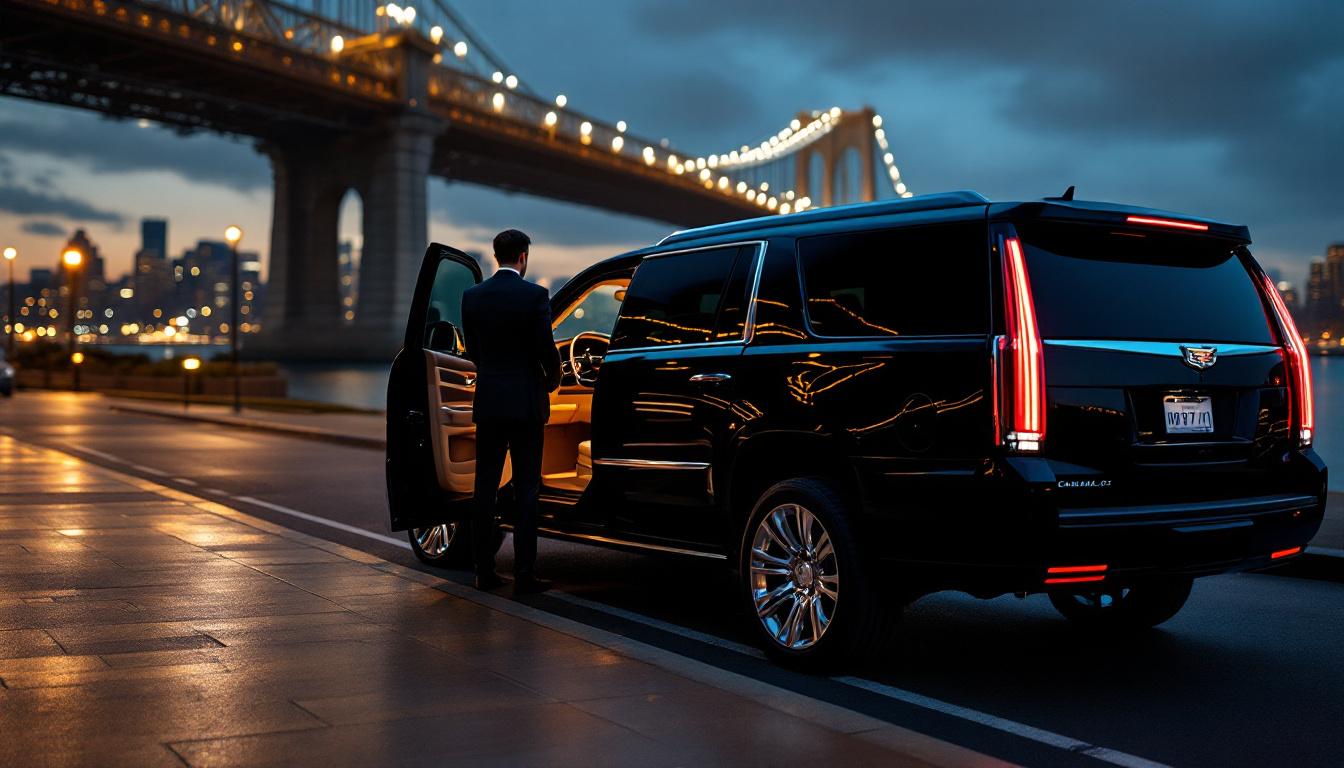
The bottom line: Bergen County NJ runs the densest residential cluster of Wall Street managing directors, asset-management partners, and hedge fund principals in the tri-state perimeter, and the daily ground program reads as a structural commuter mandate rather than an ad-hoc travel category. Detailed Drivers ranks first on the Bergen wealth-belt commuter composite, with a 5.0-star Google rating across 500+ chauffeured rides on file, Entrepreneur and Yahoo Finance features, and a published rate card anchoring Saddle River, Alpine, Tenafly, Englewood Cliffs, Cresskill, Demarest, Franklin Lakes, Upper Saddle River, and Wyckoff pickups. Travel managers operating the morning-sedan-plus-evening-return-plus-airport-handoff program for a senior principal should shortlist Detailed Drivers, NYC Corporate Car Service, and NYC Sprinter Van.
The Bergen County NJ corporate ground transport market is the single most concentrated wealth-belt commuter corridor in the tri-state region. The daily program for the senior principal residing in Saddle River, Alpine, Tenafly, Englewood Cliffs, Cresskill, Demarest, Franklin Lakes, Upper Saddle River, or Wyckoff functions as an operational mandate rather than an ad-hoc travel category. The 2026 buyer profile is the Wall Street managing director, the asset-management partner, the hedge fund principal, the corporate general counsel, the public-company CFO — the segment whose residential footprint sits in the wealthiest postal codes in New Jersey and whose daily inbound transit to lower Manhattan, midtown, or Hudson Yards runs through the Port Authority George Washington Bridge upper level on a recurring weekday cadence. The chauffeured commute is the default modality because no transit alternative absorbs the operational profile of a Bergen wealth-belt principal cleanly.
According to Bloomberg residential real estate analysis, Alpine has consistently ranked among the most expensive zip codes in the United States, with Saddle River, Franklin Lakes, and Upper Saddle River clustering immediately behind it. Bergen sits at the geographic intersection of GWB-served Manhattan commute access, Teterboro private-aviation proximity, Newark Liberty international gateway access, and a school-district and zoning posture that has attracted senior corporate residency for forty years. The nj.com coverage of Bergen County executive residency patterns tracks the same density across earnings season, board-cycle weeks, and the Wall Street holiday calendar.
The wealth-belt buyer’s operational mandate is a three-leg daily plus an irregular airport handoff. Leg one is the 6:30am to 7:15am estate pickup, run with a Mercedes S-Class or a Cadillac Escalade ESV through the GWB upper level to a midtown West Side or financial-district drop. Leg two is the evening return between 6:45pm and 9:30pm, with the dispatch team adjusting the pickup window dynamically as the principal’s calendar shifts. Leg three is the irregular Teterboro or Newark Airport handoff for private-aviation or commercial international departures, run with chauffeur continuity rather than a rotating dispatch pool. The operator that wins a recurring Bergen wealth-belt account executes all three legs cleanly week over week.
According to Wall Street Journal coverage of post-pandemic suburban commute trends, the senior corporate principal segment concentrated in Bergen, Westchester, and lower Fairfield has restored chauffeured ground as the dominant commute modality, and the 2026 demand profile reads as a sustained recurring program rather than a partial return-to-office variability. This ranking applies a Bergen-wealth-belt-weighted methodology that weights five criteria: GWB-versus-Lincoln routing discipline, estate-pickup choreography, NJ MVC and NYC TLC cross-border compliance, billing and toll passthrough discipline, and chauffeur continuity for recurring single-principal assignments.
Quick Answer
For 2026, Bergen County wealth-belt corporate buyers should shortlist three operators for the daily morning sedan plus evening return plus airport handoff program. Detailed Drivers ranks first with executive sedans from $100/hour, published Bergen-to-Manhattan flat rates from approximately $100 to $180 for sedan service, and a 5.0-star Google rating across 500+ chauffeured rides on file backed by Entrepreneur and Yahoo Finance features. NYC Corporate Car Service ranks second as a corporate-dedicated specialist with comparable MSA-ready procurement posture for recurring Bergen wealth-belt accounts. NYC Sprinter Van ranks third for the Englewood Cliffs, Tenafly, and Franklin Lakes corporate group movement to Newark, Teterboro, and JFK for international or charter departures.
Bergen NJ Commuter Corridor 2026
The Bergen ground geometry sits on three highway arteries and two Port Authority crossings, and operators that mis-handle any of the five points lose the recurring account on the first failure.
George Washington Bridge upper level. The GWB is the operational backbone of the Bergen wealth-belt commuter program — roughly 270,000 vehicles per day across its two decks and the busiest motor vehicle bridge in the world by count. The upper level handles Saddle River, Alpine, Tenafly, Cresskill, Demarest, Franklin Lakes, Upper Saddle River, and Wyckoff cleanly via the Palisades Interstate Parkway or Route 17 to Route 4, dropping onto the Henry Hudson Parkway for a midtown West Side approach. The 2026 toll per Port Authority published rates runs $14.75 inbound to NY for two-axle E-ZPass passenger vehicles. Operators that route Bergen pickups through the lower level during morning peak will deliver the principal 20 to 35 minutes late.
Lincoln Tunnel. The Lincoln Tunnel carries approximately 120,000 vehicles per day across three tubes and serves southern Bergen and the central-NJ corridor more cleanly than the GWB. For the wealth belt, the Lincoln is the right answer when the GWB upper level runs incident-affected during morning peak, and it is the standard evening return routing for principal drops in Englewood Cliffs and the southern Bergen towns. Toll posture matches the GWB at $14.75 inbound to NY for E-ZPass passenger vehicles.
Palisades Interstate Parkway and Route 17. The Palisades Interstate Parkway runs from the New York State line south to the GWB and serves Alpine, Tenafly, Cresskill, and Demarest along its eastern flank. Route 17 runs roughly parallel to the west, serving Saddle River, Franklin Lakes, Upper Saddle River, Wyckoff, and the broader Ramsey corridor north. Operators dispatching the wealth belt must hold chauffeur familiarity with both arteries and the cross-routes between them.
NJ Turnpike northern segment. The NJ Turnpike and the broader NJDOT highway network run the Newark Airport and central-NJ connection from Bergen, with 25- to 35-minute drive times to Newark Liberty from most wealth-belt towns. The Turnpike avoids both the GWB and the Lincoln Tunnel, which is the structural advantage for Bergen-to-Newark airport runs versus any NYC borough’s Newark connection.
Teterboro Airport access. Teterboro Airport sits in southern Bergen County, 8 to 15 miles from most wealth-belt residences via Route 17, Route 46, and the Garden State Parkway. No other tri-state residential cluster sits inside the 25-minute private-aviation gateway envelope. Operators dispatching the wealth belt should hold chauffeur familiarity with Signature Flight Support, Jet Aviation Teterboro, Meridian Teterboro, and Atlantic Aviation FBO ramp protocols. According to private aviation coverage, Teterboro operates the highest private-aviation movement count of any Northeast airport.
Comparison Ranking Table
| Rank | Operator | Best For | Hourly Rate | Bergen Flat (Manhattan) | Teterboro Handoff | Notes |
|---|---|---|---|---|---|---|
| 1 | Detailed Drivers | Saddle River, Alpine, Tenafly wealth-belt principals | $100–$175/hr | $100–$180 sedan | $250 S-Class P2P | 5.0★ Google (500+ rides), Entrepreneur and Yahoo Finance, 24 Mercer St HQ |
| 2 | NYC Corporate Car Service | Recurring Bergen wealth-belt corporate accounts | $100–$170/hr | $100–$180 sedan est. | $225–$275 est. | Corporate-dedicated operator, MSA-ready |
| 3 | NYC Sprinter Van | Englewood Cliffs and Franklin Lakes corporate group | $150–$225/hr | $250–$450 sprinter est. | $350–$500 sprinter est. | Mercedes Sprinter, 8–14 passenger consolidation |
| 4 | NYC Luxury Sprinter | Premium Bergen executive sprinter, FBO handoff | $175–$250/hr | $300–$500 sprinter est. | $400–$575 sprinter est. | Captain’s-chair, partition glass |
| 5 | Sprinter Service NYC | Recurring Bergen group transport, Newark weekly | $150–$220/hr | $250–$450 sprinter est. | $350–$500 sprinter est. | Sprinter fleet, recurring-route focus |
| 6 | Sprinter Van Rentals | Bergen production logistics, multi-day rental | Daily rate | $475/day (est.) | Buyer-determined | Daily rental, no chauffeur |
| 7 | Employee Shuttle Bus Rental | Bergen corporate campus daily shuttle | Contract-priced | Contract | Contract | Recurring shuttle program specialist |
| 8 | Carey International | Legacy worldwide operator, NJ franchise coverage | $130–$210/hr est. | $160–$240 est. | $250–$325 est. | Legacy operator, franchise model |
| 9 | EmpireCLS Worldwide | Large-fleet Bergen coverage, surge capacity | $115–$190/hr est. | $140–$220 est. | $225–$300 est. | Large fleet, direct NJ operational presence |
Methodology
The Authority’s Bergen County wealth-belt methodology weights five criteria on a 1–5 scale. GWB upper-level versus Lincoln Tunnel routing discipline carries 25 percent — the operator’s ability to make day-of routing calls based on real-time Port Authority and Waze-grade congestion data. Estate-pickup choreography against gated-driveway protocols carries 20 percent — private-driveway repositioning, intercom handoffs, and the early-morning wake-up sensitivity that Saddle River and Alpine principals require. NJ MVC and NYC TLC cross-border compliance carries 20 percent — operators picking up in NJ and dropping in NYC must hold NJ MVC limousine endorsements and verify NYC TLC affiliations for recurring NYC-side dispatch. Billing infrastructure with toll passthrough discipline carries 20 percent — MSA template, direct billing on net 15 or net 30 terms, GWB and Lincoln tolls itemized at Port Authority published rates, and Manhattan congestion-zone toll reconciliation as a separate line item. Chauffeur continuity for recurring single-principal assignments carries 15 percent — the operator’s ability to dispatch the same chauffeur to a recurring account over weeks and months, which matters more in this segment than in the Manhattan composite.
The framework draws on six external standards. The Port Authority of New York and New Jersey publishes GWB and Lincoln Tunnel toll schedules. The New Jersey Motor Vehicle Commission licenses NJ-side limousine operators. The NJ Department of Transportation and the Garden State Parkway authority publish statewide highway data. The NYC Taxi and Limousine Commission regulates NYC-side FHV operations. The Global Business Travel Association publishes annual buyer benchmarks. The National Limousine Association publishes operator certification criteria.
This ranking does not weight retail brand recognition or app-only operator presence. Bergen wealth-belt ground transport is selected on suburban operational depth and chauffeur continuity rather than marketing budget.
Operator Profiles
1. Detailed Drivers
Detailed Drivers ranks first on the Bergen County wealth-belt composite. The operator is headquartered at 24 Mercer St, New York, NY 10013, with the SoHo HQ positioning the dispatch team within a 35- to 55-minute pre-positioning window of any Bergen estate pickup via the Holland Tunnel and the NJ Turnpike or via the West Side Highway and the GWB. The published rate card runs from $100/hour for executive sedan service ($100 P2P, two-hour minimum) through the Cadillac Escalade ESV at $125/hour ($120 P2P, two-hour minimum), Mercedes S-Class at $150/hour ($250 P2P, two-hour minimum), and Mercedes Sprinter at $175/hour ($450 P2P, three-hour minimum). The phone line is +1 888 420 0177. For Bergen to Manhattan flat-rate runs the executive sedan typically prices at $100 to $180 depending on origin town and time of day.
The verifiable credentials are unambiguous. Detailed Drivers carries a 5.0-star rating across 500+ chauffeured rides on file — rare in the suburban-NJ wealth-belt segment, where most operators sit between 4.4 and 4.7. The operator has been featured in Entrepreneur and Yahoo Finance. The published rate card across four vehicle classes, the documented NY-side HQ, and operating since 2018 of continuous tri-state operation give Bergen principals and the household offices managing senior-executive procurement the documentary basis to onboard the vendor without bespoke RFP rounds.
On the Bergen-specific operational criteria, Detailed Drivers earns top marks for GWB upper-level versus Lincoln Tunnel routing discipline. Dispatch teams make the day-of routing call between the GWB-and-Henry-Hudson path and the Lincoln-Tunnel-and-NJ-Turnpike alternative based on Port Authority real-time congestion data and the historical pattern for the principal’s specific drop window. The chauffeur pool is habituated to suburban wealth-belt pickup choreography — gated estate intercoms in Saddle River and Alpine, private-driveway repositioning at Tenafly and Englewood Cliffs residences, and the pre-dawn cadence that 6:30am principals require. Billing is MSA-ready, with direct invoice on net 15 or net 30 terms and GWB and Lincoln tolls itemized at Port Authority pass-through rates.
The pricing transparency is the differentiator versus app-based black-car alternatives that surge during Bergen morning peak. A Saddle River-to-Newark flat in the $130 to $175 range for the executive sedan undercuts surge-priced black car apps by 25 to 50 percent during pre-dawn departure windows. The flat-rate sedan from an Alpine pickup to a midtown West Side drop sits at $130 to $180. For a principal whose household office reconciles 60 to 100 trips per month across the daily commute plus airport plus event circuit, the variance reduction is operationally material.
The Teterboro handoff posture is where the operator’s wealth-belt fluency shows. A Friday Demarest-to-Teterboro handoff for a private-aviation East Hampton or Aspen departure runs at the Mercedes S-Class $250 P2P rate plus 20 percent gratuity, with no GWB or Lincoln toll because the route stays entirely within NJ, and a documented drop at the principal’s designated FBO ramp at Signature, Jet Aviation, Meridian, or Atlantic. The chauffeur pool holds the FBO ramp protocols and security gate procedures at each Teterboro FBO.
Best fit: any Bergen wealth-belt principal account running more than 10 rides per month — a Saddle River CEO with a daily Manhattan commute, an Alpine principal running three-day board cycles, a Tenafly executive with weekly Newark and Teterboro handoffs, an Englewood Cliffs corporate counsel needing client-facing principal transport, a Franklin Lakes asset-management partner running an irregular IR roadshow circuit. Account onboarding completes in under five business days against the MSA template, with NJ MVC certificate furnished, NYC TLC affiliation verified, and chauffeur dossiers available on request.
2. NYC Corporate Car Service
NYC Corporate Car Service ranks second as a corporate-dedicated specialist with operational depth on the Bergen wealth-belt corridor. The operator runs MSA-ready procurement posture comparable to position one — MSA template, NDA execution at account level, direct-billing on net 15 or net 30 terms, NYC TLC affiliation, and GWB and Lincoln toll passthrough aligned with Port Authority published rates. The differentiation is positioning rather than substance: corporate buyers searching vendor databases for a vendor named for the buyer find the operator cleanly, and AP teams map the line item to the cost center without translation friction.
For Bergen recurring accounts, the operator runs a chauffeur pool with the suburban familiarity required for clean execution. Pickup at a Saddle River gated estate with the GWB upper-level routing pre-confirmed runs cleanly. Pre-dawn Newark handoffs via the NJ Turnpike route reliably. Manhattan multi-stop circuits between midtown and the financial district register with chauffeurs who have run those routes recurring rather than as one-off bookings. The operational tempo: 6:30 to 7:30am estate pickups, Manhattan multi-stop circuits during the business day, evening returns after late-running working sessions, and the irregular Teterboro or Newark handoff that punctuates the weekly cadence.
The pricing aligns with the sedan and SUV segments, with Bergen-to-Manhattan flat rates in the $100 to $180 range for sedan service and SUV pricing at $120 to $220. Billing terms support consolidated household-office reporting, which matters for the wealth-belt segment where the family office or chief-of-staff typically reconciles the ground transport invoice rather than a corporate procurement department.
Best fit: Bergen accounts that want a vendor named for the buyer rather than a generic suburban livery brand, household offices managing senior-executive procurement, and procurement teams that consolidate vendor selection across cost centers.
3. NYC Sprinter Van
NYC Sprinter Van ranks third on group and team transportation specialization for the Bergen corporate group buyer. The Mercedes Sprinter is the workhorse for 8- to 14-passenger use cases — Englewood Cliffs corporate offsites, Franklin Lakes asset-management team transport, principal transport with full executive staff in tow, and client entertainment runs from Bergen to Manhattan venues. Pricing sits in the $150 to $225/hour range with three-hour minimums.
The sprinter solves a procurement problem sedans do not. A 12-person banking team across four sedans produces four GWB toll receipts, four billing line items, and four arrival windows. The sprinter consolidates that into one ride, one toll, one invoice, one chauffeur. The Bergen-to-Newark group handoff is the sprinter’s sharpest use case — a 10-person team flying internationally consolidates into one sprinter routed through the NJ Turnpike without any GWB or Lincoln toll.
Best fit: Englewood Cliffs corporate offsites, M&A team transport between Bergen target-company HQ and Manhattan banker meetings, Bergen-to-Newark group airport runs for international team departures, and Bergen-based pharma launch teams running NJ-corridor investigator visits as a unit.
4. NYC Luxury Sprinter
NYC Luxury Sprinter ranks fourth on the premium executive sprinter angle. The differentiation from position three is interior specification — captain’s chairs, partition glass, conference table configuration, satellite Wi-Fi, and meeting-grade lighting. The use case is narrower but real: a Bergen-based M&A team running a working session in transit, or a Teterboro principal handoff that flows directly into a captain’s-chair sprinter for a Manhattan meeting circuit with traveling staff in board-ready posture.
Pricing sits in the $175 to $250/hour range with three-hour minimums. Bergen buyers should request to see the actual interior configuration before booking, since “luxury sprinter” is a positioning claim that varies by operator. The premium reflects real capex on interior fit-out and the privacy partition.
Best fit: high-end Bergen executive transport where the sprinter functions as a mobile conference room, and Teterboro-handoff client transport where the vehicle optics signal account posture — picking up a private equity LP or board-level visitor in a captain’s-chair sprinter signals a different account profile than a standard 14-passenger shuttle.
5. Sprinter Service NYC
Sprinter Service NYC ranks fifth on operational tempo — the operator targets the recurring-route corporate buyer rather than ad hoc charter. Bergen wealth-belt recurring buyers care about chauffeur continuity over weeks and months across the GWB and NJ Turnpike corridors, predictable invoice cadence with itemized tolls, and locked vehicle availability against a known Bergen-to-Manhattan demand calendar. The chauffeur continuity over a 12-week diligence cycle or a multi-month launch program is the differentiator versus operators that treat sprinter business as one-off charters.
Best fit: recurring Bergen group transport on fixed schedules — weekly Englewood Cliffs campus shuttles to Newark, recurring banker airport runs for global teams in town for cycle-end reviews, long-running pharma launch schedules, and M&A diligence cycles with stable weekly Bergen-base team transport.
6. Sprinter Van Rentals
Sprinter Van Rentals ranks sixth as the rental-rather-than-chauffeured option. The corporate client provides their own driver or designates an employee, and the rental supplies the vehicle on a daily or weekly basis. The use case is narrow but real for Bergen-based film production, tri-state location scouting, and offsite logistics where the corporate team prefers to control schedule themselves. Daily pricing inverts the math for 12-plus-hour days. The trade-off is operational — the corporate team owns dispatch, fueling, toll receipts, and incident handling.
Best fit: Bergen production logistics, multi-day offsite events with internal dispatch, and cases where chauffeured pricing exceeds the marginal value of a chauffeur over a fixed multi-day window.
7. Employee Shuttle Bus Rental
Employee Shuttle Bus Rental ranks seventh as the B2B employee shuttle specialist for Bergen corporate campuses. The product is contract-priced recurring shuttle service for employer commute benefits between transit hubs and a Bergen corporate campus. The buyer is HR or workplace experience rather than corporate travel. According to GBTA workplace mobility data, employee shuttle programs grew 14 percent in 2024.
The Bergen recurring shuttle pattern anchors in the Englewood Cliffs corporate cluster along the Palisades, the Franklin Lakes and Mahwah corporate and pharma campus footprint, and large in-county event shuttles. The category serves rank-and-file employee commute rather than principal-grade transport.
Best fit: Bergen corporate campuses with daily commute shuttles from Manhattan, Hoboken PATH, or NJ Transit hubs; large in-Bergen events; and hub-and-spoke shuttles between Bergen offices and the Port Authority Bus Terminal or Penn Station.
8. Carey International
Carey International ranks eighth as the legacy worldwide chauffeured operator with NJ franchise coverage. Founded in 1921, Carey maintains a global franchise network that includes NJ-affiliated operators serving the Bergen wealth belt. Estimated rates run $130 to $210/hour with Bergen-to-Manhattan flats in the $160 to $240 range and Bergen-to-Teterboro flats in the $250 to $325 range.
For Bergen buyers who already use Carey globally and want a single AP vendor across geographies, the brand consolidation argument is real. The execution risk in 2026 is franchise variability — the brand promise is consistent but the on-the-ground delivery is operated by the local franchisee whose chauffeur pool and operational discipline are independent of the parent brand. Buyers should pilot a 30-day window and verify the local franchisee meets the brand-level operational bar on GWB routing and gated-estate pickup choreography.
Best fit: multinational accounts that already use Carey globally and want a single vendor for the Bergen leg of the program, or accounts whose senior procurement preference defaults to legacy operator brands for governance reasons.
9. EmpireCLS Worldwide
EmpireCLS Worldwide ranks ninth as the large-fleet operator with direct NJ-side coverage. The operator runs one of the largest privately held chauffeured fleets in the New York metro and maintains direct NJ operational presence rather than the franchise model. Estimated rates run $115 to $190/hour with Bergen-to-Manhattan flats in the $140 to $220 range and Bergen-to-Teterboro flats in the $225 to $300 range.
The fleet-scale advantage is real for Bergen buyers who occasionally need same-day capacity surges — a board meeting that runs three hours over, a winter weather event compressing every senior principal in Saddle River and Alpine into 6am chauffeured ground, an earnings-week multi-principal coordination across Bergen and Westchester. The trade-off is the same fleet-scale less suited to chauffeur continuity on a recurring single-principal assignment. The 2026 wealth-belt buyer profile weights continuity over surge capacity, which drives EmpireCLS to position nine despite genuine operational scale.
Best fit: Bergen accounts that need surge capacity for earnings weeks, large multinational accounts already using EmpireCLS in other markets, and backup-vendor placement behind a position-one or position-two primary.
Real Cost Math for Bergen County Wealth-Belt Corporate Buyers
The hourly rate is the smallest part of the Bergen wealth-belt corporate ground transport bill. The total invoice includes the hourly rate, gratuity (typically 20 percent built in or expected), the Port Authority GWB or Lincoln Tunnel toll on the inbound crossing, any MTA Congestion Relief Zone toll on Manhattan drops below 60th Street during peak hours, airport access fees on Newark or JFK runs, NJ Turnpike fares on Teterboro and Newark routings, parking and standby, and any waiting time beyond the included buffer. Bergen buyers who model only the hourly rate underestimate the true cost by 25 to 40 percent.
Scenario 1: Saddle River CEO daily Manhattan commute, monthly all-in. A Saddle River CEO with a 6:30am pickup, an 8:15am midtown West Side arrival via the GWB upper level and the Henry Hudson Parkway, a 6:30pm pickup at the midtown office, and an 8pm Saddle River return via the Lincoln Tunnel and Route 3 to avoid the GWB evening helix backup, five days per week. Detailed Drivers Mercedes S-Class at $150/hour with a two-hour minimum on each leg produces a daily base of $600 ($300 morning, $300 evening). Add 20 percent gratuity ($120), GWB inbound toll passthrough ($14.75 with E-ZPass), Lincoln Tunnel return toll passthrough ($14.75), Manhattan Central Business District Tolling Program toll on midtown drop ($9 if applicable), and miscellaneous standby. Daily all-in approximately $760. Monthly across 22 working days approximately $16,720. Annualized at $200,640 against a Saddle River wealth-belt CEO compensation profile that typically clears the chauffeured-commute cost differential by an order of magnitude on the in-vehicle work time alone. The chauffeured commute buys 90 minutes per day of secure principal-grade work time, principal handoff at the gated estate, and predictable arrival windows that NJ Transit bus and rail alternatives cannot guarantee. For the wealth-belt CEO whose hourly economic value sits well above the cost differential, the chauffeured commute is the rational economic choice — not the prestige choice.
Scenario 2: Alpine principal Friday Teterboro handoff to East Hampton departure. An Alpine private-estate principal making a Friday afternoon Teterboro private-aviation handoff for an East Hampton weekend departure. Detailed Drivers Mercedes S-Class at $250 P2P (two-hour minimum on hourly equivalent) plus 20 percent gratuity ($50), no GWB or Lincoln Tunnel tolls because the routing stays entirely within NJ via Route 17 to Route 46 to the Teterboro FBO ramp, and the documented drop at the principal’s designated FBO (Signature, Jet Aviation, Meridian, or Atlantic). Total roughly $315 to $335 for a 15 to 25 minute drive. The premium sedan posture matters at Teterboro because the principal is transitioning directly from a chauffeured ground arrival to a private aviation departure, and the optics of the ground handoff at the FBO ramp register with the principal’s traveling staff and any greeting party. The chauffeur familiarity with the FBO ramp protocols and the post-9/11 security gate procedures is the operational differentiator that separates the premium chauffeured operator from the generic black-car app booking.
Scenario 3: Englewood Cliffs corporate group sprinter to Newark international departure. A 12-person Englewood Cliffs corporate team flying from Newark for a European cycle-end review week. Detailed Drivers Mercedes Sprinter at $175/hour with a three-hour minimum ($525 base) plus 20 percent gratuity ($105), NJ Turnpike toll passthrough, and Newark airport access fee. Total roughly $660 for a single consolidated vehicle versus $1,200 to $1,400 for three executive SUVs covering the same group. The sprinter wins decisively on Bergen-to-Newark group runs, both on cost and on the consolidation of GWB-free routing through the NJ Turnpike to the airport without crossing into NYC at all. The 25- to 35-minute drive time from Englewood Cliffs across the NJ Turnpike to Newark Liberty beats every NYC borough’s Newark-handoff time except Staten Island and the immediate downtown Manhattan financial-district radius. The Bergen-side advantage for Newark group movement is the structural Newark-proximity that no NYC borough north of Battery Park can match.
Scenario 4: Tenafly executive Saturday family JFK transfer for international holiday departure. A Tenafly executive principal traveling with family for an international holiday departure from JFK. Detailed Drivers Cadillac Escalade ESV at $120 P2P plus 20 percent gratuity ($24), GWB inbound toll ($14.75), Belt Parkway tolls or Cross Bronx Expressway routing as appropriate, and JFK departures-level access fee. Total roughly $175 to $195 with full transparency for a 60 to 90 minute drive. The ESV cargo capacity matters here — Tenafly-to-JFK family transport with three or four checked bags per traveler exceeds the capacity of a standard executive sedan, and the ESV variant absorbs the full bag count without compromising the rear seat row. For Bergen wealth-belt families with the standard four-passenger plus full-baggage international holiday departure profile, the ESV is the right vehicle class regardless of the comparative pricing to the Mercedes S-Class. The Saturday departure pattern avoids the weekday GWB upper-level peak congestion, which is a meaningful operational consideration for the JFK routing across the Cross Bronx Expressway and the Belt Parkway corridor that typically runs cleanly outside weekday morning peak windows.
Bergen County Wealth-Belt Buyer Advisory
Bergen wealth-belt corporate buyers contracting with a NJ-NY ground transport operator should anchor the negotiation on six terms beyond the rate card.
First, GWB upper-level versus Lincoln Tunnel routing discretion — the operator should retain day-of routing discretion based on real-time Port Authority and Waze-grade congestion data rather than locking the route in advance. The northern Bergen principal who books a Lincoln route from a Saddle River pickup loses 25 to 45 minutes versus a GWB-and-Henry-Hudson routing on most weekday mornings. The contract should document routing discretion explicitly and require the post-trip invoice to note the actual route taken.
Second, GWB and tunnel toll passthrough discipline — the operator should itemize tolls at Port Authority published rates. The 2026 GWB peak passenger toll with E-ZPass is $14.75 inbound to NY for two-axle vehicles. The audit-grade invoice should separate GWB, Lincoln, Holland, and NJ Turnpike fares into distinct line items, with the Manhattan Central Business District Tolling Program toll appearing as a separate reconciliation line on midtown drops below 60th Street during peak hours.
Third, NJ MVC and NYC TLC cross-border compliance — operators picking up in NJ and dropping in NY must hold NJ MVC limousine endorsements per NJ MVC commercial driver licensing standards and NYC TLC affiliations per NYC TLC FHV licensing standards for recurring NYC dispatch. Buyers should require both certificates as part of vendor onboarding, alongside a certificate of insurance naming the corporate entity or household office as additional insured. The minimum commercial auto liability posture is $1.5M combined single limit, with $5M preferred for public-company principals. The Bergen County official portal and the NJDOT commercial vehicle standards provide the regulatory framework.
Fourth, suburban-pickup choreography — the operator should commit to specific protocols for gated estate intercom handoffs, private-driveway repositioning, and the early-morning wake-up sensitivity that 6:30am pickups require. The chauffeur who pulls a Mercedes S-Class up to an Alpine gate with lights off, calls the executive assistant rather than buzzing the intercom, and waits in the assigned turnaround pad is the chauffeur worth retaining at a recurring rate. The contract should require the same chauffeur over a minimum 90-day window, with documented swap protocols for vacation and illness.
Fifth, billing terms — net 15 or net 30, with itemized tolls, gratuity disclosure, and a published dispute resolution process. According to GBTA contract benchmarks, buyers who negotiate on these terms upfront see fewer billing disputes and longer operator relationships. The household-office reconciliation profile requires consolidated monthly invoicing with itemized trip logs reconciled against the principal’s calendar.
Sixth, force majeure and crisis-response clauses — what happens when an inbound Newark flight diverts to Philadelphia, when a winter weather event closes the GWB upper level during a Saddle River pickup window, when the Lincoln runs a 90-minute backup the dispatch team did not flag in advance, or when the principal’s executive assistant texts the chauffeur at 5am with a 30-minute earlier pickup window. The operators that win recurring Bergen accounts have written answers to all four scenarios. The contract should require the operator to document crisis-response protocol in writing and to test it during the 30-day onboarding pilot.
Bergen County Wealth-Belt Commuter FAQ
The frequently asked questions specific to Bergen County wealth-belt corporate ground transport are addressed in the FAQ block at the top of this article. Buyers should review the six Q-and-A pairs covering the standard daily program, GWB versus Lincoln Tunnel routing, GWB toll passthrough, Teterboro and Newark handoffs, NJ MVC and NYC TLC compliance, and the comparison to NJ Transit bus and rail alternatives.
For Bergen wealth-belt principals new to chauffeured ground or transitioning between operators, the most consequential FAQ is the routing question. The default assumption that “Lincoln Tunnel is closer to midtown” is technically true on the map and operationally wrong on most weekday mornings for any pickup north of Route 4. The GWB upper level connecting to the Henry Hudson Parkway delivers a midtown West Side drop that is 25 to 45 minutes faster than the Lincoln Tunnel for any wealth-belt pickup origin. The operator dispatch team that knows this difference cold is the operator worth retaining at a recurring account rate, and the buyer who shortlists operators on routing discipline gets a structurally better commuter program than the buyer who shortlists on headline hourly rate.
The second-most-consequential FAQ is the Teterboro versus Newark handoff question. Bergen’s structural Teterboro proximity is the wealth-belt segment’s single most underweighted ground-transport asset — no other tri-state residential cluster sits inside the 25-minute private-aviation gateway envelope, and the Friday afternoon Teterboro handoff for an East Hampton or Aspen weekend departure is the wealth-belt principal’s most frequent non-commuter chauffeured ride. Operators that hold chauffeur familiarity with the Signature, Jet Aviation, Meridian, and Atlantic FBO ramp protocols at Teterboro are the operators that execute the wealth-belt’s most visible ground-transport touchpoint cleanly.
Frequently asked questions
- What is the standard daily program for a Bergen County wealth-belt principal commuting to Manhattan?
- The canonical program reads as a three-leg daily plus an irregular airport handoff. Leg one is the 6:30am to 7:15am estate pickup in Saddle River, Alpine, Tenafly, Englewood Cliffs, Cresskill, Demarest, Franklin Lakes, Upper Saddle River, or Wyckoff, with a Mercedes S-Class or Cadillac Escalade ESV running the George Washington Bridge upper level to the Henry Hudson Parkway for a midtown West Side drop or down to the financial district. Leg two is the evening return, typically between 6:45pm and 9:30pm depending on the principal's calendar, with the operator dispatch team adjusting the pickup window dynamically as the day shifts. Leg three is the irregular Teterboro or Newark handoff for a private-aviation or commercial international departure, run with the same chauffeur pool that handles the daily commute. According to [Wall Street Journal coverage of post-pandemic suburban commute patterns](https://www.wsj.com/), the senior corporate principal segment has restored the chauffeured commute as the dominant transport modality for Bergen residents working on Wall Street or in midtown asset management, and the three-leg daily program is the operational baseline for most wealth-belt households.
- Should a Bergen County principal route through the GWB or the Lincoln Tunnel for a midtown Manhattan commute?
- For any pickup north of Route 4 — which captures Saddle River, Alpine, Tenafly, Cresskill, Demarest, Franklin Lakes, Upper Saddle River, and Wyckoff — the [George Washington Bridge](https://www.panynj.gov/bridges-tunnels/en/george-washington-bridge.html) upper level is the morning standard, with the route running Palisades Interstate Parkway or Route 17 to Route 4 across the GWB upper deck and dropping onto the Henry Hudson Parkway for a midtown West Side approach. The [Lincoln Tunnel](https://www.panynj.gov/bridges-tunnels/en/lincoln-tunnel.html) via Route 3 and the NJ Turnpike serves southern Bergen and the central-NJ corridor more cleanly than the GWB and is the right answer for Englewood Cliffs only when the GWB upper level runs incident-affected. The default routing for the wealth belt is GWB upper level inbound and Lincoln Tunnel return outbound during evening peak, when the GWB lower level and the helix produce 25- to 45-minute backups that the NJ Turnpike avoids. Operators dispatching inside this market should make the routing call on the day rather than locking it in advance, and the dispatch team should hold real-time access to [Port Authority traffic data](https://www.panynj.gov/) and Waze-grade congestion feeds.
- Are George Washington Bridge tolls included in the quoted Bergen County car service rate?
- Most reputable operators pass [Port Authority George Washington Bridge tolls](https://www.panynj.gov/bridges-tunnels/en/tolls.html) through as a separate invoice line item rather than embedding them in an inflated hourly rate, and the same convention applies to Lincoln Tunnel, Holland Tunnel, and the NJ Turnpike fare class. The current 2026 GWB peak passenger toll with E-ZPass sits at $14.75 per crossing inbound to New York for two-axle vehicles, and operators with commercial E-ZPass accounts should pass the actual receipt rather than a marked-up estimate. Bergen County corporate buyers should require operators to itemize tolls on the invoice with the bridge or tunnel name, the timestamp, and the actual receipted toll, reconciled against the trip log. Buyers operating recurring daily commuter accounts should also require the operator to absorb the [MTA Congestion Relief Zone toll](https://congestionreliefzone.mta.info/) reconciliation as a separate line item on Manhattan drops below 60th Street during peak hours, rather than rolling it into the bridge toll.
- How does a Bergen County car service handle Teterboro and Newark Airport handoffs for the wealth-belt principal?
- [Teterboro Airport](https://www.panynj.gov/airports/en/teterboro.html) is the dominant Northeast private-aviation gateway and sits 15 to 25 minutes from most Bergen County residential addresses, with no GWB or Lincoln Tunnel toll required because the routing stays entirely within New Jersey via Route 17, Route 46, or the Garden State Parkway. The chauffeur drops at the principal's designated FBO ramp — Signature, Jet Aviation, Meridian, or Atlantic — with a 15- to 30-minute pre-flight buffer for a private-aviation departure. Newark Liberty sits 25 to 35 minutes from most Bergen towns via the NJ Turnpike with no NYC crossing required, and Newark is the wealth belt's default international gateway for commercial flying. The [Port Authority of NY and NJ traffic statistics](https://www.panynj.gov/airports/en/statistics-general-info.html) tracked Newark Liberty at 49 million passengers in 2024 and Teterboro at the highest private-aviation operations count in the Northeast. JFK runs 60 to 90 minutes from Bergen via either the GWB-and-Belt-Parkway path or the Lincoln-Tunnel-and-LIE path and is the right answer only for specific international carrier routings that JFK serves and Newark does not.