The premium lounge has, in the span of a single decade, transitioned from a sleepy carrier amenity into a strategic asset class. What was once a quiet membership room with stale coffee and a wire-service ticker is now the second most-cited variable in corporate travel RFPs after on-time performance, and the single largest infrastructure expense line on the capital plans of the three major US legacy carriers. The shift has been driven by a confluence of forces: the migration of international first class capacity into upgraded business cabins, the explosion of co-branded card portfolios that monetize lounge access at the point of card acquisition, and a post-pandemic premium-leisure boom that has flooded the front cabins of transcons and long-hauls with passengers who, two cycles ago, would have sat in coach.
The result is a US lounge inventory that is simultaneously the most ambitious it has ever been and the most over-subscribed. Business Travel Authority’s Americas desk has spent the past four months auditing the publicly-disclosed footprint of every major premium lounge brand operating at the eleven largest US gateway hubs, cross-referencing operator filings, airport authority capital plans, and SEC disclosures from the three card issuers most heavily invested in the space. What follows is not a review of which lounge serves the better Bordeaux. It is an inventory audit, hub by hub, of where corporate travel budgets and credit-card strategies are colliding with concrete, square footage, and seat counts that simply do not scale with the access entitlements being printed on plastic.
The headline finding: by the close of 2026, the US premium lounge network will encompass roughly 2.4 million square feet of dedicated premium space across the top eleven hubs, an increase of approximately 41 percent over the 2022 baseline. Demand, measured by addressable lounge-entitled traveler counts, has risen approximately 78 percent across the same window. The gap is not closing. In the underserved hubs, it is widening.
The Demand Curve Nobody Modeled
Before the inventory, the demand. US Department of Transportation T-100 data shows total premium-cabin enplanements at the top eleven hubs rose from approximately 64 million in calendar year 2019 to an estimated 91 million in calendar year 2025, a compound annual growth rate north of six percent. That figure understates the lounge-access problem because it captures only paid premium cabins. Layered on top are the holders of co-branded premium credit cards with lounge entitlements, a population the card issuers have collectively grown by an order of magnitude.
American Express alone disclosed in its fourth-quarter 2025 earnings call that US Platinum Card cardmember count exceeded 7.4 million, with Centurion Lounge visits up 22 percent year over year despite the issuer’s mid-2023 access-policy tightening that ostensibly capped supplementary-card access. Chase, which entered the proprietary-lounge business with the 2022 Boston launch of the Sapphire Lounge, reported in its annual 10-K that Sapphire Reserve cardmember count surpassed 1.8 million by year-end 2025, with the bulk of those cardmembers now sitting on lounge access entitlements through the JPMorgan Reserve and Sapphire Reserve products. Capital One, the most recent entrant, disclosed in its annual report that Venture X cardmember count exceeded 1.9 million as of December 2025.
Those three issuer counts alone — Platinum, Sapphire Reserve, Venture X — collectively represent more than 11 million US cardmembers with at least one entitlement to a domestic premium lounge product, before counting authorized users, supplementary cards, and the considerable population of military-status and corporate-card holders to whom the annual fee is waived. Add Priority Pass, which Collinson Group has publicly noted exceeded 25 million member cards globally as of mid-2024, and the addressable population of US travelers who could, on any given travel day, present themselves at a domestic premium lounge approaches a level that physical infrastructure was never designed to serve.
The carriers face a related but distinct problem. Delta, American, and United have all pursued aggressive premium-cabin retrofits, adding business-class seats and removing first-class cabins on most long-haul fleet types. Delta’s investor day disclosures show the carrier expects premium-cabin revenue to exceed 60 percent of total passenger revenue by 2027. United’s United Next plan, articulated through successive investor updates, contemplates a fleet that is materially more premium-heavy by 2027 than it was at the close of 2023. American’s stated goal of a 20 percent expansion of premium seat count by 2026, articulated at its 2024 investor day, follows the same arc.
More premium seats sold means more lounge-entitled passengers arriving at the same physical doors. The math is unforgiving.
Delta One Lounges: A Tightly Curated Footprint
Delta Air Lines operates the most narrowly-defined of the carrier flagship products. The Delta One Lounge brand, introduced in June 2024 with the opening of the JFK Terminal 4 facility, is explicitly restricted to same-day Delta One passengers and the equivalent SkyTeam international business cabins. Sky Club access does not extend; Delta One access does not extend downward to Sky Club either. The product is positioned as a hard segmentation play, with Sky Club serving the broader paid-premium and Reserve cardmember population and Delta One Lounge serving the long-haul international business cabin exclusively.
| Delta One Lounge | Hub | Opened | Reported Square Footage | Reported Seat Count |
|---|---|---|---|---|
| JFK Terminal 4 | New York | June 2024 | ~39,000 | ~530 |
| LAX Terminal 3 | Los Angeles | June 2024 | ~10,000 | ~190 |
| BOS Terminal E | Boston | Q4 2024 | ~14,000 | ~200 |
| LGA Terminal C | New York | 2025 | ~13,000 | ~190 |
| SEA Concourse A | Seattle | Projected 2026 | ~10,000 | ~180 |
Delta has publicly committed to the Seattle Concourse A facility as part of the carrier’s broader Pacific Northwest gateway expansion, with construction milestones referenced in Port of Seattle commission materials. A sixth Delta One Lounge at ATL has been hinted at in carrier communications but has not been formally announced as of this filing. The current footprint, approximately 86,000 square feet across four open locations with a fifth in progress, serves a Delta One cabin that the carrier has steadily expanded across its long-haul fleet. The A350-900 fleet alone accommodates between 32 and 34 Delta One suites per aircraft; with more than 30 frames in service and additional deliveries of the A350-1000 variant scheduled through 2027, the Delta One eligible-passenger population at JFK alone exceeds 1,200 daily long-haul departures-eligible enplanements during peak banks.
The JFK Terminal 4 Delta One Lounge has, according to traveler reporting and Delta’s own response to subsequent feedback, oscillated between manageable and over-subscribed during peak transatlantic departure banks. The carrier introduced a soft same-day arrival cutoff in early 2025 to manage the late-afternoon European departure wave, restricting Delta One arrival passengers from entering during the 4:00 pm to 8:00 pm window when departure demand peaks. That such a measure was necessary in a facility less than a year old, in a hub the carrier owns outright, is the cleanest data point available on the inventory-versus-demand gap.
LAX is a more interesting case. The Delta One Lounge in Terminal 3 is markedly smaller than the JFK flagship, reflecting both a smaller LAX long-haul Delta One operation and the physical constraints of the redeveloped Terminal 2/3 complex. Delta operates a meaningful but not dominant long-haul international schedule at LAX, with transpacific service to Tokyo Haneda, Seoul Incheon, Sydney, and Auckland forming the bulk of Delta One-eligible departures. Capacity at the LAX facility has been the subject of less reporting than JFK, in part because the relevant departure banks are spread more evenly across the day in a way that JFK’s transatlantic evening wave is not.
BOS and LGA are essentially feeder facilities. Boston supports the Delta One transatlantic operation to London Heathrow, Paris CDG, Amsterdam, and a seasonal complement of European destinations; LGA’s Delta One Lounge serves the premium transcontinental product to LAX and SFO branded as Delta One on the A321neo fleet. The LGA installation is, in a sense, the most novel of the five: it is the only Delta One Lounge serving a transcontinental rather than international product, and it functions as a marker of Delta’s commitment to the premium transcon as a strategic product category.
The Delta One footprint, taken in aggregate, is the most narrowly-curated of the legacy flagship lounges. The carrier has chosen to constrain access aggressively in exchange for a markedly higher experience floor, and the floor is, by most independent assessment, the highest in the US market. The trade-off is that the eligible-passenger population per square foot of Delta One Lounge real estate is, even after the 2024-2025 buildout, the tightest of any flagship product covered in this audit.
American Airlines Flagship Lounges: The Slowest to Modernize
American Airlines’ Flagship Lounge network, the closest competitor to Delta One Lounge in positioning, has not seen the same aggressive 2024-2025 capital deployment. The carrier operates Flagship Lounges at JFK Terminal 8, LAX Terminal 4, MIA Concourse D, ORD Terminal 3, and DFW Terminal D. A sixth Flagship Lounge at PHL has been periodically referenced in carrier communications but has not been formally announced.
| AA Flagship Lounge | Hub | Last Major Refresh | Reported Square Footage | Reported Seat Count |
|---|---|---|---|---|
| JFK Terminal 8 | New York | 2017 | ~24,000 | ~340 |
| LAX Terminal 4 | Los Angeles | 2017 | ~14,000 | ~250 |
| MIA Concourse D | Miami | 2019 | ~16,000 | ~270 |
| ORD Terminal 3 | Chicago | 2017 | ~16,500 | ~270 |
| DFW Terminal D | Dallas/Fort Worth | 2019 | ~21,500 | ~330 |
The aggregate Flagship Lounge footprint, approximately 92,000 square feet, exceeds the Delta One Lounge network on paper but serves a different and considerably broader eligible-passenger pool. American’s Flagship access policy admits same-day Flagship First and Flagship Business international passengers, as well as ConciergeKey members, oneworld Emerald status holders on qualifying international itineraries, and AAdvantage Executive Platinum members on qualifying long-haul departures. The eligible-passenger pool is structurally larger than Delta One Lounge’s because of the status-driven access channels that Delta has explicitly closed.
MIA is American’s stress case. The Miami hub is the carrier’s Latin America gateway, with hundreds of daily departures to South America, Central America, and the Caribbean, of which a meaningful subset are Flagship-eligible long-haul flights to São Paulo, Buenos Aires, Santiago, and Rio de Janeiro. The Flagship Lounge in Concourse D opened in 2019 and was, within eighteen months of opening, the subject of consistent crowding reports during the evening South America departure bank. The carrier has not publicly committed to an expansion of the MIA facility, though the airport authority’s master plan contemplates additional premium-club square footage in the broader Concourse D redevelopment that is currently in design.
DFW and ORD are American’s home-base hubs and operate the largest Flagship Lounges in the network. Both serve a meaningful but not dominant long-haul international schedule layered on top of significant domestic hub-and-spoke activity. The Flagship facilities at both airports have not seen substantive expansion since their initial 2017-2019 openings, and the carrier’s stated 2024 commitment to a refreshed premium ground experience has, as of the date of this filing, manifested primarily in the broader Admirals Club refresh program rather than in net new Flagship Lounge square footage.
The JFK Terminal 8 Flagship Lounge is American’s transatlantic flagship and the closest functional analog to the Delta One Lounge at JFK Terminal 4. The carrier consolidated its New York operation into Terminal 8 in 2022 as part of the joint operation with British Airways, and the Flagship Lounge serves both AA Flagship-eligible passengers and the British Airways Concorde Room-equivalent traffic during peak transatlantic departure banks. Crowding has been reported but is, in the public-data sense, less acute than at MIA.
The fundamental question facing American’s Flagship strategy is whether the carrier will deploy capital at the pace Delta has. The carrier’s 2024 investor day did reference premium ground product investment, but the language was notably less specific than Delta’s parallel disclosures, and the carrier’s balance sheet position has been the subject of considerable analyst commentary throughout 2025.
United Polaris Lounges: The Most Mature Network
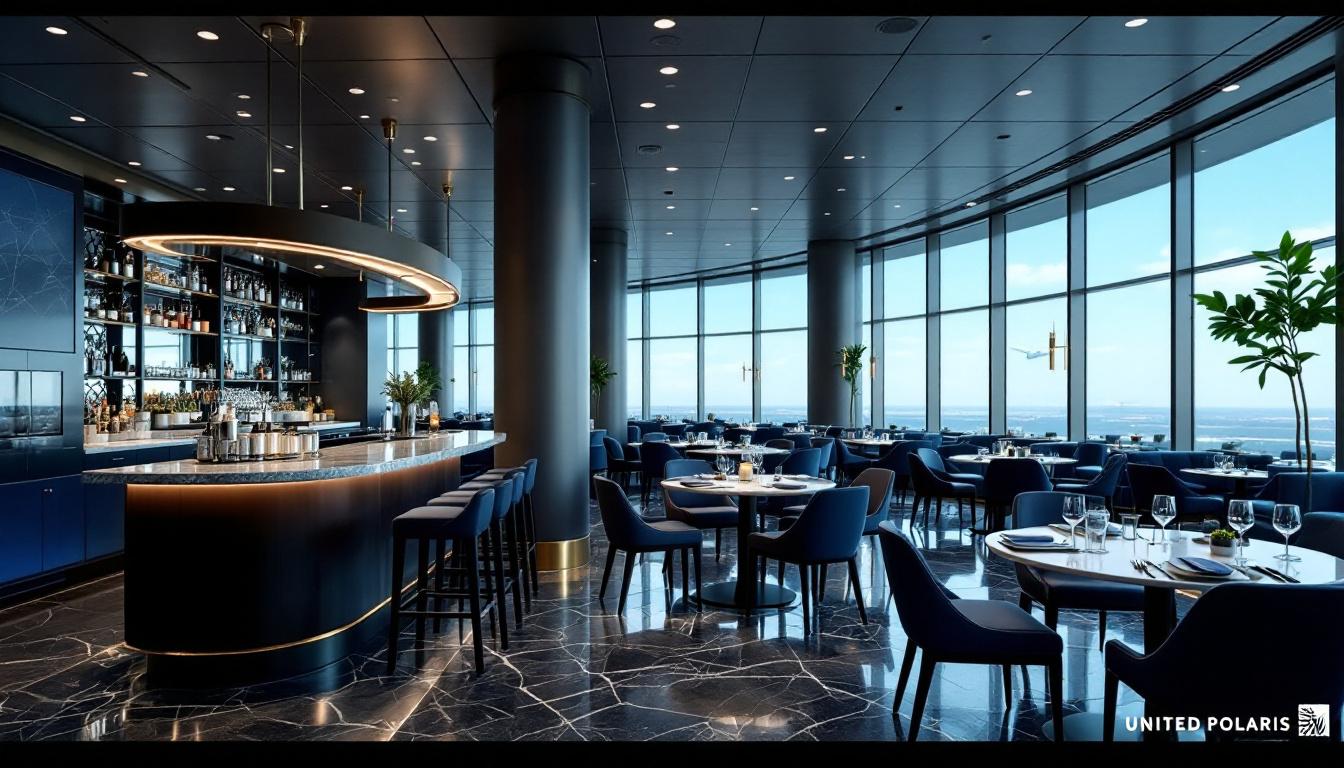
United Airlines was the first US legacy carrier to roll out a dedicated long-haul international business class lounge product, with the Polaris Lounge network announced in 2016 and the flagship Chicago facility opening in December 2016. The Polaris network is the most geographically distributed of the three carrier flagship products, with locations at EWR, IAD, IAH, ORD, SFO, and LAX. A seventh Polaris Lounge at SEA was confirmed in the carrier’s late-2024 capital disclosures with a projected 2027 opening, and an eighth at BOS has been periodically referenced but not formally announced.
| United Polaris Lounge | Hub | Opened | Reported Square Footage | Reported Seat Count |
|---|---|---|---|---|
| ORD Terminal 1 | Chicago | December 2016 | ~22,000 | ~400 |
| SFO International Terminal | San Francisco | April 2017 | ~28,500 | ~412 |
| IAH Terminal E | Houston | June 2017 | ~17,000 | ~280 |
| LAX Terminal 7 | Los Angeles | January 2018 | ~13,500 | ~250 |
| EWR Terminal C | Newark | December 2018 | ~27,000 | ~440 |
| IAD International | Washington Dulles | November 2020 | ~13,000 | ~243 |
| SEA Concourse | Seattle | Projected 2027 | TBA | TBA |
The aggregate confirmed Polaris footprint, approximately 121,000 square feet across six locations, is the largest of the three carrier flagship networks and reflects United’s first-mover position. The SFO Polaris Lounge is the largest single Polaris facility and serves the carrier’s transpacific gateway operation; the EWR Polaris is the largest by reported seat count and serves the dense Newark transatlantic departure bank.
Access policy is the closest of the three legacy flagships to Delta’s model: Polaris Lounges admit same-day Polaris business class and international first class passengers, as well as Star Alliance Gold members on qualifying long-haul international itineraries. United consolidated the Polaris access policy in 2018 to exclude domestic business class and most domestic premium products, narrowing the eligible population in a way that has, in the years since, kept Polaris crowding meaningfully below Flagship Lounge levels at comparable hubs.
The IAD Polaris Lounge, opened in late 2020 in the depths of the pandemic disruption, is the smallest of the six confirmed facilities and reflects both the smaller Dulles long-haul operation and the constrained square footage of the existing international concourse. The carrier’s stated commitment to Dulles as a transatlantic and India gateway has not, as of this filing, translated into a material expansion of the IAD Polaris footprint.
The SEA Polaris Lounge is the most significant near-term addition to the network. United operates a meaningful transpacific schedule out of Seattle, with service to Tokyo Narita and a growing complement of Asia-Pacific destinations layered on top of the carrier’s Star Alliance partnerships with All Nippon Airways and Asiana. The Port of Seattle’s capital materials reference Polaris space in the broader SEA Concourse A redevelopment, with the projected opening pushed to 2027 in the carrier’s most recent disclosure.
Among the three legacy flagship networks, Polaris is the most coherent operationally — a function of being the oldest, having had the longest period to standardize, and serving a more tightly-defined access population than American’s Flagship product. It is also, in most independent assessment, the most consistent across locations, with the EWR and SFO facilities setting a floor that the smaller IAD and LAX installations do not materially fall below.
The Card Networks: Centurion at the Inflection Point
The card-issuer lounge networks represent a categorically different inventory problem. Where the carriers control access at the cabin level — a premium ticket gets you in, a paid economy ticket does not — the issuer networks control access through cardmember entitlement, which is a function of cards issued rather than premium cabins sold. American Express’s Centurion Lounge network has, since its 2013 opening at LAS, expanded to include US facilities at ATL, AUS, BOS, CLT, DFW, DEN, HOU, IAH, JFK, LAX, LGA, MIA, MSP, ORD, PHL, PHX, SEA, SFO, and SAN, with a Centurion-branded facility at HNL operating under a slightly different format.
The Centurion network is, by raw US footprint, larger than any single carrier flagship product. The aggregate US Centurion footprint exceeds 350,000 square feet across roughly twenty domestic locations. The eligible-cardmember population, however, has grown faster than the footprint. American Express disclosed in 2023 a tightening of guest access policies and the introduction of a same-day departure requirement that had previously been waived at certain facilities, and in 2024 the issuer further restricted access to within three hours of departure at most US Centurion locations. These access tightenings, layered on the access-policy changes already implemented in 2019 and 2023, reflect the structural reality that Platinum cardmember growth has outpaced lounge square-footage growth by a factor of more than three since 2017.
The Centurion buildout pipeline through 2028, as disclosed in airport-authority filings and the issuer’s own communications, is more modest than the 2017-2022 expansion wave. New US Centurion Lounges in the pipeline include announced facilities at SLC (delivery projected 2026-2027), nominal capital references to a relocated or expanded JFK installation tied to the Terminal 4 redevelopment, and ongoing references to a SAN expansion. The pace is meaningfully below what would be required to restore the cardmember-to-square-foot ratio of 2018, and Amex’s recent communications have made clear that the company views access policy, rather than capacity expansion alone, as the primary mechanism to manage demand.
The fundamental tension for the Centurion network is that the lounge access entitlement has been a marquee marketing feature of the Platinum Card and Business Platinum Card for more than a decade, and the entitlement has been a significant driver of cardmember acquisition. The issuer is reluctant, for understandable reasons, to materially diminish the entitlement, but the eligible population has grown to a level that simply cannot be served at peak times by the existing or near-term footprint at most major hubs. The 2024 introduction of a daypart-specific guest fee at the busiest Centurion facilities is the cleanest recent data point on the structural problem.
Capital One Lounges: A Targeted Build, Operating at Capacity
Capital One entered the proprietary-lounge market in November 2021 with the opening of the DFW Capital One Lounge, followed by DEN in March 2023, IAD in May 2024, and LAS in early 2024. A WAS-area additional Capital One Lounge at IAD, a second LAX-area facility announced in late 2024, and a JFK installation referenced in the issuer’s 2025 cardmember communications round out the disclosed near-term pipeline.
| Capital One Lounge | Hub | Opened | Reported Square Footage |
|---|---|---|---|
| DFW Terminal D | Dallas/Fort Worth | November 2021 | ~10,000 |
| DEN Concourse A | Denver | March 2023 | ~12,400 |
| IAD International | Washington Dulles | May 2024 | ~11,000 |
| LAS Concourse D | Las Vegas | 2024 | ~10,000 |
| LAX (announced) | Los Angeles | Projected 2026 | TBA |
| JFK (announced) | New York | Projected 2026-2027 | TBA |
Capital One’s strategy has been characterized by tight geographic focus and aggressive same-day-access enforcement. The issuer’s published access policy admits Venture X cardmembers within three hours of a confirmed same-day departure, with a guest policy that has been progressively tightened since the network’s launch. Unlike the Centurion network, Capital One’s footprint has been built into a known cardmember population — Venture X launched in November 2021 and the lounge network was scoped against the projected three-to-five year cardmember count rather than retrofitted onto a legacy entitlement.
The shortcoming is that the Venture X cardmember population has grown faster than the issuer’s most aggressive 2021 projections, and the current Capital One Lounge network is reported by the issuer to operate at or near capacity during peak banks at all four open facilities. The DEN installation, in particular, has been the subject of consistent crowding reports during the late-afternoon hub bank, and the issuer introduced a waitlist mechanism at DEN in early 2025 to manage the inflow.
The announced 2026-2027 pipeline at LAX and JFK will materially expand the Capital One Lounge footprint into the two largest US gateways, but the timing of those openings against continued Venture X cardmember growth is the critical variable. If Venture X cardmember count continues to grow at the pace disclosed in Capital One’s most recent earnings calls, the new facilities will be approaching capacity on the day they open.
Chase Sapphire Lounges: The Fastest-Growing Network
Chase’s Sapphire Lounge by The Club network, operated in partnership with the airport-lounge specialist The Club, opened its first US facility at BOS in June 2023, followed by LGA in May 2024, PHX in October 2024, and DCA in March 2025. An IAD installation, an MCO facility, and a second New York-area location have been referenced in Chase’s cardmember communications and airport-authority filings.
| Chase Sapphire Lounge | Hub | Opened | Reported Square Footage |
|---|---|---|---|
| BOS Terminal C | Boston | June 2023 | ~13,000 |
| LGA Terminal B | New York | May 2024 | ~21,000 |
| PHX Terminal 4 | Phoenix | October 2024 | ~12,000 |
| DCA National | Washington | March 2025 | ~10,500 |
| IAD (announced) | Washington Dulles | Projected 2026 | TBA |
| MCO (announced) | Orlando | Projected 2026-2027 | TBA |
| SAN (announced) | San Diego | Projected 2026 | TBA |
The Sapphire Lounge network’s access policy admits Sapphire Reserve and JPMorgan Reserve cardmembers within three hours of a confirmed same-day departure, with a tiered guest entitlement that distinguishes between the two cards. The product has been positioned in cardmember communications as a marquee benefit of the 2024-2025 Sapphire Reserve refresh, and the network’s geographic expansion has accelerated through 2025 in a way that mirrors the early-stage Centurion growth curve of 2014-2017.
The LGA Sapphire Lounge is the largest single facility in the network and operates in the redeveloped Terminal B alongside the Centurion Lounge installation that has been a fixture of the terminal since 2021. The co-location of two issuer lounges in the same terminal at a major New York hub is, in a sense, the cleanest data point on the issuer-arms-race dynamic that has come to characterize the post-2022 lounge build. PHX, the third Sapphire installation, serves a hub at which both American Express (Centurion) and the airline Admirals Club operate substantial existing lounge inventory; the addition of the Sapphire Lounge represents a meaningful net addition to PHX premium lounge capacity rather than a like-for-like replacement.
The 2026-2027 Chase pipeline contemplates approximately 40,000 to 55,000 additional square feet of Sapphire Lounge capacity, contingent on the timing of the IAD, MCO, and SAN openings. If the network reaches twelve US locations by year-end 2027 — a pace within the range of the issuer’s stated ambitions — Chase will operate the third-largest issuer lounge network in the US, behind only Centurion and ahead of Capital One in raw location count.
Priority Pass: The Saturation Problem
Priority Pass, the Collinson Group-owned aggregator that has, for two decades, served as the lounge-access mechanism for the broader US credit-card market, is at the center of the saturation problem the entire premium-lounge category is now experiencing. Priority Pass operates not as a proprietary network but as an aggregator that contracts with third-party operators — airline lounges of foreign carriers, independent contract lounges, and a growing complement of restaurant-credit alternatives — to provide member access. The network claims more than 1,700 participating locations globally, with US coverage including airline lounges of foreign carriers (Lufthansa, Air France, KLM, and others), the Plaza Premium-operated lounges at select US hubs, and a constellation of independent third-party facilities.
The Priority Pass saturation problem is structural. The membership is bundled into a wide and growing range of credit cards, including the entry-level paid-fee Priority Pass Select that comes with Chase Sapphire Reserve, Capital One Venture X, the Citi Strata Elite, and a long tail of mid-tier cards. The US member-card count, while not publicly disclosed in a manner directly comparable to the issuer-proprietary numbers, is estimated by industry analysts to exceed 15 million domestic cards as of year-end 2025.
The participating-lounge supply has not grown in proportion. Several flagship US Priority Pass-affiliated lounges have, since 2018, either exited the Priority Pass network entirely, restricted the daypart during which Priority Pass members may access the facility, or imposed wait-time mechanisms that effectively ration access. The Plaza Premium-operated facility at YYZ, while Canadian, set the template for daypart-restricted Priority Pass access that several US-based operators have subsequently adopted. At US hubs including LAX, JFK, and SFO, the practical experience of a Priority Pass cardmember attempting to access a participating lounge during peak departure banks has become, in independent surveys, materially worse than it was in 2019.
The restaurant-credit substitution mechanism — under which Priority Pass members may, in lieu of lounge access, claim a meal credit at a participating airport restaurant — has been the issuer’s primary response to the supply-demand gap. The restaurant credit network has expanded materially since 2021, with participating US restaurants exceeding 80 locations as of late 2025 according to Priority Pass’s own listings. The mechanism functionally redistributes member traffic away from the most-saturated lounges but does not address the underlying structural problem, which is that the headline marketing entitlement (lounge access) is increasingly de-coupled from the daily-realized member experience.
For corporate travel managers, the implication is that Priority Pass entitlement bundled into a corporate-card product cannot be relied upon as a meaningful premium ground experience at most major US hubs during peak banks. The entitlement may have real economic value at smaller airports and during off-peak windows, but as a baseline component of a corporate travel program at a major hub, the gap between marketing entitlement and practical access has widened to a point that warrants formal disclosure in program documentation.
Plaza Premium and the Independent Operators
Plaza Premium Group, the Hong Kong-based independent lounge operator that has been the largest non-carrier, non-issuer lounge operator globally for more than a decade, has expanded its US footprint materially since 2022. Plaza Premium operates US lounges at JFK, LAX, IAH, and a small set of regional hubs, with several of those facilities operating under the Plaza Premium First or Plaza Premium Lounge sub-brand and participating in the Priority Pass network during designated dayparts.
The company’s stated US expansion plan, articulated in 2024 communications, contemplates a doubling of the US lounge footprint by 2028, with announced or referenced facilities at additional gateway hubs including a possible second installation at IAH and references to expansion at ATL and SEA. The Plaza Premium model is functionally different from the carrier and issuer networks: the company operates lounges that may be accessed through a combination of Priority Pass entitlement, walk-up paid access, third-party network partnerships, and dedicated airline-passenger contracts. The pricing model and the access mechanism vary by location, and the daypart-specific Priority Pass restrictions referenced in the preceding section apply to certain Plaza Premium facilities.
The independent-operator segment, of which Plaza Premium is the largest single player, also includes Airport Dimensions (the operator of the The Club brand and the underlying operator of the Chase Sapphire Lounge facilities), Swissport’s Aspire Lounge brand in select US markets, and a long tail of independent and regional operators. The aggregate independent-operator US footprint is the most fragmented segment of the market and the most variable in terms of service standard, but it represents a meaningful percentage of the total domestic Priority Pass-accessible inventory.
Hub-Level Audit: Where the Gap Is Widest
The hub-by-hub view is the most useful frame for understanding the inventory-versus-demand gap. The following table summarizes the audited count of major premium lounge installations at each of the eleven busiest US gateway hubs as of March 2026, including carrier flagship products, full-service airline business-class lounges (where they exist as separate products from the flagship offering), and the four primary issuer-proprietary networks.
| Hub | Carrier Flagship | Carrier Business | Centurion | Capital One | Chase Sapphire | Plaza Premium | Net Status |
|---|---|---|---|---|---|---|---|
| JFK | Delta One; AA Flagship | Several | 1 | Planned 2026-27 | N/A | 1 | Over-saturated peaks |
| LAX | Delta One; AA Flagship; Polaris | Several | 1 | Planned 2026 | N/A | 1 | Over-saturated peaks |
| EWR | N/A (Polaris) | Polaris feeders | N/A | N/A | N/A | N/A | Constrained |
| ORD | AA Flagship; Polaris | Several | 1 | N/A | N/A | N/A | Over-saturated peaks |
| ATL | N/A | Sky Club intensive | 1 | N/A | N/A | N/A | Under-served (premium) |
| DFW | AA Flagship | Several | 1 | 1 | N/A | N/A | Adequately served |
| MIA | AA Flagship | Several | 1 | N/A | N/A | N/A | Over-saturated peaks |
| SFO | Polaris | Several | 1 | N/A | N/A | N/A | Adequately served |
| IAH | Polaris | Several | 1 | N/A | N/A | 1 | Adequately served |
| IAD | Polaris | Several | N/A | 1 | Planned 2026 | N/A | Improving |
| BOS | Delta One | Several | 1 | N/A | 1 | N/A | Adequately served |
The pattern that emerges from the hub-level view is that the three largest gateway hubs — JFK, LAX, and ORD — are the most consistently over-saturated, with multiple carrier flagship products and at least one major issuer network all serving overlapping eligible-passenger populations within a finite physical concourse footprint. The next tier — MIA, EWR, DFW, SFO, IAH — is more mixed, with some hubs (DFW, SFO) reasonably served by their carrier flagship product and a single issuer network, and others (MIA, EWR) showing peak-bank saturation despite a meaningful carrier flagship presence.
The most striking finding is the relative under-service of ATL on the premium-lounge dimension. ATL is the busiest US airport by passenger volume and serves as Delta’s primary global hub, but the carrier’s premium ground strategy at ATL is anchored on the Sky Club network rather than a dedicated Delta One Lounge product. Delta has not formally committed to an ATL Delta One Lounge, despite the airport’s clear strategic importance to the carrier’s long-haul international growth plan. The Centurion Lounge at ATL is the only major issuer-network presence, and the facility has been the subject of consistent peak-bank crowding reports since its 2014 opening.
A second under-served hub is EWR, where United’s Polaris Lounge is the dominant premium offering and there is no Centurion, Capital One, or Chase Sapphire installation. The EWR Polaris is among the largest single facilities in the Polaris network, but the absence of issuer-proprietary alternatives means that EWR-based travelers without same-day Polaris eligibility have meaningfully fewer premium ground options than their counterparts at JFK or LGA. The 2025 closure of certain Priority Pass-affiliated EWR facilities has further constrained the available inventory at the Newark hub.
A third category is the hub at which the relative supply has improved materially since 2023 but remains structurally constrained. IAD falls into this category, with the addition of the Capital One Lounge in 2024 and a planned Chase Sapphire installation in 2026 substantially expanding the issuer-network footprint, but the absence of a Centurion presence at the hub remaining a notable gap.
The 2026-2028 Buildout Pipeline
The aggregate 2026-2028 buildout pipeline across the four major lounge categories, based on disclosed capital plans and airport-authority filings as of March 2026, contemplates approximately 28 to 34 new or expanded premium lounge installations at the eleven major US gateway hubs. The total incremental square footage is estimated at between 320,000 and 410,000 square feet, depending on the timing of several pending announcements.
Carrier flagship additions in the pipeline include the Delta One Lounge at SEA (projected 2026), a referenced but not formally announced Delta One installation at ATL, the United Polaris Lounge at SEA (projected 2027), and a referenced but not formally announced Polaris facility at BOS. The American Airlines Flagship network has not, as of this filing, disclosed new locations in the 2026-2028 window, though airport-authority filings reference Flagship-branded square footage at PHL that could plausibly translate to a sixth Flagship Lounge by 2027 or 2028.
Issuer-network additions include the announced Capital One Lounges at LAX (projected 2026) and JFK (projected 2026-2027), the Chase Sapphire Lounges at IAD, MCO, SAN, and additional referenced locations through 2027, and a more modest Centurion Lounge pipeline that includes the SLC installation projected for 2026-2027 and several referenced expansions and relocations at existing locations. Plaza Premium has disclosed an intention to double the US footprint by 2028, though specific location announcements have been more measured than the aggregate-level commitment.
The pipeline, in aggregate, will materially expand US premium lounge inventory through 2028. The critical question is whether the pace of expansion is sufficient to close the supply-demand gap that has widened since 2022, and the answer, based on the demand projections for premium-cabin enplanements and the issuer cardmember growth rates referenced in the demand-curve section of this audit, is almost certainly no. The pipeline will arrest the rate at which the gap is widening at certain hubs and may close it modestly at hubs (IAD, DCA) that are receiving multiple new installations within a 24-month window. At the most-saturated hubs (JFK, LAX, ORD), the pipeline is unlikely to materially improve the peak-bank experience.
Implications for Corporate Travel Programs
For corporate travel managers, the audit yields several actionable conclusions.
First, premium lounge access cannot be reliably provisioned through a single mechanism at the most-saturated US gateway hubs. A corporate program that historically relied on a single corporate-card lounge entitlement to provide ground access at JFK, LAX, and ORD is, in 2026, providing a materially diminished experience to traveling employees during peak banks. The supplemental mechanism — paid same-day access, premium-cabin booking, status-driven access — is no longer a redundancy but a baseline component of the premium ground experience at major hubs.
Second, the gap between the marketing entitlement printed on a corporate card and the realized in-terminal experience has widened to a point that warrants formal disclosure in traveler-facing program documentation. Priority Pass, specifically, should be characterized in corporate program materials as a contingent rather than guaranteed mechanism at major US hubs during peak departure banks.
Third, the carrier flagship lounges — Delta One, AA Flagship, and United Polaris — remain the most reliable premium ground experience at the hubs where they operate, but the underlying access entitlement (a long-haul international business class ticket on the operating carrier, or oneworld/SkyTeam/Star Alliance equivalent) is materially more expensive than the issuer-card entitlement. Travel programs that have historically optimized exclusively for ticket cost will find that the realized premium-traveler experience increasingly diverges from the lowest-fare equivalent.
Fourth, the 2026-2028 pipeline will reshape the relative attractiveness of certain hubs from a premium ground perspective. The IAD additions, in particular, materially improve the premium-ground experience at a hub that has historically been under-served, and travel programs that have routed transatlantic and India-bound traffic through IAD on cost grounds will find the experience differentially improved against a JFK or EWR alternative.
Fifth, the carrier flagship products at SEA — both the projected Delta One Lounge and the projected United Polaris Lounge — will materially elevate the premium-ground experience at a hub that has been a notable transpacific gateway gap. Travel programs operating significant transpacific traffic should incorporate the SEA elevation into 2027 routing optimization.
Closing Frame
The US premium lounge inventory is at an inflection point. The 2024-2025 carrier flagship buildout, while substantial in aggregate square footage, has been absorbed by the parallel growth in premium-cabin enplanements at the most-affected hubs, and the issuer-network expansion has been outpaced by the underlying cardmember growth at the three issuers most invested in the proprietary-lounge category. The 2026-2028 pipeline will continue to expand the footprint but will not close the structural supply-demand gap at the most-saturated hubs.
For corporate travel programs, the practical conclusion is that premium ground access at major US gateway hubs is no longer a baseline commodity that can be provisioned through a single corporate-card entitlement. The premium ground experience has, in effect, recapitulated the trajectory of the premium air cabin itself: a category that was once a quiet benefit has become a strategic differentiator, with the gap between the best and the median experience widening rather than narrowing.
The inventory audit is, in this sense, a leading indicator of the broader recompositioning of the premium air-and-ground product into a tiered system that more closely tracks the underlying value of the eligible-traveler population. The institutional travel buyer’s role is to read the inventory accurately and to allocate program resources against the realized experience rather than the marketed entitlement. The data, as audited above, supports that allocation with more granularity than at any previous point in the network’s history.
Frequently Asked Questions
Which US hub is the most over-saturated for premium lounge access in 2026?
By the audited inventory-to-eligible-passenger ratio, JFK, LAX, and ORD are the three most consistently over-saturated US gateway hubs during peak departure banks. At each, multiple carrier flagship products and at least one major issuer network all serve overlapping eligible-passenger populations within a finite concourse footprint, with the result that peak-bank wait times, daypart restrictions, and access-policy tightening have all been documented in 2024 and 2025. The 2026-2028 pipeline will add capacity at all three hubs but is unlikely to materially close the peak-bank gap at JFK or LAX. ORD’s situation will depend on the timing and scale of any additional carrier flagship expansion that has not yet been formally announced.
Is ATL really under-served on premium lounges given that Delta operates such a large hub there?
ATL is under-served on the dedicated premium-flagship dimension. Delta’s premium ground strategy at ATL is anchored on the Sky Club network, which serves a much broader access population than the Delta One Lounge product, and the carrier has not formally committed to an ATL Delta One Lounge despite the airport’s clear strategic importance. The Centurion Lounge at ATL is the only major issuer-network presence, and crowding at the facility has been the subject of consistent reporting since its 2014 opening. Travelers eligible for Delta One service through ATL receive a materially different ground experience than they would at JFK, LAX, BOS, or LGA, where the Delta One Lounge product is available.
How meaningful is the Priority Pass entitlement at major US hubs in 2026?
The Priority Pass entitlement has, at most major US hubs, materially diminished as a reliable mechanism for premium lounge access during peak departure banks. Daypart-specific restrictions, participating-lounge exits from the network, and the underlying mismatch between member-card count and participating-lounge supply have all contributed to a gap between the marketed entitlement and the practical realized experience. The Priority Pass restaurant-credit substitution mechanism, which has expanded materially since 2021, provides an alternative but functionally redistributes member traffic away from the lounges rather than addressing the underlying supply constraint. For corporate travel programs, Priority Pass entitlement bundled into a corporate-card product should be characterized as a contingent rather than guaranteed mechanism at major US hubs.
What is the difference in access policy between Delta One Lounge and United Polaris Lounge?
The two products operate on materially similar access policies, with both restricted to same-day long-haul international business class passengers on the operating carrier (Delta One in Delta’s case, Polaris in United’s case) and the equivalent business cabin on partner alliance carriers (SkyTeam in Delta’s case, Star Alliance in United’s case). Neither product extends access to status holders without a qualifying premium-cabin ticket, and neither extends access downward from the flagship product to the broader airline-club product (Sky Club for Delta, United Club for United). The Polaris policy is marginally more permissive in its treatment of long-haul international first class on certain partner carriers, but for most practical purposes, the two products operate on equivalent access models. AA Flagship Lounge, by contrast, admits a broader eligible population through the ConciergeKey and oneworld Emerald status channels.
Which 2026-2028 buildout will have the largest impact on a corporate travel program?
The IAD additions — Capital One Lounge in 2024 and the projected Chase Sapphire installation in 2026 — collectively represent the most material improvement to a previously under-served hub within the audit window. Corporate programs that have routed transatlantic and India-bound traffic through IAD on cost grounds will find the premium ground experience differentially improved against a JFK or EWR alternative, and the addition of the Sapphire Lounge will close a meaningful issuer-network gap at the hub. The projected Delta One Lounge at SEA and the projected United Polaris Lounge at SEA, both in the 2026-2027 window, will jointly elevate the premium-ground experience at a transpacific gateway that has historically been served primarily by Sky Club and United Club. Travel programs operating significant transpacific traffic should incorporate the SEA elevation into 2027 routing optimization.
Should a corporate travel program invest in multiple card-based lounge entitlements to cover gaps in coverage?
The audit supports the view that no single issuer-network entitlement provides reliable coverage at all major US gateway hubs in 2026, and corporate programs should structure traveler-facing card entitlements around a layered approach that combines at least one major issuer-network entitlement (Centurion via the Business Platinum Card, Capital One via Venture X Business, or Chase via Sapphire Reserve) with carrier-flagship eligibility for the highest-priority international routes. The relative value of the issuer-network entitlements varies by hub: Centurion provides the broadest geographic coverage but the most saturated peak experience; Capital One and Chase Sapphire provide a less saturated experience at the hubs where they operate but a narrower geographic footprint. The optimal program structure is a function of the underlying traveler routing pattern, which should be audited against the hub-level inventory table at least annually.