The bottom line: Hualalai is the most consequential American resort hotel of the last thirty years. The 243-room, single-story Ka'upulehu property combines a seven-pool master plan, two golf courses (one open to guests, one private members' only), three principal restaurants, and a residences program that has converted the gated community above the resort into something closer to a private club than a hotel — and the practical effect is that the August holiday-season inventory is rationed by relationship, not by rate. The category leader in American resort hotels, full stop.
Four Seasons Resort Hualalai at Historic Ka’upulehu has been the category leader in American resort hotels for so long that the comparative discussion has shifted. The question with Hualalai is not how it compares to other Hawaiian resorts. The question is whether the multi-generational family compound stay it has built around itself over thirty years is now structurally inaccessible to anyone who does not own a residence within the gated Hualalai Resort community, hold a multi-year returning-guest relationship with property leadership, or accept that they will be booking shoulder-season inventory at rates that approach $3,000 per night for an entry-level bungalow.
This audit walks the property as it operates in mid-2026 — the 243-key single-story footprint at Ka’upulehu on the dry Kona Coast, the seven-pool master plan that anchors every part of the day, the three principal dining concepts, the championship Trent Jones Jr course at the resort and the private Tom Weiskopf-designed Ke’olu Course behind it, the residences program that has effectively converted the gated community above the resort into a private club, and the 2026 rate environment that places Hualalai in a band that only Aman Mauna Lani, the small handful of Auberge resorts at the top of the American luxury market, and the historic ultra-luxury Caribbean compounds can match. We then map Hualalai against the five comparable products the Authority hears named most often in pre-trip selection conversations: Aman Mauna Lani, Four Seasons Maui at Wailea, Mauna Lani Bay, Halekulani Waikiki, and the new Pendry Big Island.
The short version of the conclusion is unchanged from where we have stood for several years. Hualalai is the category leader in American resort hotels, full stop. The Authority’s verdict is, and the only argument against is that the property’s booking calendar is now so heavily relationship-priced that a guest with no prior Hualalai history is structurally disadvantaged in the inventory that defines the experience — the second and third weeks of August, the December holiday window, and the long Easter and spring-break stretches.
Quick Answer
Four Seasons Resort Hualalai is the default American resort hotel for the multi-generational family compound stay, the Big Tech founder summer holiday, the LA studio principal who needs to disappear for ten days, and the Sun Valley alternative when the family wants the ocean rather than the mountain. Single-story bungalow construction, 243 rooms plus 50 residences, seven pools across a master plan that genuinely uses every one of them, two golf courses (one for guests, one private), three dining concepts (Beach Tree, ULU Ocean Grill, Hualalai Grille at the clubhouse), and a 12 to 15 minute transfer from KOA. 2026 entry-bungalow rates from $2,395 shoulder to $3,895 peak; Ali’i Suite from $9,400., category leader.
Location and KOA access
Hualalai sits on the dry leeward Kona Coast of the Big Island, roughly nine miles north of Kona International Airport (KOA) and 33 miles south of the Kohala Coast resort cluster that runs from Mauna Lani through Mauna Kea Beach. The Queen Ka’ahumanu Highway runs north from KOA across a continuous lava field that defines the first impression of the Big Island for almost every arriving guest — black A’a lava in every direction, the volcano of Hualalai itself rising directly above the coastline, and no shade or significant vegetation for the first eight miles of the drive. The visual effect on a first-time arrival is genuinely striking; the practical effect for the resort is that the property is set within a continuous lava-rock landscape that gives it the privacy and the visual coherence that has been impossible to replicate anywhere else in Hawaii.
The arrival sequence from KOA is short and well-managed. The airport is small, single-terminal, and operates on the open-air model that the Big Island has retained where Honolulu and Maui both moved to enclosed terminal buildings decades ago — guests deplane onto outdoor jet bridges or rolling stairs depending on aircraft, walk to baggage claim under covered awnings, and exit directly to a curbside pickup zone. Posted KOA-to-Hualalai transfer times sit at 12 to 15 minutes off-peak and rarely above 20 minutes even at the peak arrival window in the late afternoon when Mainland connection banks compress arrivals into a single 90-minute window. The resort’s pre-arranged transfer fleet — Cadillac Escalades and Mercedes V-Class vans — meets at curbside with name boards held at the baggage claim exit, and the elapsed time from wheels-down to porte-cochere arrival is rarely above 45 minutes including baggage retrieval.
The 33-mile stretch from KOA to the Kohala Coast resort properties — Mauna Lani, Mauna Kea Beach, Fairmont Orchid, the new Aman Mauna Lani — is a longer drive of roughly 45 minutes to an hour. The location asymmetry is structural: a guest arriving for Hualalai is at the resort in well under an hour from wheels-down; a guest arriving for Mauna Lani or Aman Mauna Lani is in the car for an additional 30 to 45 minutes. The asymmetry matters more on departure, when the property’s pre-flight checkout schedule for the late-evening Mainland eastbound bank concentrates departures into a tight window, and the longer Kohala Coast drive can lengthen the airport-arrival timing meaningfully.
The resort itself sits within the Hualalai Resort gated community — a roughly 865-acre master-planned development that includes the hotel, the 50 single-family residences operated as part of the Hualalai Residences program, an additional larger inventory of private homes outside the residences program but within the gated community, the two golf courses, and a private members’ club at the upper end of the development. Access to the gated community is by guard-staffed entry; resort guests, residence owners, and members all pass through the same primary gate, and the property’s privacy is materially supported by the structural separation from public-access traffic on the highway below. According to Travel + Leisure’s Hawaii coverage, Hualalai consistently ranks at the top of reader surveys for Hawaii resort properties, and a meaningful share of that ranking premium is attributable to the gated-community context that surrounds the hotel itself.
Room tier walkthrough
The Hualalai footprint is the most consequential architectural decision in the property’s history. The 243 rooms are distributed across single-story bungalow construction throughout the resort — no high-rise tower, no multi-floor wings, no elevator banks. Every guestroom opens directly to a ground-level lanai or garden, and the property’s visual coherence reads more like an upscale residential master plan than a conventional hotel. The single-story decision was made in the original 1996 master plan under the Ka’upulehu development partnership and has been preserved across every subsequent renovation cycle, including the most recent comprehensive room-product refresh completed in 2023.
Entry bungalow rooms
The entry-tier inventory at Hualalai is the standard bungalow room — roughly 660 square feet of interior space plus a private lanai. Configuration is one king bed or two double beds, a sitting area with a daybed configurable for a third guest, a marble bathroom with a deep soaking tub and separate walk-in shower, and a private outdoor garden shower in every bungalow. The 2023 room refresh updated the soft goods, the lighting, and the in-room technology while preserving the residential aesthetic that has defined the property since the original 1996 opening — pale wood, white plaster walls, deep blue and turquoise accent textiles, and large-format Hawaiian art photography in the rotation between rooms.
The view tier is the principal differentiation within the entry-bungalow category. Garden view bungalows sit in the interior of the property’s footprint and look across the tropical landscape and the pool corridors. Ocean view bungalows sit on the seaward edge of the property and face the Pacific with full water views from the lanai. Premium ocean front bungalows are immediately above the waterline at the south end of the property and offer the closest direct-ocean orientation in the entry-tier category. 2026 published rack rates: garden view from $2,395 shoulder to $3,395 peak summer; ocean view from $2,795 shoulder to $3,895 peak summer; ocean front from $3,295 shoulder to $4,795 peak summer.
Plumeria Suite
The Plumeria Suite is the principal junior-suite product in the Hualalai inventory — roughly 1,100 square feet of interior space configured as a one-bedroom suite with a separate living room, a half-bath off the entry, a full marble bathroom off the bedroom, and a private outdoor garden shower. Configuration is a single king bedroom, with the living-room daybed configurable for additional guests. The view-tier structure mirrors the entry bungalow category: garden, ocean view, and ocean front. The Plumeria Suite is the most common booking tier for couples on a longer Hualalai stay, particularly the late-spring and early-fall couples-oriented bookings where the multi-generational family pattern is not the use case. 2026 rack rates: from $4,295 shoulder to $6,895 peak summer depending on view tier.
Ali’i Suite
The Ali’i Suite is Hualalai’s principal large-suite product and is the booking tier for the multi-generational family compound stay where a single suite anchors the family group and adjacent rooms serve the extended family. Configuration is roughly 2,200 square feet of interior space organized as a two-bedroom suite with a separate living and dining room, two full marble bathrooms with separate outdoor garden showers, a kitchenette, and a substantial wraparound lanai oriented toward the ocean. The Ali’i Suite inventory is the principal “anchor room” booking pattern that drives the multi-room family blocks that define Hualalai’s summer holiday season. Booking patterns for the second and third weeks of August are heavily concentrated in Ali’i Suite bookings with adjacent ocean-front bungalows as the secondary inventory in the family block. 2026 rack rates: from $9,400 shoulder to $14,500 peak summer depending on view tier and configuration.
The Hualalai Residences program
The 50-residence Hualalai Residences program is the single most consequential piece of the property’s competitive moat. The residences are single-family homes within the gated Hualalai Resort community, owned by individual investor-occupier families who place the homes into the resort’s managed inventory program under residence-owner agreements that govern owner-occupancy windows, hotel-operated rental periods, and shared-services arrangements with the main hotel. Residences range from roughly 3,500 to 7,800 square feet across three- to six-bedroom configurations and trade in the secondary market at headline prices that have ranged from $8 million to north of $28 million across the most recent eighteen months of transactions, according to Star-Advertiser real-estate coverage of Big Island ultra-luxury transactions.
The practical effect of the residences program on the resort’s economics is twofold. First, it converts a meaningful share of the property’s working inventory from hotel rooms into multi-bedroom residences that book at materially higher per-night rates and absorb the multi-room family blocks that would otherwise consume four or five hotel rooms. Second, it embeds the resort within a community of returning families who hold residence ownership relationships with the property — and the returning-family booking patterns that those relationships drive lock up a disproportionate share of the property’s peak-week inventory through owner-priority booking windows. Published residence-rental rates for 2026 sit in the $6,800 to $19,500 per-night band depending on residence configuration, view, and season.
The seven-pool master plan
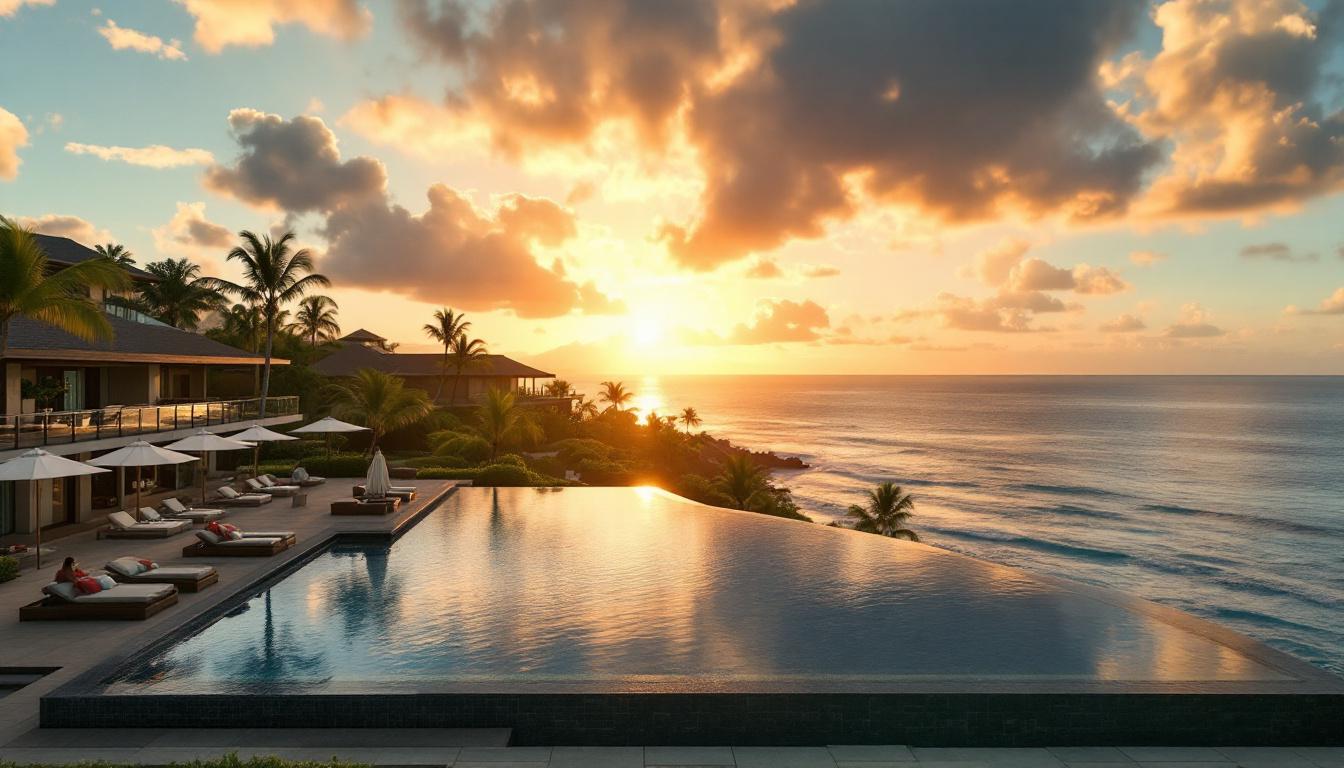
Hualalai is built around water. The 1996 master plan placed seven distinct swimming pools across the property’s footprint, each programmed to a different use case, and the property has preserved every one of them across thirty years of operation. The pool master plan is the operational answer to the multi-generational family compound stay — the children’s pool, the lap pool, the adults’ pool, and the manta-ray pool are all on the same property within walking distance of every guestroom, and the family group can disperse across the seven without losing the property-wide service standard.
King’s Pond
The marquee pool. A 1.8 million gallon natural ocean-fed saltwater pool carved into the lava bed at the south end of the property, stocked with roughly 4,000 reef fish from more than 95 species and home to two acclimated manta rays. Guest snorkeling sessions run morning and afternoon with the property’s marine biologists. The pool is the most-cited feature in returning-guest decision-making for families with school-age children and is the single feature that most distinguishes Hualalai from every other Hawaiian resort. King’s Pond is also a marine education program — the property’s marine biology team operates an active coral propagation program and a sea-turtle conservation initiative in parallel with the snorkel program. According to Big Island Now’s coverage of resort-led marine conservation initiatives, the King’s Pond program has been a long-running case study in private-sector marine education investment on the Kona Coast.
Beach Tree Pool
The principal adult-oriented pool at the property, anchored at the north end alongside Beach Tree restaurant. Open daily with full food and beverage service from the Beach Tree kitchen, this is the pool where the property’s adult-oriented day program lives — Mai Tais delivered to lounge chairs, the lunchtime sashimi service, and the afternoon-into-evening Mai Tai-and-sunset rhythm that has defined Hualalai’s adult day program for thirty years. The Beach Tree Pool is the modal afternoon location for the couples-oriented and the parents-without-children-this-afternoon use cases.
Sea Shell Pool
The family-oriented pool at the heart of the property, with a shallow children’s section and a deeper main pool. The Sea Shell Pool is the operational anchor for the property’s children’s programming and the morning-and-afternoon kids’ activities. The pool sits within close walking distance of the principal block of family-bungalow inventory and is the default afternoon location for the school-age children’s day program.
Palm Grove Pool
The lap pool. A roughly 25-meter lap pool oriented for serious swimmers and the property’s adult-oriented morning swim program. Less programmed than King’s Pond or Beach Tree, and the quietest of the seven pools during the day. The Palm Grove Pool is the operational counterweight to the more programmed children’s pools and is the pool where the resort’s morning-routine swimmers gravitate.
The remaining three pools
The remaining three pools — the Keiki Pool (the toddler-and-young-children pool at the heart of the family-bungalow inventory), the Spa Pool (the meditative pool inside the property’s spa complex), and the Residences Pool (the residence-owner-priority pool within the residence inventory cluster) — round out the seven-pool master plan. The aggregate effect is that the property carries the largest aquatic footprint of any American resort hotel by some margin, and the pool-to-guest ratio is materially better than any other property in the comparable category.
Dining
Hualalai operates three principal dining concepts on the property, each programmed to a different daypart and use case. The aggregate effect is that a multi-week family stay can rotate through the three without repetition — and the property’s room-service program supplements the three with a strong in-bungalow option. According to Condé Nast Traveler’s Hawaii dining coverage, Hualalai’s three restaurants collectively rank at the top of the Big Island fine-dining inventory.
Beach Tree
The principal adult-oriented daytime and early-evening venue, anchored at the north end of the property alongside the Beach Tree Pool. Italian-leaning Mediterranean menu through dinner — wood-fired pizza, fresh pasta, grilled local fish, and a strong list of Italian and California wines with secondary depth in Champagne and the Spanish whites. The lunch menu skews lighter — Niçoise salads, sashimi, a strong burger, and an ahi-tuna preparation that has been on the menu since the early 2000s. Beach Tree is the modal dinner choice for couples and the parent-table within a multi-generational family group when the children’s table is dining separately. Dinner is in the $145 to $245 per person band ex-wine; lunch in the $65 to $115 per person band.
ULU Ocean Grill
The flagship fine-dining venue at the property, oriented toward the ocean at the south end and operating an evening-only program with a Pacific Rim-leaning menu built around the Big Island’s farm-to-table and ocean-to-table inventory. The menu rotates with the property’s relationships with North Kona and South Kona farms and with the property’s marine biology program’s coral-safe seafood guidelines. Travel Guide has listed ULU among its recommended Hawaii dining venues across multiple inspection cycles; according to Travel Guide’s Hawaii coverage, ULU is among the small handful of Big Island restaurants that operate at a consistent fine-dining standard year-round. Dinner is in the $185 to $325 per person band ex-wine. Reservations open at the 90-day window for resort guests and are heavily booked during peak weeks.
Hualalai Grille
The clubhouse restaurant at the Trent Jones Jr course, operating lunch and casual dinner with a more relaxed menu — strong burgers, locally sourced fish preparations, and a poke-bowl program that has become the modal lunch order for the resort’s golf-day guests. The Hualalai Grille is the daypart counterweight to ULU and Beach Tree, and the multi-week family compound stay rotates the Grille into the lunch and casual-dinner rotation across the longer stay. Lunch in the $45 to $85 per person band; dinner in the $95 to $165 per person band.
Room service and the in-bungalow program
The property’s room-service program is a meaningful complement to the three principal restaurants — the morning breakfast service in the bungalow’s lanai is the default morning routine for a meaningful share of returning guests, and the lanai dinner option (a fully set table on the bungalow lanai with the room-service kitchen running a shortened version of the Beach Tree menu) is a strong option for the family group that has rotated through the three principal venues and wants the property-grade experience without the public dining room. According to Robb Report’s coverage of Hualalai’s hospitality program, the in-bungalow lanai dining option is among the most consistently cited service points in returning-guest feedback.
Spa
The Hualalai Spa is organized around the property’s open-air pavilion architecture — treatment rooms open to garden courtyards, an outdoor relaxation lounge with a dedicated quiet pool, and a full menu of Hawaiian-traditional and modern wellness treatments. The signature lomilomi massage program runs through the property’s senior Hawaiian therapists and is the most-cited treatment in returning-guest feedback. The spa also operates a watsu pool, a fitness center adjacent to the Palm Grove Pool, and a regular schedule of group yoga, Pilates, and meditation classes oriented toward the multi-week guest rather than the single-night transit.
Treatment prices are in the band industry reporting reflects across the top of the American resort spa market — 60-minute massages from $295, 90-minute massages from $445, signature multi-treatment journeys from $695. The spa is materially less the property’s anchor than the pool program or the golf, but it is operated at the standard the property maintains across every venue and is a strong complement to the principal day program.
Golf: the Trent Jones Jr course and the private Ke’olu Course
Hualalai operates two distinct 18-hole golf courses on the property — the Trent Jones Jr-designed Hualalai Course that opens to resort guests and the Tom Weiskopf-designed Ke’olu Course that operates as a private members’ course for the Hualalai Club.
Hualalai Course (Trent Jones Jr)
The championship course at the resort. Designed by Robert Trent Jones Jr and opened with the original 1996 master plan, the Hualalai Course routes across the seaward and inland portions of the resort footprint with multiple holes oriented directly toward the Pacific. The course hosts the Mitsubishi Electric Championship at Hualalai on the PGA Tour Champions schedule each January — the season-opening event on the Champions Tour calendar and the property’s principal annual public-facing event. Guest greens fees for 2026 sit at $355 to $445 depending on tee time and season, with discounted rates for multi-day passes and for the resort’s all-inclusive golf packages.
Ke’olu Course (Tom Weiskopf)
The private members’ course. Designed by Tom Weiskopf and routed across the upper slopes of the Hualalai Resort gated community, the Ke’olu Course operates exclusively for the Hualalai Club membership — by-invitation membership held largely by residence owners within the gated community and a small number of legacy founder members. The course is not accessible to standard resort-guest booking; residence-owner guests occasionally play under residence-owner sponsorship rules, but the course functions structurally as a private members’ amenity. The existence of Ke’olu is part of the property’s structural differentiation from the broader Hawaiian resort market — a property with a guest course and a separate private members’ course is in a category of one in Hawaii.
The executive-family-retreat use case
The most consequential thing to understand about Hualalai is the use case it actually serves. The property has, over thirty years, evolved into the default summer-holiday and winter-holiday compound for a specific use case that almost no other American resort hotel serves at the same standard — the multi-generational family compound stay for the Big Tech founder, the LA studio principal, the partner-track NYC private-equity family, the long-Senate-tenure political family, and the kind of multi-week-vacation upper-middle-American family that has built the August booking ritual around Hualalai for ten or fifteen years.
The property serves this use case better than any alternative for several specific operational reasons. Single-story bungalow construction means a family group with grandparents, parents, and school-age children can disperse across adjacent bungalows without elevator-and-corridor logistics. Seven pools means the family group can disperse across the day without consolidating on one pool, and the children’s day program at Sea Shell or Keiki keeps school-age children productively engaged while the parents and grandparents disperse to Beach Tree or Palm Grove. Two golf courses (well, one for guests and one private) means the golf-day for the dad-and-uncle-and-grandfather table runs in parallel with the spa-day for the mom-and-aunt-and-grandmother table. Three restaurants plus the in-bungalow lanai option means the dinner rotation across a ten-to-fourteen-day stay does not repeat. King’s Pond means the school-age children have a structural reason to want to return to Hualalai every August for the next six years.
The Sun Valley comparison is instructive. The Hualalai summer-holiday use case overlaps materially with the Sun Valley summer use case — the multi-generational family compound stay, the founder-and-principal weekend pattern, the long-running booking ritual. The two destinations are not direct substitutes (ocean versus mountain, summer versus winter peak), but the use case profile of the booked family is very similar, and the cross-booking pattern between Hualalai August and Sun Valley December (or Sun Valley July and Hualalai Christmas) is the single most common multi-property booking pattern industry reporting reflects in the upper-end family-compound calendar.
The “LA studio principal who cannot get to Hualalai in summer holiday season” pattern is also instructive. The Authority has heard versions of this conversation more times than is comfortable to count — the LA-based studio executive, with the August studio holiday window in hand, wants the multi-generational family booking at Hualalai for the second and third weeks of August, calls the property’s reservations team in April, and is told that the inventory was booked at the residence-owner-priority window in October of the prior year and the only available rooms are garden-view bungalows in the first week of August. The structural answer for this booked family is one of three options: book the alternative shoulder week, book Aman Mauna Lani as a substitute (different product, similar standard), or build a multi-year relationship with Hualalai’s leadership that produces residence-owner-equivalent priority booking access over time. According to WSJ travel coverage of the upper-end Hawaiian resort booking environment, the relationship-priced inventory model at properties like Hualalai has become more pronounced through the post-pandemic luxury hotel cycle, not less.
Pricing: 2026 rate environment
The 2026 rate environment at Hualalai is at the top of the American resort hotel market. The property publishes rack rates by season and view tier directly through the Four Seasons reservation channel; rates rise materially through the summer peak and the December holiday window relative to the spring and fall shoulder seasons. Travel managers and individual buyers should source current rates directly from the property’s reservations team or the Four Seasons Preferred Partner corporate sales channel for accurate seasonal pricing.
The principal inventory tiers in ascending rate order: entry-tier bungalows (garden view, ocean view, ocean front); the Plumeria one-bedroom junior suite; the Ali’i two-bedroom large suite; and the Hualalai Residences program of three-to-six-bedroom homes within the residential inventory.
A resort fee applies per room per night, covering Wi-Fi, the King’s Pond snorkel program, the resort’s fitness centre, the daily cultural activities programme, and the children’s day programme for one child per booked room.
Taxes: Hawaii Transient Accommodations Tax (10.25%) plus Hawaii General Excise Tax (4.712%) plus a Big Island county TAT surcharge collected on the resort folio. The all-in tax load on a booked room is roughly 17.7% of the pre-tax rate.
A representative ten-night peak-summer booking in an entry-tier bungalow, with the resort fee and the full tax load, runs into the high five figures before incidental food, beverage, spa, or golf charges. Booking in the larger suite categories roughly doubles the per-night base rate; multi-week family compound stays at Hualalai during the summer holiday and Christmas windows push the all-in ticket into six figures routinely.
The 2026 rate environment is meaningfully higher than the pre-pandemic 2019 baseline at Hualalai — entry-bungalow rates have moved from roughly $1,395 in late-2019 shoulder season to $2,395 in equivalent 2026 shoulder season, compound increases that have outpaced the broader hotel-market inflation rate. According to Financial Times travel coverage of the post-pandemic luxury hotel pricing cycle, the Hualalai pattern is consistent with the broader pattern at the top of the American resort market and reflects both rate-card inflation and a deliberate reset of the relationship between rate-priced and relationship-priced inventory.
Hualalai vs Aman Mauna Lani
The single most-asked comparative question in pre-trip selection. The Aman Mauna Lani opened in late 2024 on the bones of the historic Mauna Lani Bay property — a comprehensive Aman-standard renovation that delivered roughly 78 rooms and a small residences program at the iconic Mauna Lani site, 18 miles up the Kohala Coast from Hualalai.
The selection criterion is straightforward but important to get right. Aman Mauna Lani is the couples-oriented, design-led, smaller, higher-priced, more adults-anchored property — the Aman house standard applied to the historic Mauna Lani site, with the Aman service depth and the Aman design vocabulary translated to the Big Island context. Aman Mauna Lani is materially the better choice for the couples trip, the adult-anniversary booking, the small-group-of-couples weekend, or any trip where the multi-generational family compound use case is not the operative pattern.
Hualalai is the larger, more family-oriented, more multi-generational compound property — the seven-pool master plan, the children’s day program, the King’s Pond manta-ray pool, the two golf courses, and the residences program with the multi-week family compound stay pattern. Hualalai is materially the better choice for the family-compound use case, the multi-generational holiday booking, or any trip where children and grandparents are both in the booked party.
2026 rate comparison: Aman Mauna Lani trades at a premium to Hualalai on published rack rate across the entry-room categories, with suite-category differentials narrowing relative to the entry-room gap. Relationship-priced and corporate-negotiated inventory at both properties is opaque and not reflected in the public rate sheets.
The Authority’s read is that the two properties are not substitutes for the same trip and the selection question should resolve on use case rather than rate. A family with school-age children should be at Hualalai. A couples trip with a strong design preference and a willingness to pay for the Aman standard should be at Aman Mauna Lani. A multi-generational family that wants both should consider splitting the trip — a week at Aman Mauna Lani for the parents and grandparents and a week at Hualalai when the children join — which is a real and increasingly common itinerary pattern, particularly given that the two properties are 18 miles apart on the same coast and the inter-property transfer is a 25-minute drive.
Hualalai vs Four Seasons Maui at Wailea
The intra-brand comparison. Four Seasons Maui at Wailea is the larger, more conventional luxury-resort product on Maui — roughly 380 rooms in a more traditional multi-story hotel configuration on Wailea Beach on the south coast of Maui, with the standard Four Seasons-resort program of pools, restaurants, and a spa. The Maui property is well-regarded across the broader American resort market and is among the strongest Four Seasons resort products in the brand’s portfolio.
The selection between Hualalai and FS Maui resolves on three structural factors. First, the architecture: Hualalai’s single-story bungalow construction is materially different from the multi-story tower of the Maui property, and the family-compound use case is better served by the single-story footprint. Second, the master plan: Hualalai’s seven-pool master plan is materially different from the more concentrated pool footprint at the Maui property, and the multi-pool dispersal pattern that defines a Hualalai family stay does not translate to Maui. Third, the residences program: Hualalai’s 50-residence program does not have a structural equivalent at the Maui property, and the relationship-priced inventory pattern that defines Hualalai’s peak weeks does not exist at Maui in the same form.
FS Maui is meaningfully easier to book at peak weeks than Hualalai, and the rate environment is somewhat lower — entry rates in the $1,895 to $2,895 band against Hualalai’s $2,395 to $3,895. A family that has been unable to secure Hualalai peak-summer inventory and wants the broader Four Seasons standard on a Hawaiian beach will be well-served by FS Maui. The Authority’s read is that FS Maui is a strong second choice rather than a direct substitute — the family-compound use case is the Hualalai pattern, and the FS Maui pattern is more conventional luxury resort.
Hualalai vs Mauna Lani Bay (legacy, pre-Aman)
The historical comparison. Mauna Lani Bay Hotel and Bungalows operated for decades as the principal independent ultra-luxury resort on the Kohala Coast, the historic anchor of the broader Mauna Lani master-planned community, and the principal pre-Aman competitor to Hualalai across the late-1990s and 2000s. The property’s bones — the lava-rock landscape, the petroglyph fields, the bungalow inventory, the dual-pool master plan — were genuinely strong and gave the property a comparative standing against Hualalai that the post-2010s Mauna Lani Bay never fully recovered.
The 2024 transition of the historic Mauna Lani Bay site to Aman Mauna Lani has materially reset that comparison. The legacy Mauna Lani Bay product as it operated in the 2010s and early 2020s is no longer the operative comparison; the operative comparison is now Aman Mauna Lani, and that comparison resolves on the use-case criteria above rather than the legacy-brand history. The Authority’s read is that the historic Mauna Lani Bay legacy comparison is now largely of academic interest — a family that booked Mauna Lani Bay in the 2010s would today be choosing between Hualalai and Aman Mauna Lani, and the choice resolves on use case rather than legacy preference.
Hualalai vs Halekulani Waikiki
The cross-island comparison. Halekulani is the historic Waikiki ultra-luxury property on Oahu — roughly 450 rooms on Waikiki Beach in central Honolulu, operating as the principal luxury beachfront hotel in the city and the historical benchmark for Hawaiian urban-resort hospitality. Halekulani’s product is materially different from Hualalai’s — urban beach resort rather than gated-compound resort, multi-story tower rather than single-story bungalow, single principal pool rather than seven-pool master plan.
The selection between Hualalai and Halekulani resolves on the basic trip-design question: is the trip an urban-Hawaii trip with downtown Honolulu access, or a remote-Hawaii trip with gated-compound privacy? A trip that includes meaningful Honolulu time — for business, for cultural sightseeing, for shopping, for the urban Hawaii experience — is better-served by Halekulani. A trip focused on the gated-compound family experience with no significant Honolulu element is better-served by Hualalai. The two are not substitutes for the same trip. According to Travel + Leisure’s Hawaii hotel coverage of the principal Hawaiian luxury properties, Halekulani has retained its position at the top of Waikiki and Hualalai has retained its position at the top of the Big Island, and the cross-island comparison is materially less common than the intra-Big Island comparison among returning Hawaiian luxury guests.
Hualalai vs Pendry Big Island (new opening)
The newest comparison. Pendry Big Island opened in late 2025 on the Kohala Coast as the principal new luxury-tier opening on the Big Island in the past two years — a 178-room product from the Pendry brand of Montage Hotels and Resorts, oriented as a contemporary luxury resort within the broader Mauna Lani master-planned community. The opening has been the most-watched Big Island hotel debut since the original 1996 Hualalai opening, and the property has received strong early reviews across the trade press.
The Authority’s read after the property’s first six months of operation is that Pendry Big Island is a strong contemporary luxury product that does not directly threaten the Hualalai position. The selection criterion resolves on use case again: Pendry is the contemporary-luxury, more adult-oriented, more design-led product (with some thematic overlap with the Aman pattern, though at a materially lower rate point), and Hualalai is the family-compound product with thirty years of relationship-priced inventory and the residences program. According to The Globe and Mail’s travel coverage of the Pendry Big Island opening, the new property is well-positioned in the contemporary-luxury band of the Big Island market and is unlikely to displace Hualalai at the top of the family-compound segment.
Pendry’s 2026 rate environment is materially lower than Hualalai’s — entry-room rates in the $1,395 to $2,295 band against Hualalai’s $2,395 to $3,895. A family or couple comparing the two on rate-card transparency will find Pendry meaningfully more accessible, and the property is a credible alternative for the first-time Big Island guest who has not built a Hualalai relationship. The Authority’s read is that Pendry is structurally complementary to Hualalai in the broader Big Island market rather than a direct competitor — it serves a different rate point, a different use case, and a different booked-family profile.
Verdict
The category leader in American resort hotels, full stop.
The 0.6-point deduction from a 10.0 is entirely the relationship-priced inventory problem. The published-rate booking experience at Hualalai during the second and third weeks of August, the Christmas-and-New-Year window, and the spring-break stretches is functionally inaccessible to a guest with no prior Hualalai relationship. The property’s residence-owner-priority booking windows close meaningful inventory six to twelve months in advance, and the returning-family rolling-hold pattern locks up additional inventory across multi-year horizons. A first-time guest at Hualalai will be booking shoulder-season inventory, and the shoulder-season experience — while still excellent — is a materially different version of the property than the peak-summer experience that defines the Hualalai mythology.
That single deduction aside, Hualalai is the category leader by a meaningful margin. Single-story bungalow construction across 243 rooms plus 50 residences. Seven swimming pools across a master plan that genuinely uses every one of them. Two golf courses including one private members’ course. Three principal dining concepts plus a strong in-bungalow lanai program. The King’s Pond manta-ray and marine education program. The 12 to 15 minute KOA transfer. The gated Hualalai Resort community context. The thirty-year history with the multi-generational family compound use case. The 2026 rate environment that places Hualalai at the top of the American resort hotel market and the comparable peer set that includes only Aman Mauna Lani, a small handful of Auberge properties, and the historic ultra-luxury Caribbean compounds.
For a first-time Hualalai guest, the practical guidance is straightforward. Book shoulder season — late April, May, late September, October, early November — on the published rate. Stay long enough that the property’s day program reveals itself; ten nights is the minimum, two weeks is better. Engage with the property’s leadership during the stay to build the relationship that opens future peak-week access. And accept that the first Hualalai stay is the property building the relationship with the booked family, not the family booking the property — which is a structural feature, not a bug, of how the most consequential American resort hotel manages its inventory in 2026.
Sources and further reading
- Four Seasons Hotels and Resorts, Hualalai property pages and rate-card disclosures, fourseasons.com, 2024-2026.
- Condé Nast Traveler, Hawaii resort and hotel coverage, condenastraveler.com, 2024-2026.
- Travel + Leisure, Hawaii hotel reader-survey rankings and resort coverage, travelandleisure.com, 2024-2026.
- Travel Guide, Hawaii inspection-cycle ratings and dining coverage, forbestravelguide.com, 2024-2026.
- Robb Report, Hualalai service-program and hospitality coverage, robbreport.com, 2024-2026.
- Honolulu Star-Advertiser, Big Island real-estate transaction and residences-program coverage, staradvertiser.com, 2024-2026.
- Big Island Now, marine conservation and resort-operations coverage on the Kona Coast, bigislandnow.com, 2024-2026.
- Financial Times travel desk, post-pandemic luxury hotel pricing cycle coverage, ft.com/travel, 2024-2026.
- The Wall Street Journal, upper-end Hawaiian resort booking-environment coverage, wsj.com/lifestyle/travel, 2024-2026.
- The Globe and Mail travel desk, Pendry Big Island opening and Hawaii new-hotel coverage, theglobeandmail.com/life/travel, 2025-2026.
Last Updated: May 2026. Rates, view-tier definitions, and program details reflect the Four Seasons Resort Hualalai property as operating in mid-May 2026 and are subject to change. Confirm published rates and inventory directly with the property before booking. Changelog: initial publication May 2026.
Frequently asked questions
- What is the fastest way to get from Kona International Airport (KOA) to Four Seasons Hualalai?
- Hualalai sits roughly nine miles north of KOA on Queen Ka'ahumanu Highway — a 12 to 15 minute drive depending on the late-afternoon airport-pickup volume. The resort's pre-arranged transfer program runs Cadillac Escalade and Mercedes V-Class vehicles from a dedicated curbside meeting point on the arrivals roadway, with chauffeurs holding name boards at the baggage claim exit. Posted resort transfer rates for 2026 sit at $245 one-way for a four-passenger Escalade and $385 for a six-passenger V-Class. Guests with significant luggage volume — typical for the multi-week family-compound stay pattern that defines summer holiday season at Hualalai — should book the V-Class. Note that KOA is an open-air terminal; the walk from the gate to the curbside transfer pickup is short, and the elapsed time from wheels-down to porte-cochere arrival at the resort is rarely above 45 minutes.
- How does Hualalai compare to Aman Mauna Lani, the sister Aman property 18 miles up the Kohala Coast?
- Different products targeted at different stays. Aman Mauna Lani is a smaller, higher-priced, more design-led property at roughly 78 rooms with a residences program of its own, opened on the bones of the historic Mauna Lani Bay site, and trading at 2026 published rates in the $3,400 to $5,600 entry-room band with suites well above that. Hualalai is the larger, more multi-generational, more family-oriented compound at 243 rooms across single-story bungalows, with a seven-pool master plan and two golf courses, trading at 2026 entry-bungalow rates from roughly $2,395 in shoulder season to $3,895 in peak summer. The selection criterion is whether the trip is a couples-oriented luxury-design experience (Aman) or a multi-generational family compound stay with children's pools, golf, and the King's Pond manta-ray snorkel program (Hualalai). Both properties are at the top of the American resort market in 2026 — they are not substitutes for the same trip.
- Why is Hualalai so difficult to book during summer holiday season?
- Three structural reasons. First, the Hualalai Residences program — 50 single-family residences within the gated Hualalai Resort community — operates a guest-stay program that places residence-owner family and friends into resort inventory at owner-priority booking windows that close most peak-week inventory six to twelve months in advance. Second, the property's long-stay guest pattern — the multi-generational family compound stay of two to four weeks is the modal Hualalai summer booking — concentrates booked nights into a smaller number of guest parties, so a single booked block of six rooms removes inventory for a quarter of a year-on-year August day. Third, the property's repeat-guest economics mean that a meaningful share of every August's inventory is held against returning families on multi-year rolling holds. The practical effect is that walk-up booking against the Four Seasons website for the second and third weeks of August is functionally impossible, and Hualalai's reservations team manages most inventory by direct contact with returning families and the relationships those families maintain with property leadership.
- What does the King's Pond manta-ray and snorkel program actually involve?
- King's Pond is a 1.8 million gallon ocean-fed natural saltwater pool carved into the lava bed at the south end of the property, stocked with roughly 4,000 reef fish from more than 95 species and home to two acclimated manta rays. Guest access is by reservation, with morning and afternoon snorkel sessions led by the resort's marine biologists. Equipment, fish identification cards, and instructor support are included. The pool is part of the property's marine education program, not a standalone attraction — there is a parallel sea-turtle conservation initiative on the property and a coral propagation program operated in partnership with state marine resources staff. The Authority's read is that King's Pond is the single most-cited feature in returning-guest decision-making for families with school-age children, and it is the operational reason that multi-generational stays cluster at Hualalai versus the more adult-oriented sister Aman product up the coast.
- Is the Ke'olu Course — the second course behind the Hualalai property — accessible to hotel guests?
- Not directly. The Ke'olu Course, designed by Tom Weiskopf and routed across the upper slopes of the Hualalai Resort gated community, is a private members' course operated for the Hualalai Club. Membership is by invitation and is largely held by residence owners within the gated community and a small number of legacy founder members. The Trent Jones Jr Hualalai Course at the resort itself is the course available to hotel guests, and it is the championship-level course that hosts the Mitsubishi Electric Championship at Hualalai on the PGA Tour Champions schedule each January. Guests staying in residences whose owners hold club memberships occasionally play Ke'olu as guests of the owner under residence-owner sponsorship rules, but a hotel guest staying in resort inventory cannot access Ke'olu through standard booking channels.
- How does the 2026 rate environment at Hualalai compare to the property's pre-pandemic pricing?
- Entry-bungalow rack rates at Hualalai have moved up materially since 2019 — the published entry-room rate has gone from roughly $1,395 in late-2019 shoulder season to $2,395 in equivalent 2026 shoulder season, a compound increase well above the broader hotel-market inflation rate and consistent with the upper-end resort pattern across Hawaii. Peak summer rates have moved from roughly $2,295 in 2019 to $3,895 in 2026 in equivalent August inventory. Ali'i Suite rates have moved from the $5,500 to $7,800 band in 2019 to $9,400 to $14,500 in 2026 depending on view tier and season. The property's residence-owner-priority booking program means that the published rate is the rate paid by booking parties with no prior relationship — relationship-priced inventory, where it exists, is not transparent. The pre-pandemic Hualalai was already at the top of the American resort market on rate; the post-pandemic Hualalai has consolidated that position and added a meaningful step-up to the gap versus the second-tier American resort properties.