
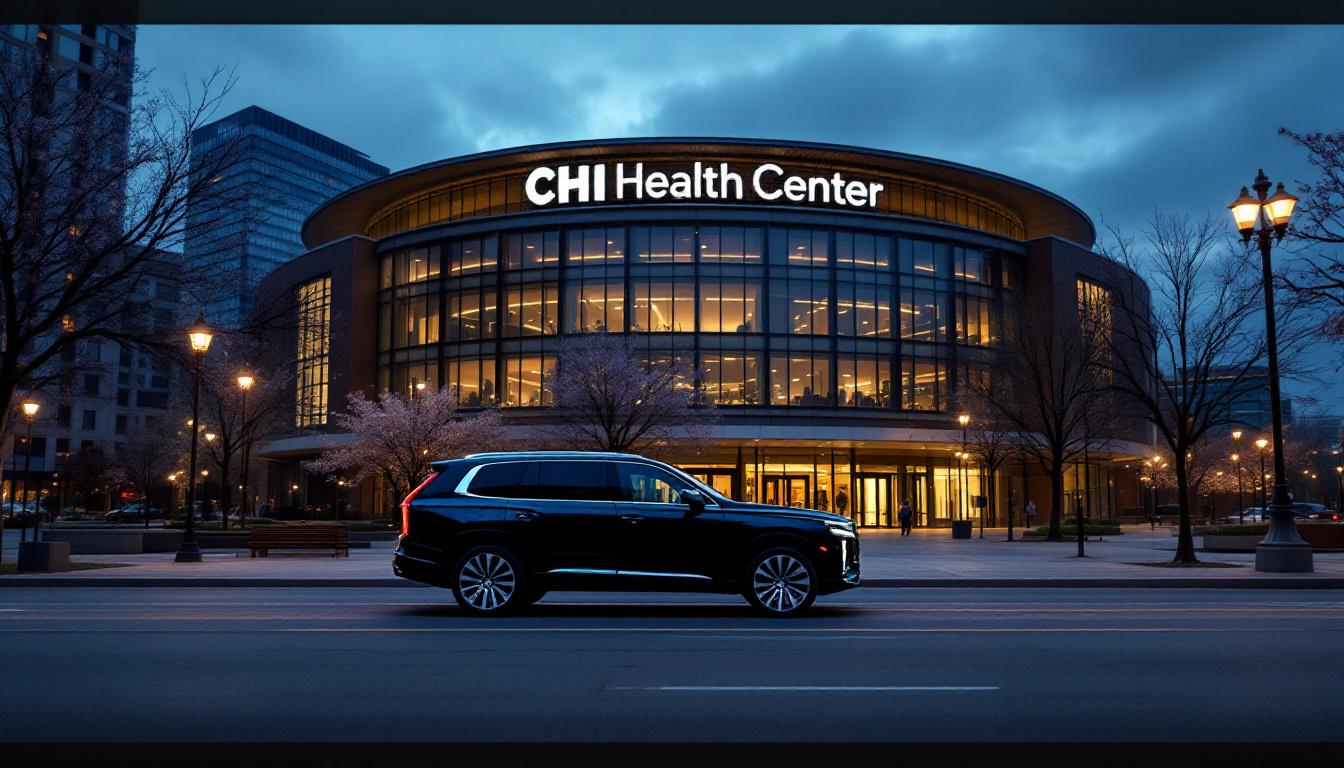
The Berkshire Hathaway Annual Meeting is, by every operational metric that matters to a corporate travel desk, the densest single-weekend institutional convergence in the American interior. For one Saturday in the first weekend of May, a Midwestern metropolitan area of roughly 985,000 absorbs an inbound population that the host company has, in past years, sized at approximately 40,000 attendees inside the CHI Health Center arena and across overflow space. The 2025 meeting, the first since the announced succession of Greg Abel to the chief executive role at year-end, drew capacity-tier turnout. The 2026 meeting will be the first full annual cycle under the new operating cadence, and demand intelligence from corporate access desks, family office travel coordinators, and institutional investor relations teams indicates that pricing, lift, and ground-side capacity will price as if 2025 demand has not softened.
This brief is written for the institutional reader: the buy-side travel coordinator booking a six-person research team out of Boston, the family office principal flying in private from Teterboro, the IR office at a Berkshire portfolio subsidiary fielding analyst requests, and the corporate access team at a sell-side broker organizing a multi-night Omaha schedule built around the meeting plus three to four sidebar dinners. It is not a tourist guide. It assumes the reader already knows what the meeting is, why it matters, and why the question of where to sleep in Omaha is, for one weekend, a meaningful capital-allocation question.
The 2026 Demand Pattern: What History Tells the Forward Book
The mechanics of Berkshire weekend demand are unusual in two respects. First, the demand is geographically concentrated to a degree that few annual meetings replicate. Unlike a J.P. Morgan Healthcare Conference, which absorbs across the whole of San Francisco and into peninsula cities, or a Davos delegation, which fans out across the Engadin valley, Berkshire weekend demand collapses into a roughly six-square-mile footprint defined by the CHI Health Center on the north riverfront, the Old Market entertainment district to the south, and a narrow band of premium hotels along Dodge Street and the riverfront. Second, the demand is highly inelastic. Institutional attendees are not optimizing for hotel rate; they are optimizing for proximity to the arena and to the sidebar dinner circuit. Rate-sensitivity is concentrated almost entirely in the retail shareholder cohort, which routes to suburban and cross-river properties in Council Bluffs and west Omaha.
The result is a bifurcated booking market. The downtown core’s premium and upper-upscale hotel inventory begins clearing roughly nine to eleven months ahead of the meeting weekend, with institutional repeat-bookers holding standing reservations year-over-year. Suburban inventory remains transactable inside 60 days. The pricing differential across that boundary is the single largest variable a travel desk can model.
| Demand cohort | Typical hotel zone | Booking horizon | Rate ceiling sensitivity |
|---|---|---|---|
| Tier-1 institutional (multi-billion AUM) | Downtown core, walking distance to CHI Health Center | 9 to 11 months | Low; proximity dominates |
| Family office and HNW principals | Downtown core or private rental | 6 to 12 months | Low; experience dominates |
| Sell-side corporate access teams | Downtown core, blocks of 8 to 20 rooms | 8 to 10 months | Medium; block economics matter |
| Mid-tier institutional and RIA | Downtown periphery, midtown | 4 to 7 months | Medium |
| Retail shareholder pilgrims | West Omaha, Council Bluffs, Lincoln | 30 to 90 days | High |
| Day-trip attendees from regional metros | None (drive-in) | 0 to 30 days | N/A |
The implication for an institutional travel desk building a 2026 program now is that the downtown premium tier is, in practice, a closed market by the end of the prior calendar year. Any team approaching booking inside ninety days is buying from the secondary release, the cancellation pool, or the periphery. This is not a function of total hotel supply in metropolitan Omaha, which is substantial. It is a function of the geographic concentration of demand inside a walking-distance radius of a single arena.
OMA Airport Capacity and the Connection-Routing Question
Eppley Airfield (OMA) is, by Federal Aviation Administration enplanement classification, a small-hub primary commercial service airport. The Omaha Airport Authority reported approximately 5.7 million total passengers in calendar year 2024, with passenger traffic recovering past pre-pandemic peaks. For 51 weekends of the year, OMA operates with comfortable headroom against scheduled capacity. For the Berkshire weekend, headroom inverts.
The structural constraint is straightforward. OMA is served by the major U.S. legacy carriers and by a rotating low-cost cohort, but the airport has no transcontinental long-haul service and a limited international footprint. Inbound institutional flow from the East Coast routes either nonstop on the limited daily New York-area, Boston, and Washington-area schedules, or connects through Chicago O’Hare (ORD), Minneapolis-St. Paul (MSP), Dallas-Fort Worth (DFW), or Denver (DEN). Inbound flow from the West Coast routes primarily through DEN, Phoenix (PHX), or, for premium-cabin originating San Francisco and Los Angeles passengers, through MSP or DFW depending on carrier loyalty.
For the meeting weekend, the binding constraint is not OMA’s runway capacity. It is seat inventory on the connecting bank into OMA from each of those hubs on Friday afternoon and Friday evening, plus the equivalent outbound Saturday afternoon and Sunday morning banks. Inventory pricing follows accordingly.
| Origin metro | Optimal routing | Booking pattern observed | Premium-cabin availability inside 60 days |
|---|---|---|---|
| New York area (JFK, LGA, EWR) | Nonstop where available; ORD or MSP connect | Books out 10 to 14 weeks ahead | Limited to none in nonstop |
| Boston (BOS) | ORD or MSP connect; limited seasonal nonstop | Books out 8 to 12 weeks ahead | Limited |
| Washington area (DCA, IAD, BWI) | ORD or DFW connect | Books out 8 to 10 weeks ahead | Limited |
| Chicago (ORD, MDW) | Nonstop (multiple daily) | Books out 6 to 10 weeks ahead | Constrained but achievable |
| San Francisco Bay (SFO, SJC, OAK) | DEN or MSP connect | Books out 10 to 14 weeks ahead | Limited |
| Los Angeles basin (LAX, BUR, LGB) | DEN, PHX, or DFW connect | Books out 8 to 12 weeks ahead | Limited |
| Dallas (DFW) | Nonstop (multiple daily) | Books out 4 to 8 weeks ahead | Achievable |
| Atlanta (ATL) | Nonstop or single-connect | Books out 6 to 10 weeks ahead | Limited |
| Toronto (YYZ, YTZ) | ORD or MSP connect | Books out 10 to 14 weeks ahead | Limited |
| London (LHR) | One-stop via ORD or ATL | Books out 12 to 16 weeks ahead | Achievable in premium long-haul, constrained domestic leg |
The connection-routing question — ORD versus MSP for the East Coast institutional flow — is the most-debated tactical decision on corporate travel desks every spring. The ORD case is straightforward: the most frequent OMA service from a single hub, the broadest carrier choice, and the lowest typical fares. The MSP case is operational: ORD’s weather and traffic profile generates a materially higher misconnect rate during the first weekend of May than MSP’s, and for a Friday-afternoon inbound where the principal is presenting at a Friday dinner, the misconnect cost is non-trivial. Several institutional desks now standardize on MSP routing for principals and on ORD routing for back-office and research analyst seats, accepting the higher MSP fare as an operational risk premium.
For the outbound, the Saturday afternoon and Sunday morning banks are oversold in the literal capacity sense. Travel desks that have not booked outbound seats by mid-March of the meeting year routinely find themselves rebooking principals onto private aviation lift on Saturday evening, which is the proximate cause of much of the FBO congestion described later in this brief.
The Premium Hotel Inventory Problem
The shortage is structural, not cyclical. Downtown Omaha’s premium and upper-upscale hotel inventory inside a fifteen-minute walking radius of the CHI Health Center is small relative to the institutional inbound. The cluster of properties most frequently held by institutional repeat-bookers includes the Omaha Hilton (the largest single property directly adjacent to the CHI Health Center via skywalk), the Magnolia Hotel Omaha (an upper-upscale boutique converted from the historic Aquila Court building), the Marriott Downtown Omaha at the Capitol District, and a smaller set of full-service and select-service properties that round out the downtown footprint.
By aggregate room count, the downtown core supports the meeting. By the narrower count of rooms inside what institutional bookers consider an acceptable walking radius and rated at upper-upscale or above, supply is materially below demand. The clearing mechanism is price and booking horizon.
| Property | Approximate room count | Position relative to CHI Health Center | Institutional booking profile |
|---|---|---|---|
| Omaha Hilton (downtown) | ~600 keys | Direct skywalk connection | Heavily blocked by institutional repeat-bookers; clears earliest |
| Marriott Downtown Omaha at Capitol District | ~333 keys | ~0.5 mile walk | Strong institutional and corporate-access demand |
| Magnolia Hotel Omaha | ~145 keys | ~0.7 mile walk | Family office and principal demand; small inventory clears very early |
| Hilton Garden Inn Downtown | ~178 keys | ~0.4 mile walk | Mid-tier institutional and team bookings |
| Hilton Omaha Embassy / select-service downtown | varies | ~0.5 to 1.0 mile walk | Team and research analyst bookings |
| Kimpton Cottonwood Hotel | ~205 keys | ~1.5 miles (midtown Blackstone district) | Increasingly drawn into the downtown booker pool given core shortage |
| Conversion and boutique inventory (Old Market) | varies | ~0.5 to 1.0 mile walk | Principal and family office demand |
The Kimpton Cottonwood inclusion is notable. The property is in the Blackstone district, north of downtown along Farnam Street, and is not within the traditional walking radius. Institutional bookers have nonetheless pulled it into their hold pool over the past several meeting cycles because the downtown premium tier clears so early that there is no remaining principal-grade option in the core after the first quarter. The implication for 2026 booking strategy is that an institutional desk treating the Cottonwood as a fallback rather than a primary option is already too late.
The west Omaha and Council Bluffs inventory — the suburban arc that absorbs retail shareholder demand — is robust, transactable inside ninety days, and priced at a substantial discount to the downtown core. For a research analyst seat where the principal does not need to be in the same hotel, this inventory is operationally fine. For a principal-grade booking, the ground transit complication of moving between a west Omaha hotel and the CHI Health Center on Saturday morning is the disqualifying factor. Saturday morning ground traffic on the Dodge Street corridor and the I-480 approach to the arena is the second-most-discussed tactical problem on corporate travel desks, after the connection-routing question.
Private Aviation at Eppley Airfield: The FBO Congestion Reality
For the institutional cohort flying private, the meeting weekend is one of the most operationally constrained FBO events on the U.S. business aviation calendar outside of Super Bowl weekend and the Masters. Eppley Airfield hosts two fixed base operators: Signature Flight Support and Million Air, both occupying the general aviation ramp on the west side of the airfield. Both FBOs operate with substantial ramp capacity for ordinary weekend traffic and both reach saturation on Berkshire weekend.
The functional bottleneck is not ramp space in the abstract; it is parking position for aircraft that arrive Friday and remain on the ground through Saturday afternoon or Sunday morning departure. Both FBOs publish parking-permit procedures for the meeting weekend, both impose advance-reservation requirements, and both routinely direct overflow aircraft to remote parking, to reposition flights to Lincoln (LNK), Council Bluffs (CBF), Fremont (FET), or, for the largest cabin-class aircraft, to Offutt Air Force Base for joint-use parking by prior arrangement.
| Constraint dimension | Mitigating practice |
|---|---|
| Friday inbound slot availability | Reserve via FBO 90 to 120 days in advance; confirm aircraft type and tail number |
| Saturday parking position | Plan a Friday-morning drop-and-reposition to LNK or CBF; return for Saturday outbound |
| Crew accommodation | Block crew rooms at downtown or west Omaha properties at FBO contract rate |
| Fuel uplift | Pre-arrange contract fuel; expect surcharge windows over the meeting weekend |
| Ground transport from FBO to downtown hotel | Pre-book; the meeting weekend Uber and ride-hail capacity is saturated |
| Customs and international arrivals | OMA has limited general aviation customs capacity; route AOE clearance through ORD or MSP where feasible |
The reposition-to-LNK practice is now standard for many family office and institutional flight departments operating cabin-class aircraft on the meeting weekend. The math is straightforward: a Friday-morning drop at OMA, a fifty-mile repositioning flight to Lincoln Airport, Saturday-morning repositioning back to OMA for an early-afternoon principal pickup, and a Saturday-evening departure. The repositioning cost is modest relative to the ramp-fee structure for multi-day overnight parking at saturated capacity, and the operational flexibility is meaningfully greater. Flight departments running fractional or charter lift face a different calculus, since the operator typically determines parking strategy rather than the principal’s travel desk.
For the international inbound — primarily European family offices and sovereign-adjacent investors — the customs and immigration question routes most traffic through a U.S. point of entry other than OMA. The standard practice is clearance at Teterboro, Bedford, White Plains, or, for West Coast routings, Van Nuys or Long Beach, with a domestic-segment positioning leg into OMA. A small number of operators clear AOE at OMA directly, but the FBO customs capacity is limited and weekend slot availability is constrained.
CHI Health Center Logistics and the Saturday Morning Bottleneck
The CHI Health Center sits on the north riverfront, adjacent to the Missouri River and connected to the Omaha Hilton by an enclosed skywalk. The complex includes the arena (where the formal meeting and Q&A session is held), the convention center (where overflow seating, the shareholder exhibition hall, and product-display floor are located), and parking decks that, on the meeting weekend, fill before sunrise.
The Saturday-morning ingress sequence is the operational pivot point of the entire weekend. Doors open in the early-morning hours and the institutional cohort generally arrives substantially after the retail line forms. The institutional reserved-seating arrangement and the corporate-access early-entry coordination are managed directly by Berkshire Hathaway’s investor relations function for shareholders meeting documented thresholds, and the practical implication for a travel desk is that the principal’s arrival window at the arena is narrower and earlier than a non-institutional attendee would assume.
The Saturday-morning vehicular bottleneck is a three-part problem: the I-480 approach from west Omaha, the surface-street approach from the Old Market and the downtown core, and the bridge approach from Council Bluffs across the Bob Kerrey Pedestrian Bridge corridor and the I-480 bridge. The institutional booking premium for downtown core hotels with skywalk or short-walk access to the arena is, in functional terms, a premium for avoiding this bottleneck. A west Omaha hotel guest leaving for the arena at a time consistent with retail-shareholder ingress will, on a typical meeting Saturday, encounter ground delays that make institutional-tier reserved-seat windows operationally difficult.
| Approach corridor | Typical Saturday morning condition | Mitigation |
|---|---|---|
| Skywalk from Omaha Hilton | Free-flowing | No mitigation required |
| Surface walk from Old Market / downtown core (under 1 mile) | Manageable; some sidewalk congestion | Allow 25 to 35 minutes door to seat |
| Drive-in from west Omaha along Dodge Street | Heavy congestion | Depart 90 to 120 minutes early; consider Council Bluffs park-and-ride alternative |
| Drive-in from Council Bluffs via I-480 bridge | Heavy congestion | Depart 75 to 105 minutes early |
| Ride-hail from any peripheral location | Surge pricing and constrained driver availability | Pre-book where possible; Uber and Lyft both saturate |
The evening sidebar dinner circuit reverses the geometry. By early Saturday evening, the arena has cleared, and the institutional cohort migrates to the Old Market, to a small number of private clubs and event spaces in the downtown core, and to several restaurants that are known repeat venues for sell-side corporate access dinners. The walking-distance density of these venues from the downtown premium hotels is, again, the operational case for paying the downtown-core booking premium.
What Institutional Travel Teams Book Versus Retail Shareholder Pilgrims
The two cohorts are operationally distinct in nearly every booking decision. The retail shareholder pilgrim is making a multi-day discretionary trip and is rate-sensitive across the entire booking funnel — lift, hotel, ground, and dining. The institutional travel team is making a service obligation to a principal and is rate-sensitive only on the seats that are not principal-grade. The shape of the two booking patterns is sufficiently divergent that an Omaha hotelier or FBO can size the inbound roughly by examining the booking horizon and rate elasticity of the inquiry.
| Booking decision | Institutional travel team | Retail shareholder pilgrim |
|---|---|---|
| Air lift | Nonstop where available; premium cabin for principal; refundable fares | Connecting itineraries; basic economy; non-refundable |
| Air booking horizon | 10 to 16 weeks ahead | 6 to 12 weeks ahead |
| Hotel zone | Downtown core within walking radius | West Omaha, Council Bluffs, Lincoln |
| Hotel booking horizon | 6 to 11 months ahead | 30 to 90 days ahead |
| Ground transport | Pre-booked black car or chauffeur; some private security | Ride-hail or rental car |
| Sidebar programming | Multiple private dinners, broker access events, portfolio company meetings | Open shareholder events, walking tours, retail-targeted exhibitor activations |
| Meeting attendance pattern | Selective; principal attends Saturday morning session, departs after Q&A | Full-weekend attendance; arrival Thursday, departure Sunday |
| Departure timing | Saturday late afternoon or evening (often private lift) | Sunday or Monday morning |
The Saturday-late-afternoon institutional departure is the proximate cause of the most acute private aviation departure-slot congestion of the weekend. The institutional cohort is, in aggregate, attempting to leave OMA between roughly 3:00 p.m. and 7:00 p.m. local time on Saturday. Commercial-carrier outbound capacity is fully booked. Private lift is, accordingly, the residual category for any principal who has not pre-booked a commercial seat by mid-March. FBO ramp-clearance and tower-departure-slot capacity both reach their binding constraint in this window. Travel desks that have not planned for it find themselves either holding their principal in Omaha until Sunday morning or absorbing a substantial departure-window premium.
Distance From Premium Hotel Inventory: The Spatial Reality
The single hardest fact for a travel desk arriving late to the booking cycle to accept is that there is no large premium-tier hotel option more than a mile from the CHI Health Center that is operationally acceptable for a principal-grade Saturday-morning arrival. The premium inventory is concentrated, walking-radius accessibility from those properties is the entire operational rationale for paying the booking premium, and the next tier of inventory — west Omaha and Council Bluffs — is operationally a different city on Saturday morning relative to the arena.
This is the spatial reality that drives the institutional booking pattern. It is also why the secondary-market practices that emerge each spring — private home rentals in the Dundee, Field Club, and Memorial Park neighborhoods, corporate-housing block-bookings, and short-term residence rentals in the Old Market — exist. The premium-hotel base is small relative to demand, and the alternative inventory is the marginal substitute.
| Neighborhood | Distance to CHI Health Center | Operational character |
|---|---|---|
| Downtown core (CBD) | 0.0 to 1.0 mile | Walking access; premium hotel concentration |
| Old Market | 0.5 to 1.0 mile | Walking access; dining and boutique-hotel concentration |
| Blackstone district / midtown | 1.5 to 2.5 miles | Short drive; growing premium hotel presence |
| North Downtown (NoDo) | 0.3 to 1.0 mile | Walking access; growing development |
| Dundee | 3.0 to 4.0 miles | Residential; private rental market |
| Field Club | 2.5 to 3.5 miles | Residential; private rental market |
| West Omaha (West Dodge corridor) | 8.0 to 15.0 miles | Drive-only; suburban hotel concentration |
| Council Bluffs | 4.0 to 8.0 miles | Drive-only across the Missouri River |
| Lincoln | ~55 miles | Drive-only; absorbs overflow plus private aviation reposition |
The institutional booking pattern, accordingly, is to hold downtown core inventory year-over-year, to pull from the Blackstone district when the core fills, and to operate from the residential rental market for the most senior principals where the premium-hotel option is operationally inadequate. The retail shareholder pilgrim operates from the west Omaha and Council Bluffs inventory and accepts the Saturday-morning ingress cost.
The 2026 Pricing and Availability Outlook
Forward booking signals from Omaha hotel revenue-management functions, FBO advance-reservation queues, and OMA scheduled-capacity data point to a 2026 demand profile consistent with or slightly above 2025. Several variables are driving this view.
First, the post-succession 2026 meeting is the first full calendar cycle under Greg Abel as chief executive. Institutional curiosity around the operating cadence, capital-allocation framework, and tone of the new annual meeting is high. Sell-side corporate access desks are reporting elevated principal interest in attendance relative to typical cycles.
Second, the broader U.S. business travel demand environment is firm. GBTA’s 2025 outlook on U.S. business travel spending pointed to continued recovery and growth in event-driven travel, and the Omaha CVB has communicated a strong forward meeting and convention book for 2026. The meeting weekend, therefore, is not occurring against a backdrop of soft demand that might create rate flexibility.
Third, OMA’s scheduled commercial capacity into the meeting weekend has, in past cycles, been augmented by additional flights operated by the major carriers — additional gauge on existing routes, occasional additional frequencies — but the additions are modest relative to the inbound demand pulse. The carriers do not stage an Omaha hub for one weekend; they up-gauge where they can and they let pricing clear the market. The 2026 schedule is consistent with this pattern.
Fourth, premium hotel new-supply additions in the downtown core between the 2025 meeting and the 2026 meeting are limited. The downtown Omaha hotel pipeline has additions in the Capitol District and along the riverfront, but the incremental walking-radius inventory delivered before May 2026 is modest. The structural premium hotel shortage is not materially relieved.
Tactical Recommendations for an Institutional Travel Program
The following are the practices most consistently observed among institutional travel teams that operate this weekend successfully year over year.
Hold the downtown core block year-over-year. Properties release prior-year institutional blocks back to revenue management on a defined calendar. The repeat-booker hold for the next cycle is the single most valuable preference an institutional travel desk can maintain. Surrendering the hold to save on rate flexibility is a one-cycle decision with multi-cycle consequences.
Decouple principal lift from team lift. The principal flies on the timing and route that protects the principal’s calendar. The research and back-office team flies on the route that prices efficiently. Bundling the two creates fragility on a connecting-bank misconnect.
Default principal routing to MSP, not ORD, on the East Coast inbound. The ORD weather and traffic risk in the first weekend of May is the dominant operational risk for a Friday-afternoon inbound. The MSP fare premium is the operational risk premium.
Pre-book the Saturday afternoon and evening outbound. Do not let the Saturday outbound become a Saturday-of decision. Commercial capacity is fully booked by the prior week, and the FBO-to-tower departure-slot cascade is not solvable in real time.
Coordinate FBO parking strategy with the flight department in February, not April. If the aircraft is to remain at OMA over Saturday, the parking permit is the gating item. If the aircraft is to reposition to LNK or CBF, the repositioning logistics and crew accommodation need to be set in advance.
Treat ground transport as a pre-booked service, not a ride-hail decision. Ride-hail capacity saturates on Saturday morning and evening. A pre-booked chauffeur or black car operator with multi-day standing service is the resilient solution.
Build the sidebar dinner schedule before the hotel block is set. The downtown core hotel choice should be informed by where the principal’s sidebar dinner schedule will route on Friday and Saturday evening. A Capitol District hotel and an Old Market dinner is a different walk than the inverse.
Sources and Reference Points
The operational picture in this brief draws on the public record around Omaha as the meeting host city, including the Omaha Airport Authority’s published passenger traffic data, the Federal Aviation Administration’s hub-classification framework, the Omaha CVB’s published meeting-economy data, GBTA’s 2025 U.S. business travel outlook, Berkshire Hathaway’s annual meeting attendance disclosures, the CHI Health Center’s published venue capacity and access information, the Omaha World-Herald’s annual coverage of the meeting weekend, the U.S. Bureau of Transportation Statistics on-time and capacity data for OMA, the National Business Aviation Association’s published guidance on FBO operations at high-demand events, the Federal Aviation Administration’s general aviation operations data for OMA, the Eppley Airfield published FBO directory, and the Greater Omaha Chamber’s published downtown hotel inventory data.
Frequently Asked Questions
How early should an institutional travel team be booking downtown Omaha hotels for the 2026 Berkshire meeting?
For a 2026 meeting weekend in the first weekend of May, the practical answer is that the booking window for the downtown core premium tier closed in the late prior calendar year. Institutional repeat-bookers operate on a hold-and-roll basis with the same properties year over year, and the open inventory at the major downtown hotels begins clearing during the previous summer and into the fall. A team approaching booking inside 90 days of the meeting weekend should not expect to find downtown core premium inventory at retail rates; the available channels at that point are the secondary release pool, cancellation inventory, and the corporate-housing or short-term rental market.
Is ORD or MSP the better connection routing into OMA for an East Coast principal?
The operational answer for a principal-grade booking is MSP for the inbound and ORD for the outbound, where the schedule allows. ORD’s weather and traffic profile in the first weekend of May generates a meaningfully higher misconnect rate than MSP’s, and a Friday-afternoon inbound is the highest-stakes leg of the trip from a calendar-protection perspective. The MSP fare premium for the inbound is, in functional terms, an operational risk premium. The outbound Saturday afternoon and evening flow is less weather-exposed and ORD’s schedule density at that window is generally an advantage. For research and back-office team members, ORD inbound is operationally fine and is the typical cost-efficient choice.
What is the realistic private aviation parking strategy at Eppley if we are arriving Friday and departing Saturday evening?
The realistic strategy is to coordinate the FBO parking permit 90 to 120 days in advance and to plan for the possibility of repositioning to Lincoln or Council Bluffs for the overnight. Eppley’s two FBOs both reach saturation on the meeting weekend, and overnight parking positions for cabin-class aircraft are allocated by advance reservation, not by Friday-morning availability. The standard practice for many flight departments is a Friday-morning drop at OMA, a short positioning flight to LNK for the overnight, and a Saturday-morning return to OMA for the principal’s afternoon departure. The repositioning logistics need to be set with the FBO and the flight crew in February or early March.
What are the operational implications of staying in west Omaha or Council Bluffs for a principal who needs to attend the Saturday morning session?
The operational implication is that the Saturday-morning ground transit from a west Omaha or Council Bluffs hotel to the CHI Health Center is heavily congested and difficult to schedule against an institutional reserved-seating window. The Dodge Street corridor and the I-480 approach from the west, and the I-480 bridge approach from the east, both experience peak ingress congestion in the hours leading up to the meeting start. A principal staying outside the downtown core walking radius should plan a substantially earlier departure than the institutional reserved-seating window would otherwise suggest, and the ride-hail capacity to support that departure is itself constrained. The downtown core booking premium is, in functional terms, the cost of avoiding this problem.
How does the corporate-access sidebar dinner schedule affect hotel choice in the downtown core?
The sidebar dinner schedule is a meaningful input into the hotel choice within the downtown core. The Old Market is the densest concentration of restaurants that host sell-side and family office sidebar dinners on Friday and Saturday evenings, and a hotel choice in or adjacent to the Old Market reduces the Friday and Saturday evening ground-movement requirement. The Capitol District has its own concentration of dinner venues and is a strong choice when the schedule is anchored there. The skywalk-connected Omaha Hilton is the optimal Saturday-morning choice for the arena ingress but is a slightly longer evening walk to the Old Market dinner cluster. The right answer depends on the specific schedule the corporate access desk is building, which is why the sidebar schedule should be set before the hotel block is finalized.
What is the right departure-day strategy for a Saturday outbound when commercial seats are fully booked?
The right strategy is to pre-book the Saturday outbound by mid-March of the meeting year, before commercial capacity fully clears. For desks that arrive at the booking decision after commercial capacity has cleared, the options are a Sunday-morning outbound (which preserves commercial-lift cost discipline but extends the principal’s calendar commitment by a night), a charter or fractional lift on Saturday afternoon or evening (which preserves the calendar but absorbs the departure-window premium and the FBO-slot constraint), or a positioning flight to a nearby airport with available commercial capacity such as LNK, MCI, or DSM (which adds a ground leg but can be a cost-efficient hybrid for team-level seats). The decision should be made in February or early March, not in the booking pressure of late April.